
Latest Network Appliance NS0-162 Dumps for success in Actual Exam Aug-2024]
Realistic NS0-162 100% Pass Guaranteed Download Exam Q&A
NEW QUESTION # 31
Which two statements are true about NVMe? (Choose two.)
- A. LUNs are mapped to Initiator groups.
- B. Namespaces are mapped to subsystems.
- C. NQNs are added to namespaces.
- D. NQNs are added to subsystems.
Answer: B,D
Explanation:
Reference:
Add the host NQN to the subsystem: vserver nvme subsystem host add -vserver SVM_name -subsystem Subsystem_name -host-nqn Host_NQN:subsystem.Subsystem_name Map the namespace to the subsystem: vserver nvme subsystem map add -vserver SVM_name -subsystem subsystem_name -path path
NEW QUESTION # 32
You have a 4-node cluster with a NetApp AFF A400 HA pair and a NetApp FAS8700 HA pair running NetApp ONIAP 9.8 software. You are required to set up 2-factor authentication for the ONTAP CU.
Which two authentication methods are required in this scenario? (Choose two.)
- A. password
- B. public key
- C. IP security (IPsec)
- D. Security Assertion Markup Language (SAML)
Answer: B,D
Explanation:
Explanation
Two-factor authentication (2FA) is a security mechanism that requires users to provide two pieces of evidence to prove their identity before accessing a system. ONTAP supports two methods of 2FA: public key and SAML. Public key authentication uses a pair of cryptographic keys (one public and one private) to verify the user's identity. SAML authentication uses a web-based protocol that allows users to log in to an application by using a secure identity provider (IdP). Both methods are required to set up 2FA for the ONTAP CLI. IPsec and password are not2FA methods, as they only provide one factor of authentication. References :- Set up multifactor authentication, TR-4647: Multifactor Authentication in ONTAP
NEW QUESTION # 33
After deploying an AFF A400, you want to deploy a storage virtual machine (SVM) to serve SMB dat a. Which three conditions must exist in this scenario? (Choose three.)
- A. You must have sufficient space for the root volume.
- B. You must have configured the export policies.
- C. You must synchronize the cluster time.
- D. You must have a non-root aggregate in the online state.
- E. You must have encryption enabled on the root volume.
Answer: A,B,C
NEW QUESTION # 34
Click the Exhibit button.
You want to add shelves to an AFF A300 HA pair that currently has six DS224C shelves already connected. You are using the onboard SAS port only, and you want to keep the multipath high availability (MPHA) configuration.
Referring to the exhibit, what is the maximum number of additional shelves allowed to be added in this configuration?
- A. 0
- B. 1
- C. 2
- D. 3
Answer: B
NEW QUESTION # 35
Exhibit.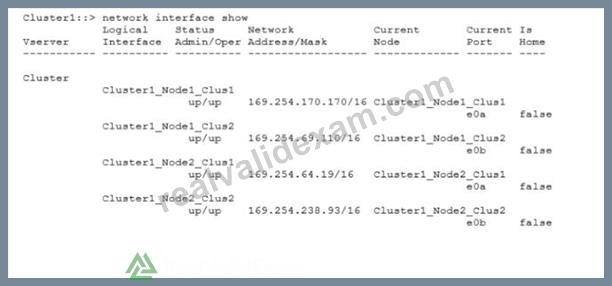
After an ONTAP upgrade, you notice that several cluster LIFs are not on their home ports as shown in the exhibit.
Which LIF option would change this outcome?
- A. the auto-revert option
- B. the data-protocol option
- C. the subnet-name option
- D. the failover-policy option
Answer: A
Explanation:
https://docs.netapp.com/us-en/ontap/networking/revert_a_lif_to_its_home_port.html
NEW QUESTION # 36
Exhibit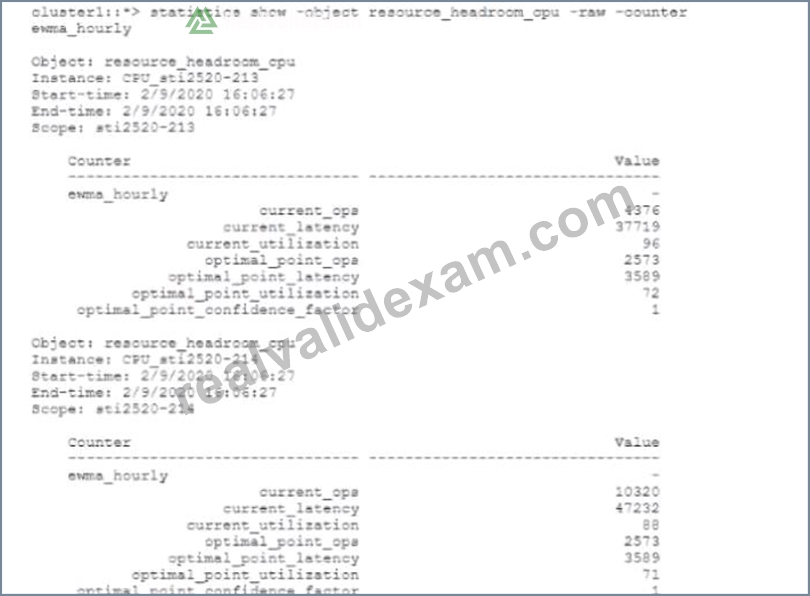
You have a 2-node FAS8300 switchless cluster. You ran the performance capacity report to see the last hour of performance Referring to the exhibit, which two statements describe the performance? (Choose two.)
- A. The CPU has been over utilized.
- B. The CPU has been underutilized.
- C. A storage failover event will cause performance issues.
- D. A storage failover event will have no performance degradation.
Answer: A,C
Explanation:
Explanation
The performance capacity report shows the current and optimal performance metrics for the CPU resource on each node of the cluster. The current metrics reflect the actual workload on the resource, while the optimal metrics reflect the workload that would result in the best performance. The performance capacity, or headroom, is the difference between the current and optimal metrics. A low or negative headroom indicates that the resource is over utilized and may experience performance degradation. The exhibit shows that both nodes have negative headroom for the CPU resource, which means that the CPU has been over utilized. A storage failover event will cause performance issues, as the surviving node will have to handle the workload of both nodes, which will further reduce the headroom and increase the latency. References :- Identify remaining performance capacity, What is Performance Capacity in ONTAP 9 and Unified Manager?
NEW QUESTION # 37
A user wants existing data in a FlexVol created in ONTAP 9.1 to be placed into a FlexGroup volume with ONTAP 9.8. In this scenario, which two statements are true? (Choose two.)
- A. Use SnapMirror to replicate data from FlexVol to FlexGroup.
- B. Use XCP to copy data from a FlexVol to a FlexGroup.
- C. A FlexVol to FlexGroup conversion is not supported.
- D. You can convert the FlexVol volume to a FlexGroup volume.
Answer: B,D
Explanation:
Explanation
You can use either XCP or the in-place conversion feature to move data from a FlexVol volume to a FlexGroup volume. XCP is a data migration tool that can copy data between different types of volumes, such as FlexVol and FlexGroup. The in-place conversion feature, introduced in ONTAP 9.7, allows you to convert a FlexVol volume to a FlexGroup volume without requiring a data copy or additional disk space. However, you cannot convert a FlexGroup volume back to a FlexVol volume. SnapMirror is not a valid option for this scenario, because it does not support replicating data from FlexVol to FlexGroup volumes. A FlexVol to FlexGroup conversion is supported, but only for transitioned volumes starting from ONTAP 9.8. References
:- Converting FlexVol volumes to FlexGroup volumes overview, Can a FlexGroup be converted to a FlexVol?, Can I convert a Flexvol to FlexGroup without rewarming the tiered data?
NEW QUESTION # 38
Exhibit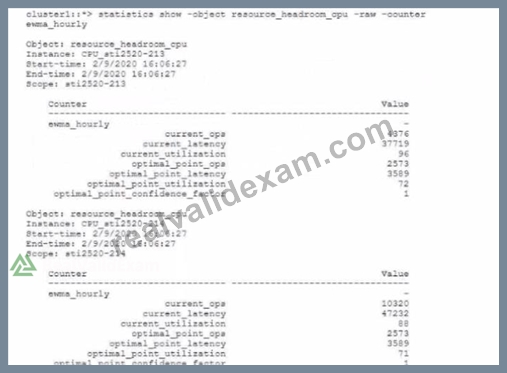
You have a 2-node FAS8300 switchless cluster. You ran the performance capacity report to see the last hour of performance Referring to the exhibit, which two statements describe the performance? (Choose two.)
- A. The CPU has been over utilized.
- B. The CPU has been underutilized.
- C. A storage failover event will cause performance issues.
- D. A storage failover event will have no performance degradation.
Answer: A,C
NEW QUESTION # 39
Which security method would be used to authenticate targets and Initiators In an ISCSI environment?
- A. CHAP
- B. LDAP
- C. /etc/hosts
- D. NIS
Answer: A
NEW QUESTION # 40
Your company requests that the monthly performance data of your ONTAP 9.8 cluster be exported to a CSV file for further processing. In this scenario, which three NetApp products satisfy this requirement? (Choose three.)
- A. Cloud Insights
- B. Active IQ OneCollect
- C. ONTAP System Manager
- D. Active IQ Config Advisor
- E. Active IQ Unified Manager
Answer: C,D,E
NEW QUESTION # 41
Exhibit.
Miss-----------------
The availability of the remote cluster in the peering relationship shows "Partial." Referring to the exhibit, what is the reason for this status message?
- A. The Intercluster LIFs on the local cluster are unavailable and not able to communicate to the remote cluster.
- B. The local cluster is unable to authenticate successfully to the remote cluster.
- C. Some nodes In the local cluster are not able to contact some or all nodes in the remote cluster.
- D. The remote cluster does not have its cluster license applied properly.
Answer: D
NEW QUESTION # 42
You attempt to create an SVM for CIFS access only.
In this scenario, which three actions must be performed to Join the existing Active Directory? (Choose three.)
- A. Create export policies.
- B. Create a data LIF.
- C. Create DNS entries.
- D. Create a cluster LIF.
- E. Create NTP entries.
Answer: A,B,D
NEW QUESTION # 43
You want to configure Active Directory domain controller access for NetApp ONTAP cluster administration.
In this scenario, which two actions would accomplish this task? (Choose two.)
- A. Configure an authentication tunnel through an admin SVM.
- B. Configure an authentication tunnel through an existing CIFS SVM.
- C. Use the vserver active-directory create command to create a computer account on the domain for a CIFS SVM.
- D. Use the vservar active-directory create command to create a computer account on the domain for a non-CIFS SVM.
Answer: A,C
NEW QUESTION # 44
You want to prepare your ONTAP cluster and your ESXI cluster to connect NFS datastores over a 10-GbE network using Jumbo frames. In this scenario, which three configurations would accomplish this task? (Choose three.)
- A. Enable Jumbo frames with an MTU of 1500 for your ONTAP cluster.
- B. Enable Jumbo frames with an MTU of 9000 for your ONTAP cluster.
- C. Enable jumbo frames with an MTU of 9216 for your switches.
- D. Enable jumbo frames with an MTU of 9000 for your ESXi hosts.
- E. Enable Jumbo frames with an MTU of 1500 for your ESXI hosts.
Answer: B,C,D
NEW QUESTION # 45
You have deployed an ONTAP cluster and want to add protocol licenses. In this scenario, which management tool accomplishes this task?
- A. Active IQ Config Advisor
- B. Active IQ Unified Manager
- C. NetApp Cloud Manager
- D. ONTAP System Manager
Answer: D
Explanation:
Explanation
ONTAP System Manager is a web-based graphical user interface (GUI) that enables you to manage and monitor your ONTAP cluster. You can use ONTAP System Manager to add protocol licenses to your cluster by following a simple and easy workflow. The other management tools are not designed for adding protocol licenses to an ONTAP cluster. NetApp Cloud Manager is a cloud-based service that helps you deploy and manage NetApp cloud data services. Active IQ Unified Manager is a software application that provides performance monitoring and health management for ONTAP clusters. Active IQ Config Advisor is a tool that scans and validates the configuration of NetApp storage systems and hosts. References :- Configure ONTAP on a new cluster with System Manager, ONTAP System Manager overview, NetApp Cloud Manager overview, Active IQ Unified Manager overview, Active IQ Config Advisor overview
NEW QUESTION # 46
A user wants existing data in a FlexVol created in ONTAP 9.1 to be placed into a FlexGroup volume with ONTAP 9.8. In this scenario, which two statements are true? (Choose two.)
- A. A FlexVol to FlexGroup conversion is not supported.
- B. Use SnapMirror to replicate data from FlexVol to FlexGroup.
- C. You can convert the FlexVol volume to a FlexGroup volume.
- D. Use XCP to copy data from a FlexVol to a FlexGroup.
Answer: B,C
Explanation:
Starting with ONTAP 9.7, you can perform an in-place conversion of a FlexVol volume to a FlexGroup volume without requiring a data copy or additional disk space. Starting with ONTAP 9.7, you can convert standalone FlexVol volumes or FlexVol volumes that are in a SnapMirror relationship to FlexGroup volumes.
NEW QUESTION # 47
You have an Internet of Things (IoT) application that will use SMB shares on a remote ONTAP Select Instance. There are no name services and only a local network Is available at the remote IoT site.
In this scenario, which two features are supported by ONTAP software for the IoT application? (Choose two.)
- A. SMB Server in workgroup mode
- B. CIFS local users
- C. Active Directory users
- D. SMB3 Witness protocol
Answer: A,B
Explanation:
Explanation
SMB Server in workgroup mode allows the SMB server to authenticate users locally without relying on a domain controller or name services. CIFS local users are users that are created and managed by the ONTAP CIFS server and can be used for CIFS authentication and authorization. These features are supported by ONTAP software for the IoT application that will use SMB shares on a remote ONTAP Select instance, where there are no name services and only a local network is available at the remote IoT site. Active Directory users and SMB3 Witness protocol are not supported in this scenario, as they require name services and network connectivity between the SMB server and the client. References :- Create an SMB server in a workgroup, Local users and groups concepts, Protocols CIFS local-users endpoint overview
NEW QUESTION # 48
You need to configure data-at-rest encryption for your NetApp ONTAP 9.8 cluster. Your company does not have Key Management Interoperability Protocol (KMIP) services available but must require a passphrase to be entered when a node Is rebooted.
In this scenario, which two actions should be performed to satisfy these requirements? (Choose two.)
- A. Enable common criteria mode.
- B. Enable onboard key management.
- C. Enable cluster-wide FlPS-compliant mode.
- D. Configure an external key management server.
Answer: B,C
NEW QUESTION # 49
You need to configure data-at-rest encryption for your NetApp ONTAP 9.8 cluster. Your company does not have Key Management Interoperability Protocol (KMIP) services available but must require a passphrase to be entered when a node Is rebooted.
In this scenario, which two actions should be performed to satisfy these requirements? (Choose two.)
- A. Enable onboard key management.
- B. Enable cluster-wide FlPS-compliant mode.
- C. Configure an external key management server.
- D. Enable common criteria mode.
Answer: A,D
Explanation:
Enabling onboard key management by default you are not required to enter a passphrase when the node is rebooted. To be asked the password , you need to enable the common criteria mode also.
NEW QUESTION # 50
You have a 2-node NetApp FAS500f system serving NAS and SAN protocols. The cluster is running NetApp ONTAP 9.8. You have a requirement to use SnapMirror to mirror your data to public cloud object storage.
In this scenario, which ONTAP native solution is supported?
- A. Cloud Compliance service
- B. Cloud Sync
- C. Flash Pool
- D. Cloud Backup Service
Answer: D
NEW QUESTION # 51
When you perform an upgrade using ONTAP System Manager 9.8, which two statements are true? (Choose two.)
- A. The Images must be manually uploaded to the cluster by using the ONTAP System Manager interface.
- B. The update history is available within the ONTAP System Manager interface.
- C. The images will be automatically uploaded to the cluster by using the ONTAP System Manager interface from the NetApp Support site.
- D. The latest available Images will appear In the ONTAP System Manager interface.
Answer: A,B
NEW QUESTION # 52
You ate attempting to establish a SnapMlrror relationship between your ONTAP cluster (AcmeClusOl) and a partner company's ONTAP cluster (WidgetsClusOl). The clusters are unable to establish a peering relationship. You perform a packet capture on WldgetsClusOl and do not see any packets from AcmeClusOl.
You also discover that the IP subnet that Is used for WidgetsClusOl's intercluster LIFs overlaps with a local subnet at your company.
In this scenario, which feature would enable AcmeClusOl and WidgetsClusOl to peer with each other?
- A. VLANs
- B. broadcast domains
- C. ONTAP subnets
- D. IPspaces
Answer: D
Explanation:
Explanation
IPspaces enable you to create multiple logical networks on a single physical network. Each IPspace contains a set of ports, broadcast domains, subnets, and routing groups that are isolated from other IPspaces. By using IPspaces, you can avoid IP address conflicts and routing issues when connecting to different networks that use the same or overlapping IP subnets. In this scenario, you can create a separate IPspace for the intercluster LIFs of AcmeClusOl and WidgetsClusOl, and assign them different subnets that do not overlap with the local subnet at your company. This way, the clusters can communicate with each other without interference from the local network traffic. References :- ONTAP 9 Network Management Guide, ONTAP 9 Cluster and SVM Peering Express Guide, ONTAP 9 Cluster and SVM Peering Guide
NEW QUESTION # 53
All SMB users are reporting that their network share performance Is slow on a new NetApp FAS500f HA pair. You determine that the users have converged network adapters (CNAs) with flow control enabled and no option to disable.
In this scenario, which two flow control settings are recommended on the NetApp ONTAP physical ports? (Choose two.)
- A. Disable flow control end-to-end on cluster network ports.
- B. Disable flow control end-to-end on data network ports.
- C. Enable flow control end-to-end on data network ports.
- D. Enable flow control end-to-end on cluster network ports.
Answer: A,B
NEW QUESTION # 54
Exhibit.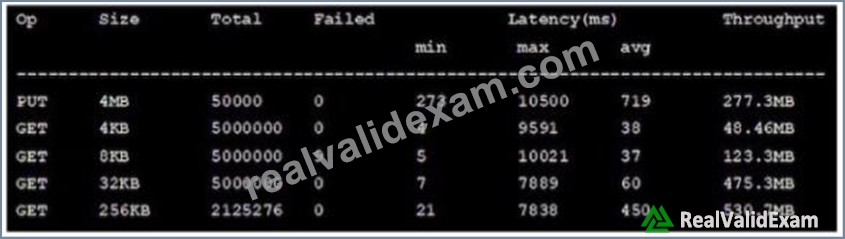
You have a NetApp AFF A400 HA pair with Fabric Pool enabled on all data using the snapshot-only policy. Users are reporting slow restores when they recover files with the Windows Previous Versions tab.
Referring to the exhibit, what is the highest latency seen on restore?
- A. 0
- B. 1
- C. 2
- D. 3
Answer: B
Explanation:
the user retrieve files, which is a GET operation. You can use the S3 GET Object request to retrieve an object from an S3 bucket. https://docs.netapp.com/sgws-113/index.jsp?topic=%2Fcom.netapp.doc.sg-s3%2FGUID-8B7BB6D4-FA59-4E82-BEAC-45DA8C642029.html
NEW QUESTION # 55
......
Accurate NS0-162 Answers 365 Days Free Updates: https://www.realvalidexam.com/NS0-162-real-exam-dumps.html
NS0-162 DUMPS Q&As with Explanations Verified & Correct Answers: https://drive.google.com/open?id=1KXVzQ0q6rkjTzdYyW0duk9FaKs6TBX2z
