
Reliable Tableau Certified TDA-C01 Dumps PDF Aug 11, 2023 Recently Updated Questions
Pass Your Tableau TDA-C01 Exam with Correct 66 Questions and Answers
Tableau TDA-C01 exam is a valuable certification for professionals who want to demonstrate their expertise in data analysis using Tableau products. It is an entry-level certification that covers a range of topics related to data analysis and visualization. Certified professionals can expect to earn higher salaries and have more job opportunities than non-certified professionals, and the certification provides a pathway to higher-level Tableau certifications.
Tableau is one of the most popular data visualization and business intelligence tools used by organizations worldwide. Becoming a Tableau certified data analyst can provide you with numerous career opportunities. Passing the Tableau TDA-C01 exam can help you showcase your skills and knowledge to potential employers. Tableau Certified Data Analyst certification can help you stand out from other candidates and improve your chances of getting hired for data analyst roles in top companies.
NEW QUESTION # 37
You want to connect a Tableau workbook to a dataset in a Microsoft Excel spreadsheet.
What should you do from Tableau Desktop?
- A. From the File menu select New
- B. From the File menu select Import Workbook
- C. From the Data menu select Replace Data Source
- D. From the Data menu select New Data Source
Answer: D
Explanation:
To connect a Tableau workbook to a dataset in a Microsoft Excel spreadsheet, you need to select New Data Source from the Data menu. This will open the Connect pane, where you can choose Microsoft Excel as your data source and browse for your spreadsheet file. You can then drag and drop your sheets or tables to join or union them in the data source page. Reference: https://help.tableau.com/current/pro/desktop/en-us/connect_basic.htm https://help.tableau.com/current/pro/desktop/en-us/connect_excel.htm
NEW QUESTION # 38
Open the link to Book1 found on the desktop. Open the Movie Durations worksheet.
Replace the existing data source with the Netflix_2019 data source.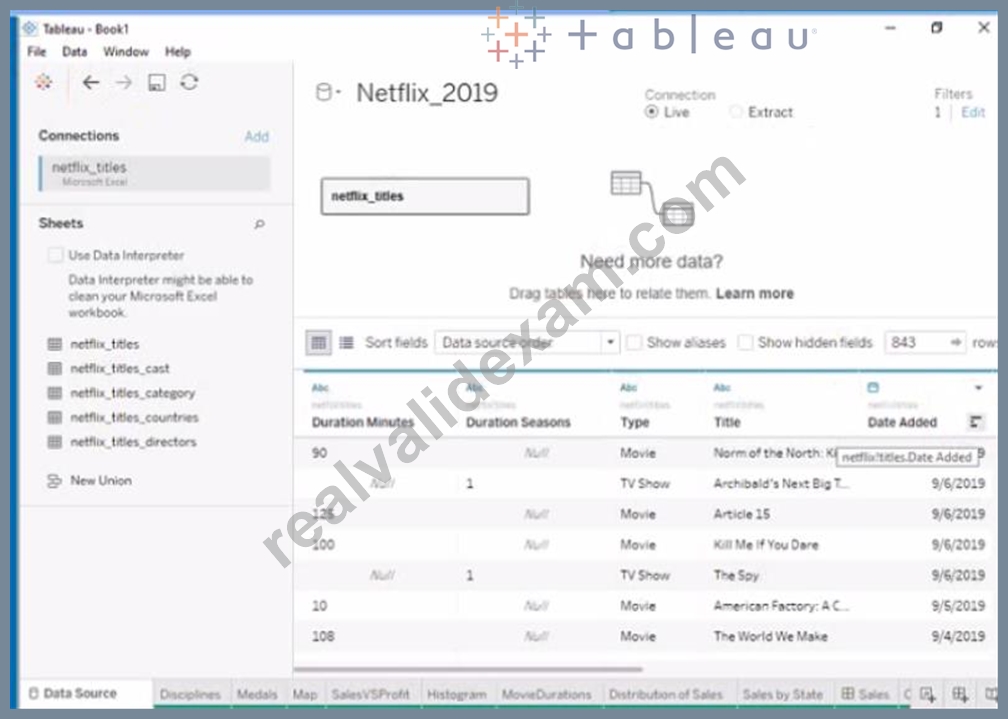
Answer:
Explanation:
check the steps below in explanation
Explanation:
To replace the existing data source with the Netflix_2019 data source, you need to do the following steps:
Open the link to Book1 found on the desktop. This will open the Tableau workbook that contains the Movie Durations worksheet.
Click on the Movie Durations tab at the bottom of the workbook to open the worksheet. You will see a bar chart that shows the number of movies by duration for the existing data source.
Go to the Data Source tab at the bottom of the workbook to see the data source page. You will see a table that shows the fields and values from the existing data source.
Click on the drop-down arrow next to the data source name at the top of the page and select Replace Data Source from the menu. This will open a dialog box that allows you to replace your data source with another one.
Select Netflix_2019 from the list of available data sources and click OK. This will replace your existing data source with the Netflix_2019 data source and update your worksheet accordingly. You may need to fix any broken fields or calculations that result from the replacement.
NEW QUESTION # 39
From Tableau Desktop you sign in lo a Tableau Server site.
What appears in the list of available data sources when you search for a published data source?
- A. All the data sources published to the Tableau Server
- B. All the data sources published to the site
- C. All the data sources published to the Tableau Server within the folders to which you have access
- D. All the data sources published to the site within the folders to which you have access
Answer: C
NEW QUESTION # 40
You have the following dashboard that contains two visualizations.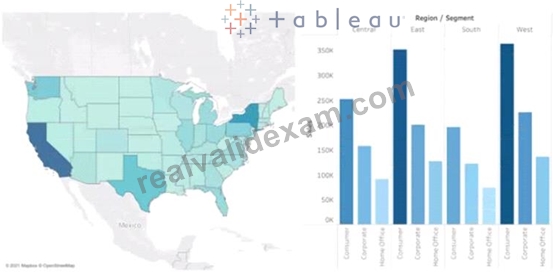
You want to show only visualization at time. Users must be able to switch between visualizations.
What should you me?
- A. Dashboard actions
- B. Showhide buttons
- C. A parameter and a calculated filed
- D. Worksheet actions
Answer: A
NEW QUESTION # 41
You have the following tiled dashboard that has one sheet.
You want to replace fit sheet with Sheet2.
What should you do?
- A. Drag Sheet2 to the dashboard.
- B. From the context menu of Sheet3. select Remove Dashboard item
- C. From the context menu of Sheet3. select Deselect
- D. Right-click Sheet2 and select Add to Dashboard.
- E. Select Sheets and click the Swap Sheet button next to Sheet2.
Answer: D
NEW QUESTION # 42
You have a dataset that contains sates dat
a. The following is a sample of the data.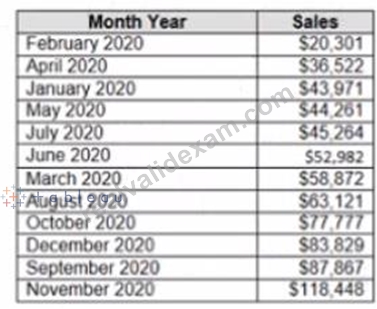
You need to return a value of true if a month has sales greater than $50 000. otherwise the formula must return a value of false.
Which two formulas achieve the goal Choose two
- A. MAX< [Sales], 50000)
- B. SUM{[Sales]) IN (50000)
- C. [Sales] > 50000
- D. IIF(SUM< [Sales] )>50000, TRUE, FALSE)
Answer: C,D
Explanation:
B) IIF(SUM([Sales]) > 50000, TRUE, FALSE) D. [Sales] > 50000
The IIF function is a logical function that returns one value if a condition is true, and another value if the condition is false. In this case, the condition is SUM([Sales]) > 50000, which means that the sum of sales for a month is greater than $50,000. The function will return TRUE if the condition is true, and FALSE if the condition is false.
The comparison operator > is a logical operator that returns TRUE if the left operand is greater than the right operand, and FALSE otherwise. In this case, the operands are [Sales] and 50000, which means that the sales for a month are greater than $50,000. The operator will return TRUE if the sales are greater than $50,000, and FALSE otherwise.
The other options are not correct for this scenario. The IN function is a logical function that returns TRUE if a value is in a set of values, and FALSE otherwise. In this case, the value is SUM([Sales]), which is not in the set of values (50000). The function will always return FALSE. The MAX function is an aggregation function that returns the maximum value in a field or expression. In this case, the field or expression is [Sales], 50000, which is not valid syntax. The function will return an error. Reference: https://help.tableau.com/current/pro/desktop/en-us/functions_functions_logical.htm#IIF https://help.tableau.com/current/pro/desktop/en-us/operators.htm https://help.tableau.com/current/pro/desktop/en-us/functions_functions_aggregate.htm#MAX Explanation:
The two formulas that will return a value of true if a month has sales greater than $50,000, otherwise the formula must return a value of false, are:
NEW QUESTION # 43
You have the following dataset.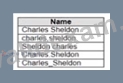
Which grouping option should you use m Tableau Prep to group al five names automatically?
- A. Manual Selection
- B. Pronunciation
- C. Common Characters
- D. Spelling
Answer: A
Explanation:
To group all five names automatically, you should use Manual Selection as a grouping option in Tableau Prep. Manual Selection is a feature that allows you to select values from your data and group them together based on your criteria. You can use Manual Selection by clicking on Group Values in Profile pane > Manual Selection from the menu. This will open a dialog box where you can select values from your data and assign them to a group.
In this case, you want to group all five names together based on their spelling variations. You can use Manual Selection by selecting all five values from your data and assigning them to a group named "Harry Potter". This will create a new field named Grouped Field that contains "Harry Potter" as one value.
The other options are not correct for this scenario. Pronunciation is a feature that groups values based on how they sound, but it may not work well with names or uncommon words. Spelling is a feature that groups values based on common spelling errors or typos, but it may not recognize all variations or synonyms. Common Characters is a feature that groups values based on the number of characters they share, but it may not capture the meaning or context of the values. Reference: https://help.tableau.com/current/prep/en-us/prep_group.htm https://help.tableau.com/current/prep/en-us/prep_group_manual.htm
NEW QUESTION # 44
You have the following dataset.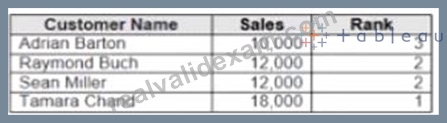
Yon need to calculate the ranking shown in the Rank field.
How should you complete the formula? (Use the dropdowns in the Answer Area to select the correct options to complete the formula ?
Answer:
Explanation:
NEW QUESTION # 45
You want to add a comment to March 2020 as shown in the following visualization.
You have the following sets in a Tableau workbook
* Top N Customers
* Customers of 2020
* Top N Products
* Sellers of 2020
Which two sets can you combine? Choose two
- A. Customers of 2020
- B. Sellers of 2020
- C. Top N Customers
- D. Top N Products
Answer: B,D
NEW QUESTION # 46
You create a parameter named Choose Region fiat contains values from a field named Region.
You want users to be able to use the Choose Region parameter to interact with a chart by logging between different regions What should you do next?
- A. Add Region to me Fitters card
- B. Add the [Region] = [choose Region) formula to the Filters card
- C. Add the Choose Region parameter to the Pages card
- D. Set the Choose Region parameter to Single Value (list)
Answer: B
Explanation:
To use the Choose Region parameter to interact with a chart by toggling between different regions, you should add the [Region] = [Choose Region] formula to the Filters card. This formula will create a boolean filter that returns TRUE if the value in the Region field matches the value in the Choose Region parameter, and FALSE otherwise. You can add this formula to the Filters card by right-clicking on it and selecting Add Filter from the menu. Then you can select Condition from the dialog box and enter the formula in the text box. This will filter the chart to show only the data for the selected region.
The other options are not correct for this scenario. Adding Region to the Filters card will create a categorical filter that shows a list of values from the Region field, but it will not use the Choose Region parameter. Adding the Choose Region parameter to the Pages card will create a page control that allows you to cycle through different values of the parameter, but it will not filter the chart. Setting the Choose Region parameter to Single Value (list) will change how the parameter control appears on the worksheet, but it will not affect how it interacts with the chart. Reference: https://help.tableau.com/current/pro/desktop/en-us/parameters.htm https://help.tableau.com/current/pro/desktop/en-us/filtering.htm https://help.tableau.com/current/pro/desktop/en-us/filtering_condition.htm
NEW QUESTION # 47
A colleague provides you with access to a folder that contains the following files:
* Sates.csv
* Bookl.twb
* Sates.hyper
* Export.mdb
Which He contains an extract?
- A. Sales.csv
- B. Book1.twb
- C. Export mdb
- D. Sales.hyper
Answer: D
Explanation:
A .hyper file is an extract file that contains a snapshot of data from a data source. It is a compressed and optimized file format that can be used to improve the performance and portability of dashboards and workbooks. A .twb file is a workbook file that contains the visualization and connection information, but not the data itself. A .csv file is a comma-separated values file that contains plain text data. A .mdb file is a Microsoft Access database file that contains tables, queries, forms, and other objects. Reference: https://help.tableau.com/current/pro/desktop/en-us/save_savework_packagedworkbooks.htm https://help.tableau.com/current/pro/desktop/en-us/extracting_data.htm https://help.tableau.com/current/pro/desktop/en-us/examples_csv.htm https://support.microsoft.com/en-us/office/introduction-to-access-database-files-9f9a0f8c-9a3c-4a0b-8e6c-6d1f1f7c2b7e
NEW QUESTION # 48
in which throe formats can you export a worksheet from the Worksheet menu? Choose three
- A. .pptx
- B. .csv
- C. .xlsx
- D. .png
- E. .html
- F. .txt
Answer: B,E,F
NEW QUESTION # 49
You have two data sources that use the same schema One data source contains order data from 2019 and the other data source contains order data from 2020.
You have a worksheet that shows the orders from 2019.
You need to configure the worksheet to show the orders from 2020 without reloading the data.
Which option should you select?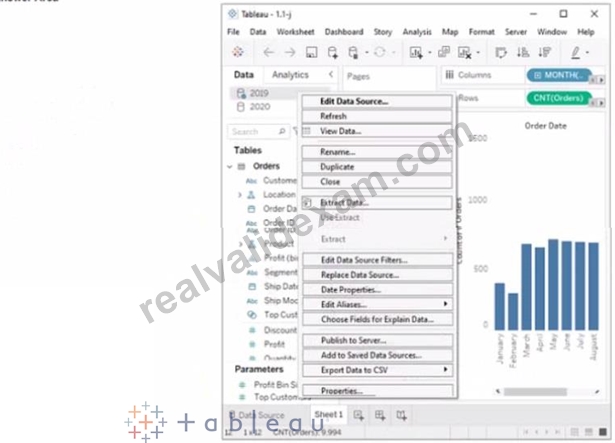
Answer:
Explanation: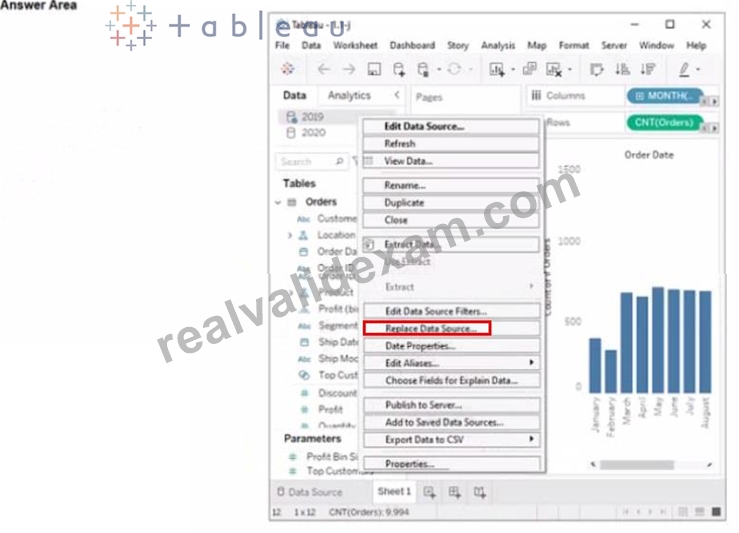
NEW QUESTION # 50
Open the link to Book1 found on the desktop. Open the CategoryPercentage worksheet.
Modify the bar chart show the percentage of sales for each Subcategory within every Category. The total percentage for every Category must be 100%.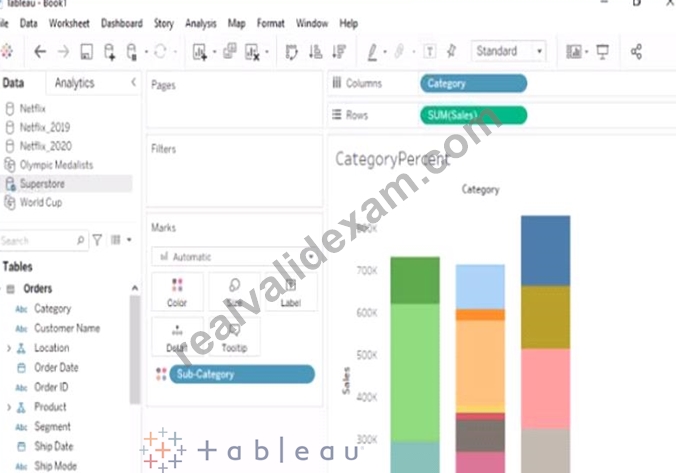
Answer:
Explanation:
Send us your feedback on it
NEW QUESTION # 51
You have the following visualization.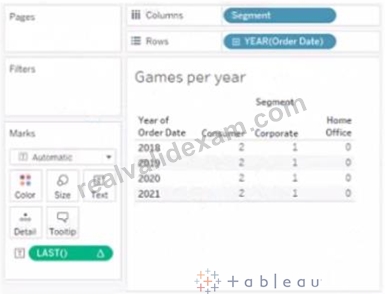
The Last() calculation is set to compute using Table (across)
Which value will appear in the crosstab for the Consumer segment of the year 2018 if you change compute to use Oder Dale?
- A. 0
- B. 1
- C. 2
- D. 3
Answer: B
Explanation:
The value that will appear in the crosstab for the Consumer segment of the year 2018 if you change compute to use Order Date is 0. The Last() calculation is a table calculation that returns the number of rows from the current row to the last row in the partition. The partition is determined by how you compute the calculation. In this case, you change compute to use Order Date, which means that the calculation will be performed for each value of Order Date.
The crosstab shows that there are two values of Order Date for the Consumer segment of the year 2018: Q1 and Q4. The Last() calculation will return 0 for Q4, because it is the last row in the partition. It will return 1 for Q1, because it is one row away from the last row in the partition.
The other options are not correct for this scenario. The Last() calculation will not return 2, 3, or 4 for any value of Order Date, because there are only two values in each partition.
NEW QUESTION # 52
You have the following dataset.
Yon need to calculate the ranking shown in the Rank field.
How should you complete the formula? (Use the dropdowns in the Answer Area to select the correct options to complete the formula ?
Answer:
Explanation:
NEW QUESTION # 53
Open the link to Book1 found on the desktop. Open the Movie Durations worksheet.
Replace the existing data source with the Netflix_2019 data source.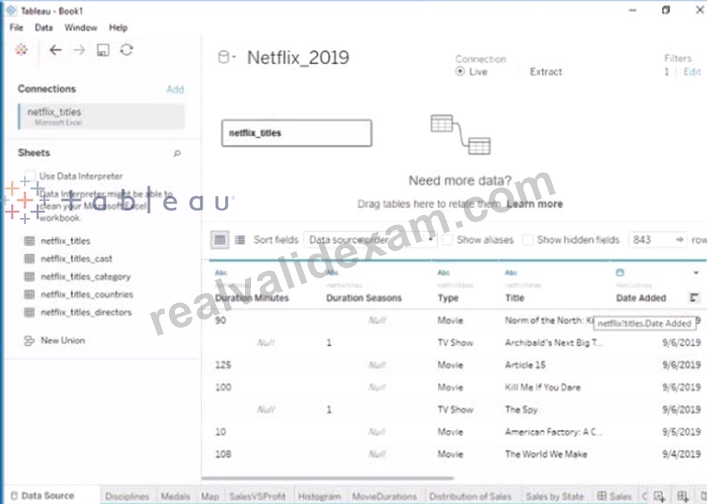
Answer:
Explanation:
Send us your feedback on it
NEW QUESTION # 54
Open the link to Book1 found on the desktop. Open the sales dashboard.
Add the Sales by State sheet in a Show/Hide button to the right side of the dashboard.
Answer:
Explanation:
check the steps below in explanation
Explanation:
To add the Sales by State sheet in a Show/Hide button to the right side of the dashboard, you need to do the following steps:
Open the link to Book1 found on the desktop. This will open the Tableau workbook that contains the sales dashboard.
Click on the sales dashboard tab at the bottom of the workbook to open the dashboard. You will see a dashboard that shows various charts and filters related to sales data.
Drag Sales by State from the Sheets pane to the right side of the dashboard. This will add the sheet as a floating element on the dashboard. You can resize and position it as you like.
Right-click on Sales by State and select Add Show/Hide Button from the menu. This will add a button that allows you to show or hide the sheet on the dashboard. You can customize the appearance and behavior of the button by clicking on it and using the options on the Marks card.
Optionally, you can drag a vertical layout container from the Objects pane to the right side of the dashboard and place Sales by State and its button inside it. This will help you organize your dashboard elements and align them neatly.
NEW QUESTION # 55
You have the following chart that shows the cumulative of sales from various dates.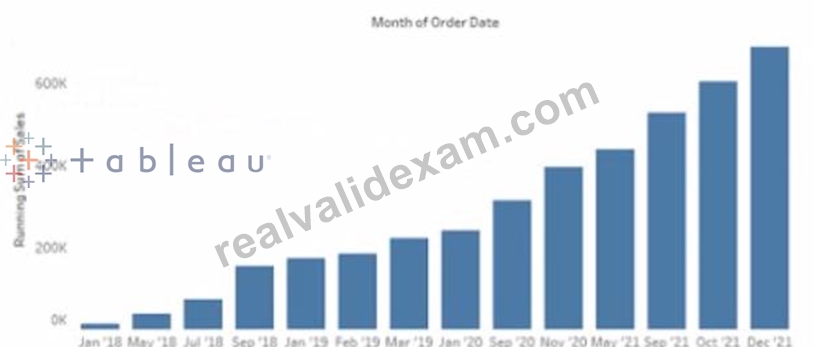
You want the months to appear as shown in the following chart.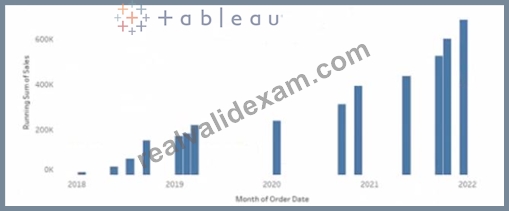
What should you do?
- A. Convert the date to Attribute
- B. Convert the date to Continuous
- C. Convert the date to Exact Date
- D. Select Show Misting Values for the dale
Answer: B
Explanation:
To make the months appear as shown in the second chart, you need to convert the date to Continuous. A continuous date is a green pill that shows a range of values on an axis. A discrete date is a blue pill that shows individual values as headers. In this case, you want to show a continuous range of months on the x-axis, instead of discrete headers.
To convert the date to Continuous, you need to do the following steps:
Right-click on the date field on the Columns shelf and select Convert to Continuous from the menu. This will change the date pill from blue to green and show a continuous range of dates on the x-axis.
Right-click on the date field again and select Month (January 2017) from the menu. This will change the level of detail of the date to month and year, instead of day.
Optionally, you can format the date axis by right-clicking on it and selecting Format from the menu. You can change the scale, tick marks, labels, and other options.
The other options are not correct for this scenario. Converting the date to Exact Date will show every single date as a header, which will be too crowded and unreadable. Selecting Show Missing Values for the date will fill in any gaps in the data with null values, but it will not change how the months appear. Converting the date to Attribute will return only one value for each partition of data, which will not show any variation over time. Reference: https://help.tableau.com/current/pro/desktop/en-us/dates.htm https://help.tableau.com/current/pro/desktop/en-us/dates_continuous.htm https://help.tableau.com/current/pro/desktop/en-us/formatting.htm
NEW QUESTION # 56
You have the following dashboard.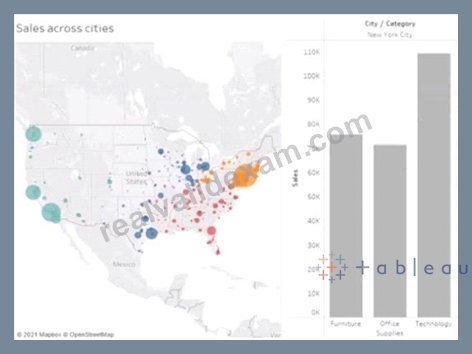
When a user selects a only on the map the data on the bar chart must show only the data for the selected city. The data in the bar chart must change only when the user selects a different city How should you configure the dashboard action? (Use the dropdowns in the Answers Area to select the correct options.)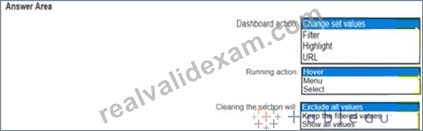
Answer:
Explanation: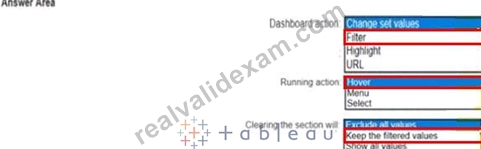
NEW QUESTION # 57
You have the following dataset.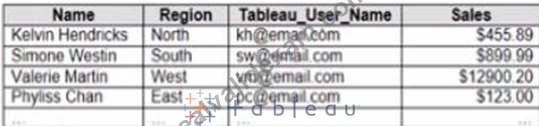
You plan to create a dashboard that will be filtered to show only data that is relevant to a specific Tableau user based on the Tableau_User_Name field You need to create a boolean calculated field to place on the data source finer Which formula should you use for the filter?
- A. NAMEUSERNAME()
- B. NAME Tableau-USER-NAME)
- C. USERNAME()=(Tableau_USER_NAME)
- D. ISFULLNAMETableu_USER_NAME))=USERNAME()
Answer: C
Explanation:
To create a boolean calculated field to place on the data source filter, you should use the formula USERNAME() = [Tableau_user]. This formula will return TRUE if the current Tableau user name matches the value in the Tableau_user field, and FALSE otherwise. You can use this formula as a data source filter by dragging it to the Filters shelf and selecting TRUE from the menu. This will filter the data to show only the rows that are relevant to the specific Tableau user.
The other options are not correct for this scenario. NAME([Tableau_user]) is not a valid function in Tableau. ISFULLNAME([Tableau_user]) = USERNAME() is not a valid expression in Tableau. 'S' + STR([Sales]/1000) is not a boolean expression, but a string expression that converts sales to thousands with a prefix of "S". Reference: https://help.tableau.com/current/pro/desktop/en-us/filtering_datasource.htm https://help.tableau.com/current/pro/desktop/en-us/functions_functions_logical.htm#USERNAME https://help.tableau.com/current/pro/desktop/en-us/calculations_calculatedfields.htm
NEW QUESTION # 58
You have the following chart that shows profits and discounts over time.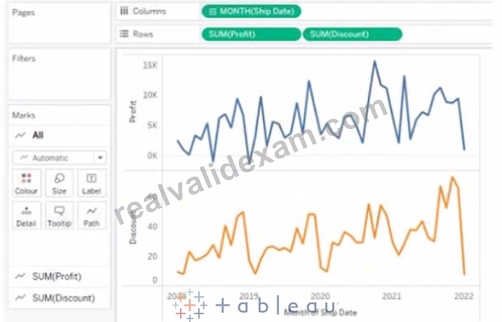
You need to combine the lines to appear as shown in the following chart.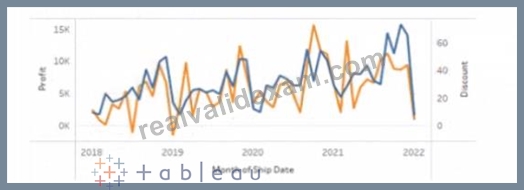
What should you do?
- A. Drag Discount to Color on the Marks card
- B. Set Discount to Dual Axis
- C. Drag Discount to the Columns shelf
- D. Convert Discount to Discrete
Answer: B
Explanation:
To combine the lines to appear as shown in the second chart, you should set Discount to Dual Axis. Dual Axis is a feature that allows you to show two measures on two separate axes on one chart. You can create a dual axis by right-clicking on a measure on any shelf and selecting Dual Axis from the menu. This will create two axes on one chart and synchronize their scales.
In this case, you want to show Profit and Discount on two separate axes on one chart. You can right-click on Discount on any shelf and select Dual Axis from the menu. This will create a dual axis chart that shows Profit and Discount as two lines with different colors.
The other options are not correct for this scenario. Dragging Discount to Color on the Marks card will change the color of Profit based on Discount, but it will not show two lines. Converting Discount to Discrete will change Discount from a green pill to a blue pill, but it will not affect how it appears on the chart. Dragging Discount to Columns shelf will create two separate charts for Profit and Discount, but it will not combine them. Reference: https://help.tableau.com/current/pro/desktop/en-us/multiplemeasures.htm https://help.tableau.com/current/pro/desktop/en-us/multiplemeasures_dualaxes.htm
NEW QUESTION # 59
You have a dataset that contains people and the awards they have won.
Which formula should you use to get the number of different types of awards that have been won?
- A. INDEX()
- B. COUNTD {(NAME])
- C. MAX {(Award})
- D. COVAR({Award})
- E. COUNTD({Award})
Answer: B
NEW QUESTION # 60
......
Latest 2023 Realistic Verified TDA-C01 Dumps: https://www.realvalidexam.com/TDA-C01-real-exam-dumps.html
Pass TDA-C01 Exam Updated 66 Questions: https://drive.google.com/open?id=1XL-rLv7MZ62LhHjGRwEpUoNE9-Gv_X6s
