
Full FCP_FGT_AD-7.6 Practice Test and 132 Unique Questions, Get it Now!
The Best FCP_FGT_AD-7.6 Exam Study Material Premium Files and Preparation Tool
Fortinet FCP_FGT_AD-7.6 Exam Syllabus Topics:
| Topic | Details |
|---|---|
| Topic 1 |
|
| Topic 2 |
|
| Topic 3 |
|
| Topic 4 |
|
| Topic 5 |
|
NEW QUESTION # 50
Refer to the exhibit.
As an administrator you have created an IPS profile, but it is not performing as expected. While testing you got the output as shown in the exhibit.
What could be the possible reason of the diagnose output shown in the exhibit?
- A. There is a no firewall policy configured with an IPS security profile.
- B. FortiGate entered into IPS fail open state.
- C. Administrator entered the command diagnose test application ipsmonitor 5.
- D. Administrator entered the command diagnose test application ipsmonitor 99.
Answer: A
Explanation:
The output shows the IPS engine count as 0, indicating no active IPS engines are running. This typically means no firewall policy is referencing the IPS security profile, so the IPS profile is not being applied or triggered.
NEW QUESTION # 51
Refer to the exhibit. Which algorithm does SD-WAN use to distribute traffic that does not match any of the SD-WAN rules?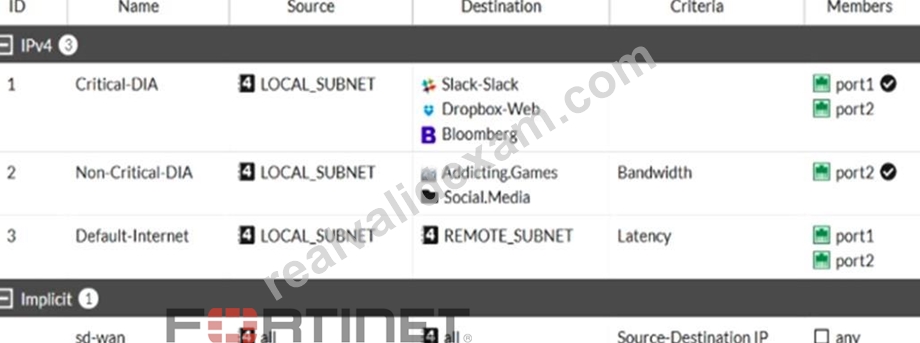
- A. All traffic from a source IP is sent to the same interface
- B. Traffic is sent to the link with the lowest latency.
- C. Traffic is distributed based on the number of sessions through each interface.
- D. All traffic from a source IP to a destination IP is sent to the same interface.
Answer: D
Explanation:
For traffic that does not match any of the defined SD-WAN rules, the default implicit SD-WAN rule is applied. By default, the FortiGate uses a "source-destination IP-based" algorithm, which means all traffic from a specific source IP to a specific destination IP is sent through the same interface.
This ensures that a consistent path is used for traffic between the same source and destination IP addresses.
NEW QUESTION # 52
An administrator suspects that the Collector Agent is not forwarding login events to FortiGate.
What is the most effective troubleshooting step?
- A. Verify if FortiGate is set to use LDAP authentication instead of FSSO.
- B. Restart the domain controller to refresh authentication services.
- C. Check if TCP port 8000 is open between the collector agent and FortiGate.
- D. Verify if DC agent is enabled on the FortiGate.
Answer: C
Explanation:
The Collector Agent communicates with FortiGate over TCP port 8000. Ensuring this port is open and reachable is essential for forwarding login events.
NEW QUESTION # 53
You have configured the below commands on a FortiGate.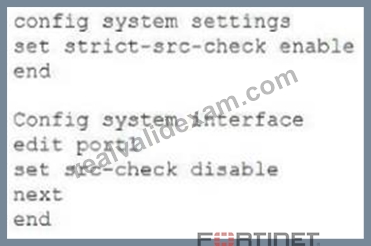
What would be the impact of this configuration on FortiGate?
- A. FortiGate will enable strict RPF on all its interfaces and port1 will be exempted from RPF checks.
- B. Port1 will be enabled with flexible RPF, and all other interfaces will be enabled for strict RPF
- C. The global configuration will take precedence and FortiGate will enable strict RPF on all interfaces.
- D. FortiGate will enable strict RPF on ail its interfaces and port1 will be enable for asymmetric routing.
Answer: A
Explanation:
The global setting enables strict source checking (RPF) on all interfaces by default. The per-interface setting disables the source check on port1, exempting it from strict RPF enforcement.
NEW QUESTION # 54
An administrator wants to form an HA cluster using the FGCP protocol.
Which two requirements must the administrator ensure both members fulfill? (Choose two.)
- A. They must have the same HA group ID.
- B. They must have the heartbeat interfaces in the same subnet.
- C. They must have the same hard drive configuration.
- D. They must have the same number of configured VDOMs.
Answer: A,C
Explanation:
They must have the same HA Group ID and same Hard Drive Configuration.
NEW QUESTION # 55
Which two features of IPsec IKEv1 authentication are supported by FortiGate? (Choose two.)
- A. No certificate is required on the remote peer when you set the certificate signature as the authentication method
- B. Extended authentication (XAuth) to request the remote peer to provide a username and password
- C. Extended authentication (XAuth) for faster authentication because fewer packets are exchanged
- D. Pre-shared key and certificate signature as authentication methods
Answer: B,D
Explanation:
Authentication-wise, both versions support PSK and certificate signature. Although only IKEv1 supports XAuth, IKEv2 supports EAP, which is equivalent to XAuth.
NEW QUESTION # 56
When FortiGate performs SSL/SSH full inspection, you can decide how it should react when it detects an invalid certificate.
Which three actions are valid actions that FortiGate can perform when it detects an invalid certificate?
(Choose three.)
- A. Trust & Allow
- B. Block & Warning
- C. Allow & Warning
- D. Block
- E. Allow
Answer: A,D,E
NEW QUESTION # 57
Refer to the exhibit, which shows a routing table.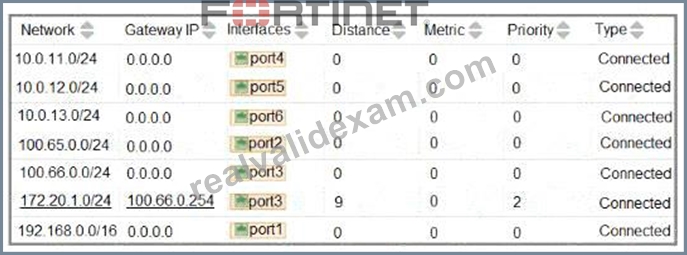
An administrator wants to create a new static route so the traffic to the subnet 172.20.1.0/24 is routed through port2 only.
What are the two criteria that the administrator can use to achieve this objective? (Choose two.)
- A. The new static route must have the metric set to 1.
- B. The new static route must have the distance set to 9.
- C. The new static route must have the priority set to 3.
- D. The existing static route through port3 must have the distance set to 11.
Answer: B,D
NEW QUESTION # 58
Refer to the exhibit, which shows a routing table.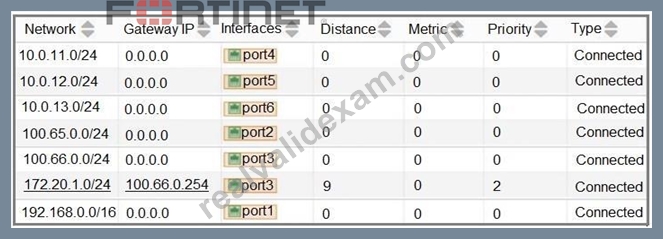
An administrator wants to create a new static route so the traffic to the subnet 172.20.1.0/24 is routed through port2 only.
What are the two criteria that the administrator can use to achieve this objective? (Choose two.)
- A. The new static route must have the metric set to 1.
- B. The new static route must have the distance set to 9.
- C. The new static route must have the priority set to 3.
- D. The existing static route through port3 must have the distance set to 11.
Answer: B,D
Explanation:
From the online study guide: "The lower the metric, the higher the preference" and "The lower the priority, the higher the preference" so it can't be C nor D.
NEW QUESTION # 59
An administrator configured a FortiGate device to act as a collector for agentless polling mode.
What must the administrator add to the FortiGate device to retrieve AD user group information?
- A. LDAP server
- B. RADIUS server
- C. Keycloak server
- D. TACACS server
Answer: A
Explanation:
If FortiGate is acting as a collector for agentless polling mode, you must select Poll Active Directory Server and configure the IP addresses and AD administrator credentials for each DC.
FortiGate uses LDAP to query AD to retrieve user group information. For this to happen, you must add the LDAP server to the Poll Active Directory Server configuration.
NEW QUESTION # 60
Refer to the exhibit.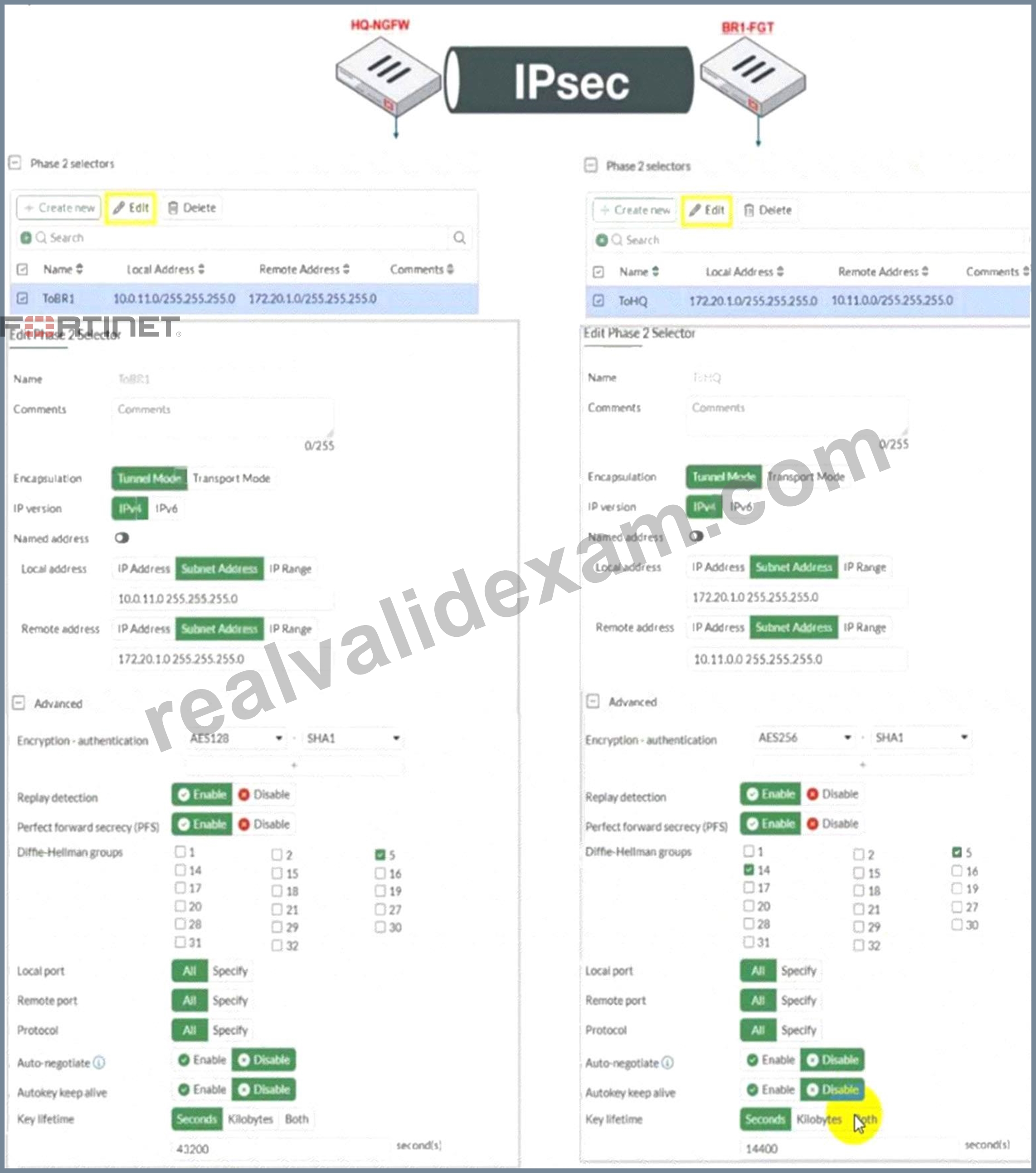
A network administrator is troubleshooting an IPsec tunnel between two FortiGate devices. The administrator has determined that phase 1 status is up, but phase 2 fails to come up.
Based on the phase 2 configuration shown in the exhibit, which two configuration changes will bring phase 2 up? (Choose two.)
- A. On BR1-FGT, set Remote Address to 10.0.11.0/255.255.255.0
- B. On HQ-NGFW. set Encryption to AES256
- C. On BR1-FGT, set Seconds to 43200.
- D. On HQ-NGFW, enable Diffie-Hellman Group 2.
Answer: A,C
Explanation:
The key lifetime (Seconds) must match on both sides; BR1-FGT is set to 14400, so setting it to 43200 matches HQ-NGFW.
The remote address on BR1-FGT should match the HQ-NGFW's local subnet (10.0.11.0/24), but it is currently set incorrectly as 172.20.1.0/24. Changing it to 10.0.11.0/255.255.255.0 will align the Phase 2 selectors.
NEW QUESTION # 61
Refer to the exhibits.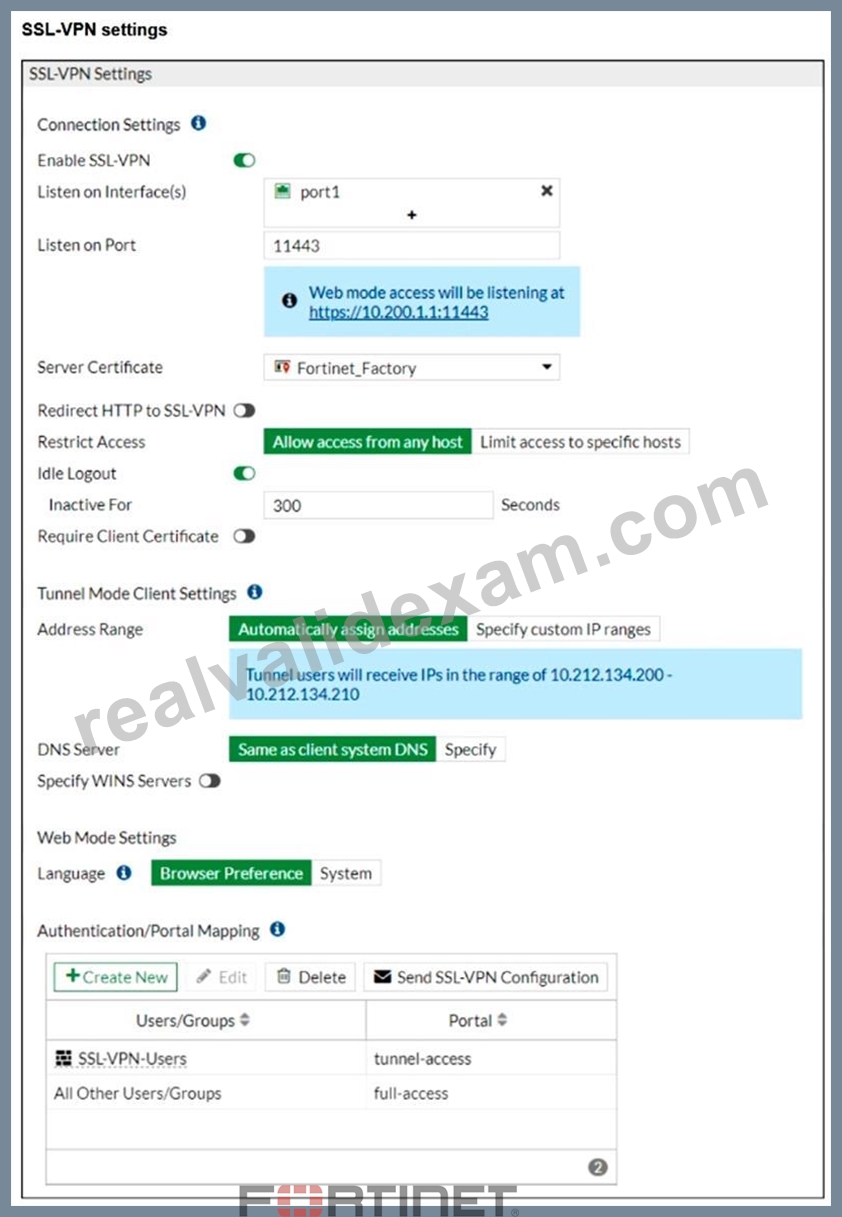
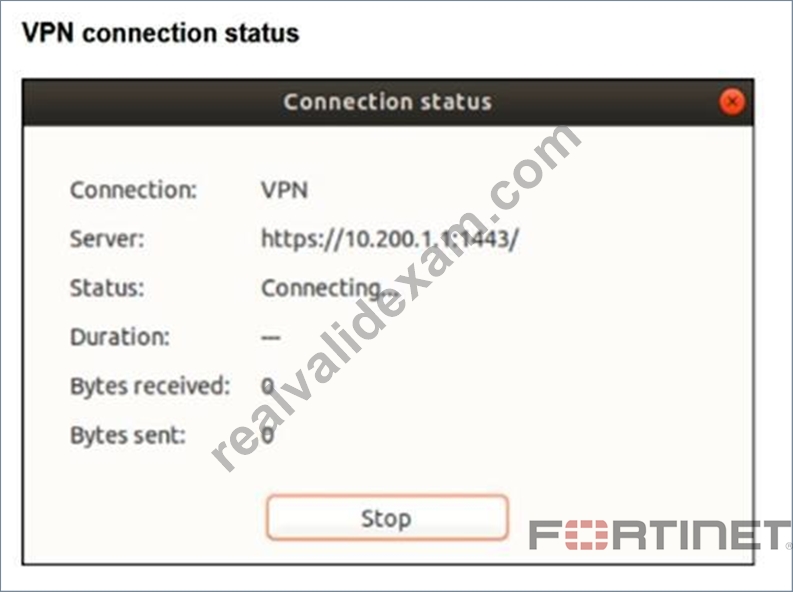
The SSL VPN connection fails when a user attempts to connect to it.
What should the user do to successfully connect to the SSL VPN?
- A. Change the server IP address.
- B. Change the SSL VPN port on the client.
- C. Change the idle-timeout.
- D. Change the SSL VPN portal to the tunnel.
Answer: B
Explanation:
In the FortiGate SSL-VPN settings, the VPN is configured to listen on port 11443, as shown in the
"Listen on Port" field. However, the VPN client is attempting to connect to https://10.200.1.1:443/, which uses the default HTTPS port (443) instead of the configured port.
To successfully connect, the user must change the SSL VPN port on the client to 11443 so that it matches the listening port defined on the FortiGate device.
NEW QUESTION # 62
A FortiGate administrator enables SSL deep inspection on a policy but users report certificate warnings in their browsers. What is the most appropriate step to resolve this while keeping deep inspection active?
- A. Disable HTTPS scanning in the policy
- B. Change the policy action from ACCEPT to DENY
- C. Disable all security profiles on the policy
- D. Install the FortiGate CA certificate on client devices
Answer: D
Explanation:
When FortiGate performs SSL deep inspection, it substitutes the original server certificate with one it generates on the fly, signed by its internal CA. If endpoints do not trust that CA, they report errors. Deploying the FortiGate CA as a trusted root certificate on client machines resolves the warnings while retaining the ability to inspect encrypted traffic for malware, policy violations, and suspicious behavior.
NEW QUESTION # 63
Refer to the exhibit. The predefined deep-inspection and custom-deep-inspection profiles exclude some web categories from SSL inspection, as shown in the exhibit.
For which two reasons are these web categories exempted? (Choose two.)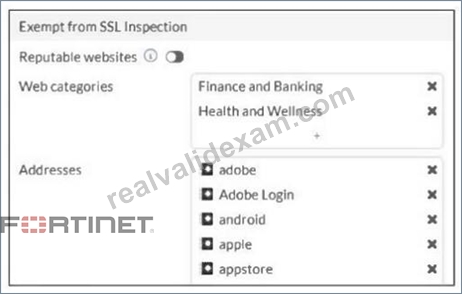
- A. These websites are in an allowlist of reputable domain names maintained by FortiGuard.
- B. The FortiGate temporary certificate denies the browser's access to websites that use HTTP Strict Transport Security.
- C. The legal regulation aims to prioritize user privacy and protect sensitive information for these websites.
- D. The resources utilization is optimized because these websites are in the trusted domain list on FortiGate.
Answer: B,C
Explanation:
FortiGate's temporary SSL certificate may cause access denial to sites using HTTP Strict Transport Security (HSTS), so such sites are exempted from deep SSL inspection. Legal regulations require exemption of certain categories to protect user privacy and sensitive information, so these web categories are excluded from SSL inspection.
NEW QUESTION # 64
Refer to the exhibit. What would be the impact of these settings on the Server certificate SNI check configuration on FortiGate?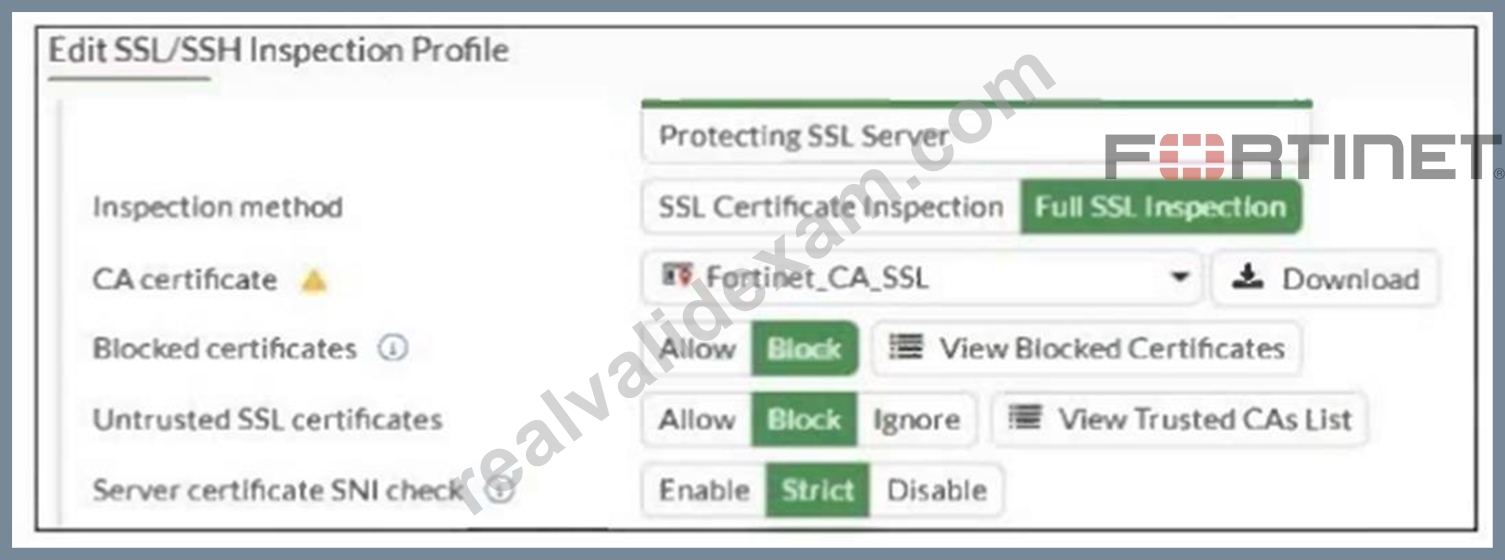
- A. FortiGate will close the connection if the SNI does not match the CN and SAN fields
- B. FortiGate will accept and use the CN in the server certificate for URL filtering if the SNI does not match the CN or SAN fields.
- C. FortiGate will accept the connection with a warning if the SNI does not match the CN or SAN fields.
- D. FortiGate will close the connection if the SNI does not match the CN or SAN fields.
Answer: A
Explanation:
With the Server certificate SNI check set to Strict, FortiGate enforces that the SNI must match either the Common Name (CN) or Subject Alternative Name (SAN) in the server certificate; otherwise, it closes the connection.
NEW QUESTION # 65
What are two features of FortiGate FSSO agentless polling mode? (Choose two.)
- A. FortiGate does not support workstation check.
- B. FortiGate uses the AD server as the collector agent.
- C. FortiGate uses the SMB protocol to read the event viewer logs from the DCs.
- D. FortiGate directs the collector agent to use a remote LDAP server.
Answer: A,C
Explanation:
FortiGate FSSO agentless polling mode uses the SMB protocol to directly read event viewer logs from domain controllers (DCs), eliminating the need for external collector agents.
Workstation checks are not supported in this mode, as FortiGate polls only DC logs and lacks the additional verification features of agent-based modes.
NEW QUESTION # 66
Refer to the exhibit.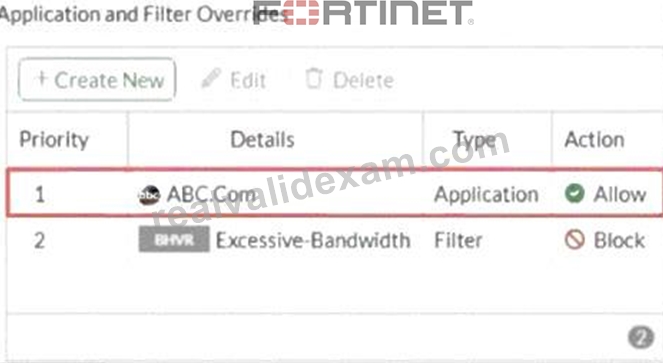
An administrator has configured an Application Overrides for the ABC.Com application signature and set the Action to Allow. This application control profile is then applied to a firewall policy that is scanning all outbound traffic. Logging is enabled in the firewall policy. To test the configuration, the administrator accessed the ABC.Com web site several times.
Why are there no logs generated under security logs for ABC.Com?
- A. The ABC.Com is configured under application profile, which must be configured as a web filter profile.
- B. The ABC.Com is hitting the category Excessive-Bandwidth.
- C. The ABC.Com Action is set to Allow.
- D. The ABC.Com Type is set as Application instead of Filter.
Answer: C
Explanation:
When the action is set to Allow in an application override, traffic matching this override is allowed without generating security logs because it bypasses deeper inspection and blocking.
NEW QUESTION # 67
Refer to the exhibit. The administrator configured SD-WAN rules and set the FortiGate traffic log page to display SD-WAN-specific columns: SD-WAN Quality and SD- WAN Rule Name.
FortiGate allows the traffic according to policy ID 1 placed at the top. This is the policy that allows SD-WAN traffic. Despite these settings, the traffic logs do not show the name of the SD-WAN rule used to steer those traffic flows.
What could be the reason?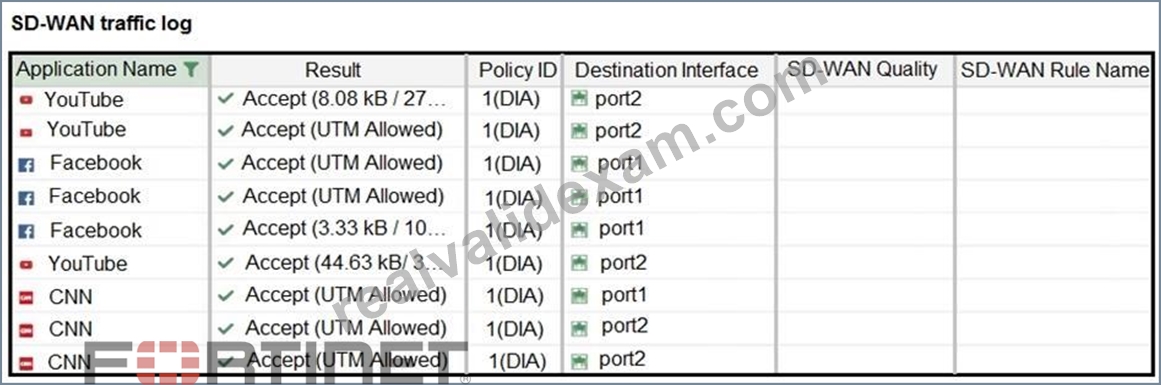
- A. Destinations in the SD-WAN rules are configured for each application, but feature visibility is not enabled.
- B. There is no application control profile applied to the firewall policy.
- C. SD-WAN rule names do not appear immediately. The administrator must refresh the page.
- D. FortiGate load balanced the traffic according to the implicit SD-WAN rule.
Answer: D
Explanation:
Note that the ImplicitSD-WAN rule name does not appear in the SD-WAN Rule Name column.
When the traffic is steered according to this rule, the field remains empty.
NEW QUESTION # 68
An administrator wants to configure dead peer detection (DPD) on IPsec VPN for detecting dead tunnels. The requirement is that FortiGate sends DPD probes only when there is no inbound traffic.
Which DPD mode on FortiGate meets this requirement?
- A. On Demand
- B. Enabled
- C. Disabled
- D. On Idle
Answer: A
Explanation:
Disable: Disable Dead Peer Detection.
On-idle: Trigger Dead Peer Detection when no IPsec traffic is received.
On-demand: Trigger Dead Peer Detection when no IPsec traffic is received AND FortiGate has been sending IPsec traffic. On-demand is the default setting.
NEW QUESTION # 69 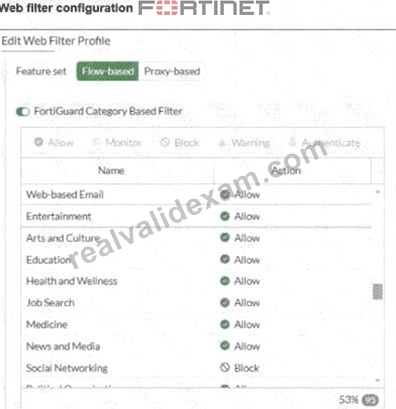
Refer to the exhibits.
An administrator configured the Web Filter Profile to block access to all social networking sites except Facebook. However, when users try to access Facebook.com, they are redirected to a FortiGuard web filtering block page.
Based on the exhibits, which configuration change must the administrator make to allow Facebook while blocking all other social networking sites?
- A. Change the type as Simple in the Static URL Filter section.
- B. Set the Social Networking action as warning in the FortiGuard Category Based Filter.
- C. Set the Action as Exempt for www.facebook.com
in the Static URL Filter. - D. Change the Feature set of Web Filter Profile as Proxy-based.
Answer: C
NEW QUESTION # 70
......
Get Instant Access to FCP_FGT_AD-7.6 Practice Exam Questions: https://www.realvalidexam.com/FCP_FGT_AD-7.6-real-exam-dumps.html
Reliable Study Materials & Testing Engine for FCP_FGT_AD-7.6 Exam Success!: https://drive.google.com/open?id=1VU_MhyyqlwyWAw_hwgDNBHsTjOCH-wo4
