
View All 2V0-21.23 Actual Exam Questions Answers and Explanations for Free Sep-2025
The Most In-Demand VMware 2V0-21.23 Pass Guaranteed Quiz
Achieving the VMware 2V0-21.23 certification can provide numerous benefits to IT professionals, including increased job opportunities, higher salaries, and professional recognition. VMware vSphere 8.x Professional certification can also help IT professionals stay up-to-date with the latest virtualization technologies and best practices, ensuring that they can effectively manage their organization's virtualized infrastructure. Overall, the VMware 2V0-21.23 certification is an excellent investment for IT professionals looking to advance their careers in virtualization and cloud computing.
NEW QUESTION # 64
An administrator is tasked with applying updates to a vSphere cluster running vSAN using vSphere Lifecycle Manager.
Downtime to the ESXI hosts must be minimal while the work Is completed.
The administrator has already completed the following steps and no errors have been returned:
* Downloaded all applicable software and created a new Image
* Attached the new Image to the cluster and run a compliance check against the Image for the cluster
* Ran a remediation pre-check for the cluster
Which two series of steps should the administrator perform to start the remediation of the cluster using the new image? (Choose two.)
- A. 1. Leave all ESXI hosts in the cluster operational
2. Use the Stage All option in vSphere Lifecycle Manager to stage the required software onto all ESXI hosts in the cluster In parallel. - B. 1. Leave all ESXI hosts in the cluster operational.
2. Use the Stage All option in vSphere Lifecycle Manager to stage the required software onto all ESXI hosts one at a time. - C. 1. Use the Remediate Option In vSphere Lifecycle Manager to remediate all of the ESXI hosts In the cluster In sequence.
2. Allow vSphere Lifecycle Manager to automatically control maintenance mode on the ESXI hoy - D. 1. Use the Remediate option in vSphere Lifecycle Manager to remediate all of the ESXI hosts in the cluster in parallel.
2. Allow vSphere Lifecycle Manager to automatically control maintenance mode on the ESXI hosts. - E. 1. Place each of the ESXI hosts into maintenance mode manually.
2. Use the Stage option in vSphere Lifecycle Manager to stage the required software on all ESXi hosts one at a time.
Answer: A,D
Explanation:
Option A and D are correct because they allow vSphere Lifecycle Manager to automatically control maintenance mode on the ESXi hosts and remediate them in parallel or in sequence. Option B and C are incorrect because they require manual intervention to place the hosts into maintenance mode or to stage the software on each host, which is not efficient or minimal downtime. Reference: https://docs.vmware.com/en/VMware-vSphere/7.0/com.vmware.vsphere-lifecycle-manager.doc/GUID-9F9E3F8C-0E2B-4B6A-8C5C-3F8E5F6B4E9D.html
NEW QUESTION # 65
An administrator successfully installs VMware ESXi onto the first host of a new vSphere cluster but makes no additional configuration changes. When attempting to log into the vSphere Host Client using the Fully Qualified Domain Name (FQDN) of the host, the administrator receives the following error message:
"Server Not Found - We can't connect to the server at esxi101.corp.local?
The following information has been provided to complete the configuration:
* Host FQDN esxi101.corp.local
* Management VLAN ID: 10
* DHCP: No
* Management IP Address: 172.16 10.101 / 24
* Management IP Gateway: 172.16.10.1
. Corporate DNS Servers: 172.16 10.5, 172.16.10.6
* ONS Domain: corp.local
In addition, all host configurations must also meet the following requirements:
* The management network must use only IPv4 network protocols.
* The management network must be fault tolerant
Which three high level tasks should the administrator complete, at a minimum, in order to successfully log into the vSphere Host Client using the FQDN for esxi101 and complete the configuration? (Choose three.)
- A. Set the value of the VMware ESXi Management Network VLAN ID to 10
- B. Update the VMware ESXi Management Network DNS configuration to use the corporate DNS servers for names resolution
- C. Ensure a DNS A Record is created for the VMware ESXi host on the corporate DNS servers.
- D. Update the VMware ESXi Management Network IPv4 configuration to use a static a IPv4 address
- E. Configure at least two network adapters for the VMware ESXi Management Network
- F. Disable IPv6 for the VMware ESXi Management Network
Answer: A,C,D
NEW QUESTION # 66
What are three options an administrator can configure after creating a vSphere Namespace? (Choose three.)
- A. Certificates
- B. Backup schedule
- C. Resource and Object limits
- D. Permissions
- E. Storage policies
- F. Update policies
Answer: C,D,E
Explanation:
Explanation
After creating a vSphere Namespace, three of the options that an administrator can configure are storage policies, which define how storage resources are allocated for objects within a namespace; permissions, which define who can access and manage objects within a namespace; and resource and object limits, which define how much CPU, memory, storage, and network resources can be consumed by objects within a namespace.
References:
https://docs.vmware.com/en/VMware-vSphere/7.0/vmware-vsphere-with-tanzu/GUID-C2E9B5C1-D6F1-4E9B-
NEW QUESTION # 67
An administrator needs to consolidate a number of physical servers by migrating the workloads to a software-defined data center solution.
Which VMware solution should the administrator recommend?
- A. VMware Horizon
- B. VMware
- C. VMware vSphere
- D. VMware vSAN
Answer: C
Explanation:
Explanation
Option C is correct because VMware vSphere is the solution that provides a software-defined data center platform that can consolidate physical servers by migrating the workloads to virtual machines. Option A is incorrect because VMware Horizon is a solution for virtual desktop infrastructure (VDI) and application delivery. Option B is incorrect because VMware vSAN is a solution for software-defined storage that is integrated with vSphere. Option D is incorrect because VMware NSX is a solution for software-defined networking that is integrated with vSphere. References: https://www.vmware.com/products/vsphere.html
NEW QUESTION # 68
After adding a new vSphere ESXi host with identical hardware configuration to an existing vSphere cluster, which task would an administrator complete prior to checking the compliance with an existing host profile?
- A. Copy the host settings from the new host
- B. Duplicate the host profile
- C. Attach the host profile to the new host
- D. Import the host profile
Answer: C
Explanation:
The task that should be completed prior to checking the compliance with an existing host profile is to attach the host profile to the new host, which allows applying the configuration template of the reference host to the new host.
NEW QUESTION # 69
Which four elements can a vSphere Lifecycle Manager image contain? (Choose four.)
- A. Vendor agents
- B. BIOS updates
- C. Firmware and drivers add-on
- D. ESXi base image
- E. ESXI configuration
- F. Vendor add-ons
- G. Independent components
Answer: C,D,F,G
Explanation:
https://docs.vmware.com/en/VMware-vSphere/8.0/vsphere-lifecycle-manager/GUID-9A20C2DA-F45F-4C9B-9D17-A89BCB62E6EF.html A vSphere Lifecycle Manager image can consist of the following four elements:
ESXi base image
The base image contains an image of VMware ESXi Server and additional components, such as drivers and adapters that are necessary to boot a server. The base image is the only mandatory element in a vSphere Lifecycle Manager image. All other elements are optional.
The vendor add-on is a collection of software components that OEMs create and distribute. The vendor add-on can contain drivers, patches, and solutions.
Firmware and drivers add-on
The firmware and drivers add-on is a special type of vendor add-on designed to assist in the firmware update process. The firmware and drivers add-on contains firmware for a specific server type and corresponding drivers. To add a firmware and drivers add-on to your image, you must install the hardware support manager plug-in provided by the hardware vendor for the hosts in the respective cluster.
Independent components
The component is the smallest discrete unit in an image. The independent components that you add to an image contain third-party software, for example drivers or adapters.
NEW QUESTION # 70
An administrator wants to create virtual machine (VM) templates and store them in a content library. The administrator would like to use the content library to manage different versions of these templates so that reverting to an earlier version is an option.
How should the administrator create these templates?
- A. Convert a VM to a template in the vCenter inventory.Clone the template to the content library.
- B. Select a VM template in the vCenter inventory. Clone the template to the content library.
- C. Export a VM in the vCenter inventory to an OVF template. Import the OVF template into the content library.
- D. Select a VM in the vCenter inventory.
Clone the VM to the content library as a VM template type.
Answer: D
Explanation:
Explanation
Option A is correct because it allows the administrator to clone a VM to the content library as a VM template type, which can be used to create and manage different versions of these templates in the content library.
Option B is incorrect because it requires the administrator to convert a VM to a template in the vCenter inventory first, which is an extra step. Option C is incorrect because it requires the administrator to export a VM to an OVF template and import it into the content library, which are extra steps. Option D is incorrect because it requires the administrator to convert a VM to a template in the vCenter inventory and clone it to the content library, which are extra steps. References:
https://docs.vmware.com/en/VMware-vSphere/7.0/com.vmware.vsphere.vm_admin.doc/GUID-9F9E3F8C-0E2B
NEW QUESTION # 71
Which two tasks can be completed using vSphere LifeCycle Manager? (Choose two.)
- A. Manage the firmware lifecycle of ESXi hosts are part of a managed cluster using baselines
- B. Upgrade VMware vCenter from version 7 to 8.
- C. Check that the ESXi hosts are compliant with the recommended baseline and update the hosts
- D. Check the hardware compatibility of the hosts in a cluster against the VMware Compatibility Guide (VCG) using baselines.
- E. Manage the firmware lifecycle of ESXi hosts that are part of a managed cluster with a single image.
Answer: A,C
Explanation:
Explanation
https://docs.vmware.com/en/VMware-vSphere/7.0/com.vmware.vsphere-lifecycle-manager.doc/GUID-774C362
NEW QUESTION # 72
An administrator manually configures a reference ESXi host that meets company security standards for vSphere environments. The administrator now needs to apply all of the security standards to every identically configured host across multiple vSphere clusters within a single VMware vCenter instance.
Which four steps would the administrator complete to meet this requirement? (Choose four.)
- A. Remediate all non-compliant hosts.
- B. Import host customization on the reference host.
- C. Check the compliance of each host against the host profile.
- D. Reset host customization on the reference host.
- E. Extract the host profile from the reference host
- F. Export the host profile from vCenter.
- G. Attach the host profile to each cluster that requires the secure configuration.
Answer: A,C,E,G
Explanation:
To apply the security standards from a reference host to other hosts across multiple clusters, the administrator needs to extract a host profile from the reference host, which captures its configuration settings; attach the host profile to each cluster that requires the same configuration; check the compliance of each host against the host profile, which compares their settings; and remediate all non-compliant hosts, which applies the configuration settings from the host profile.
NEW QUESTION # 73
A combination of which two components of the software-defined data center (SDDC) are responsible for the initial abstraction of CPU. memory, disk, and network resources and their subsequent management? (Choose two.)
- A. VMware vCenter Cloud Gateway
- B. VMware Ana Operations
- C. VMwere ESXi
- D. VMware Ana Suite Lifecycle
- E. VMware vCenter
Answer: C,E
Explanation:
Explanation
VMware ESXi and VMware vCenter are the two components of the software-defined data center (SDDC) that are responsible for the initial abstraction of CPU, memory, disk, and network resources and their subsequent management1. VMware ESXi is the virtualization platform where you create and run virtual machines and virtual appliances2. VMware vCenter is the service through which you manage multiple hosts connected in a network and pool host resources2. These two components are part of the SDDC architecture that enables a fully automated, zero-downtime infrastructure for any application, and any hardware, now and in the future3.
NEW QUESTION # 74
An administrator is tasked with moving an application and guest operating system (OS) running on top of a physical server to a software-defined data center (SDDC) in a remote secure location.
The following constraints apply:
* The remote secure location has no network connectivity to the outside world.
* The business owner is not concerned if all changes in the application make it to the SDDC in the secure location.
* The application's data is hosted in a database with a high number of transactions.
What could the administrator do to create an image of the guest OS and application that can be moved to this remote data center?
- A. Create a cold clone of the physical server using VMware vCenter Converter.
- B. Use storage replication to replicate the guest OS and application.
- C. Restore the guest OS from a backup.
- D. Create a hot clone of the physical server using VMware vCenter Converter.
Answer: A
Explanation:
Option B is correct because it allows the administrator to create a cold clone of the physical server using VMware vCenter Converter, which will create an image of the guest OS and application that can be moved to this remote data center without requiring network connectivity or affecting the application's data. Option A is incorrect because creating a hot clone of the physical server using VMware vCenter Converter will require network connectivity and may affect the application's data due to changes during conversion. Option C is incorrect because restoring the guest OS from a backup will require network connectivity and may not include the latest changes in the application. Option D is incorrect because using storage replication to replicate the guest OS and application will require network connectivity and may not be feasible for a physical server. Reference: https://docs.vmware.com/en/vCenter-Converter-Standalone/6.2/com.vmware.convsa.guide/GUID-9F9E3F8C-0E2B-4B6A-8C5C-3F8E5F6B4E9D.html
NEW QUESTION # 75
After a number of outages within a production VMware software-defined data center, an administrator is tasked with identifying a solution to meet the following requirements:
* Reduce the risk of outages by proactively identifying issues with the environment and resolving them.
* Reduce the complexity of uploading log bundles when raising support tickets.
Which solution should the administrator recommend to meet these requirements?
- A. VMware Skyline Advisor Pro
- B. VMware Skyline Health
- C. VMware Aria Operations for Logs
- D. VMware Aria Operations
Answer: B
Explanation:
Explanation
The solution that should be recommended to reduce the risk of outages by proactively identifying and resolving issues with the environment and reducing the complexity of uploading log bundles is VMware Skyline Health, which provides automated support and proactive recommendations for vSphere.
References:
https://docs.vmware.com/en/VMware-vSphere/7.0/com.vmware.vsphere.monitoring.doc/GUID-8E7C1D6D-8E1
NEW QUESTION # 76
An administrator is attempting to configure Storage I/O Control (SIOC) on five datastores within a vSphere environment. The administrator is being asked to determine why SIOC configuration completed successfully on only four of the datastores.
What are two possible reasons why the configuration was not successful? (Choose two.)
- A. The administrator is using NFS storage.
- B. The datastore has multiple extents.
- C. The datastore contains Raw Device Mappings (RDMs).
- D. The datastore is using ISCSI.
- E. SAS disks are used for the datastore.
Answer: B,C
Explanation:
SIOC configuration may fail if the datastore contains RDMs or has multiple extents, as these are not supported by SIOC.
Reference:
Storage I/O Control is supported on Fibre Channel-connected, iSCSI-connected, and NFS-connected storage. Raw Device Mapping (RDM) is not supported. Storage I/O Control does not support datastores with multiple extents.
NEW QUESTION # 77
An administrator decides to restore VMware vCenter from a file-based backup following a failed upgrade. Which interface should the administrator use to complete the restore?
- A. vCenter GUI Installer
- B. Direct Console User Interface (DCUI)
- C. vSphere Client
- D. vCenter Management Interface (VAMI)
Answer: A
Explanation:
https://docs.vmware.com/en/VMware-vSphere/8.0/vsphere-vcenter-installation/GUID-F02AF073-7CFD-45B2-ACC8-DE3B6ED28022.html#GUID-F02AF073-7CFD-45B2-ACC8-DE3B6ED28022 You can use the vCenter Server appliance GUI installer to restore a vCenter Server to an ESXi host or a vCenter Server instance. The restore procedure has two stages. The first stage deploys a new vCenter Server appliance. The second stage populates the newly deployed vCenter Server appliance with the data stored in the file-based backup. https://docs.vmware.com/en/VMware-vSphere/8.0/vsphere-vcenter-installation/GUID-F02AF073-7CFD-45B2-ACC8-DE3B6ED28022.html
NEW QUESTION # 78
Refer to the exhibit.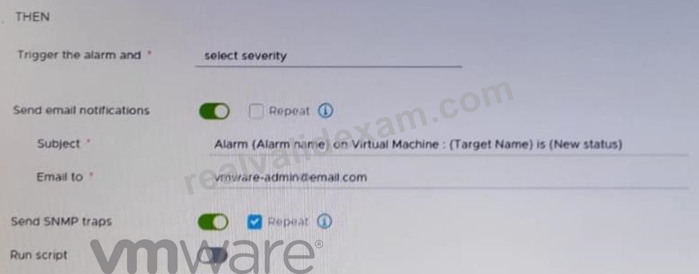
After updating a predefined alarm on VMware vCenter, an administrator enables email notifications as shown in the attached alarm; however, notifications are NOT being sent.
Where must the mail server settings be configured by the administrator to resolve this issue?
- A. in the vCenter Management Interface
- B. In the alarm rule definitions
- C. In the ESXi host system config
- D. In the vCenter settings in the vSphere Client
Answer: D
Explanation:
Explanation
Option C is correct because it allows the administrator to configure the mail server settings in the vCenter settings in the vSphere Client, which are required for sending email notifications for alarms. Option A is incorrect because it configures the mail server settings on an ESXi host system, which are not used for sending email notifications for alarms. Option B is incorrect because it configures the alarm rule definitions, which are already enabled in the exhibit. Option D is incorrect because it configures the vCenter Management Interface, which is not used for sending email notifications for alarms. References:
https://docs.vmware.com/en/VMware-vSphere/7.0/com.vmware.vsphere.monitoring.doc/GUID-A2A4371A-B88
NEW QUESTION # 79
During the staging of a patch on a vCenter Server Appliance, an error was encountered and the process stopped. An administrator resolved the root cause and is ready to continue with the staging of the patch.
From the vCenter Management Interface, which action should the administrator take to continue the process from the point at which the error occurred?
- A. Use the Unstage option to restart the staging.
- B. Use the Stage and Install option to resume the staging.
- C. Use the Stage Only option to restart the staging.
- D. Use the Resume option to resume the staging.
Answer: D
Explanation:
docs.vmware.com/en/VMware-vSphere/7.0/com.vmware.vcenter.upgrade.doc/GUID-FF533442-66F0-4797-976D-1DA99102DD0A.html
NEW QUESTION # 80
An administrator has Windows virtual machines (VMs) and VMware Tools is installed in each VM. The administrator performs a status check of VMware Tools using vSphere Lifecycle Manager.
What is the VMware Tools status for the Windows VMs if the version of VMware Tools has a known problem and must be immediately upgraded?
- A. Unknown
- B. Version Unsupported
- C. Upgrade Available
- D. Guest Managed
Answer: C
Explanation:
Explanation
The VMware Tools status for the Windows VMs if the version of VMware Tools has a known problem and must be immediately upgraded is Upgrade Available, which indicates that a newer version of VMware Tools is available for installation.
References:
https://docs.vmware.com/en/VMware-vSphere/7.0/com.vmware.vsphere.lifecycle_manager.doc/GUID-6F5F2F3
NEW QUESTION # 81
After adding a new vSphere ESXi host with identical hardware configuration to an existing vSphere cluster, which task would an administrator complete prior to checking the compliance with an existing host profile?
- A. Copy the host settings from the new host
- B. Duplicate the host profile
- C. Attach the host profile to the new host
- D. Import the host profile
Answer: C
Explanation:
Explanation
The task that should be completed prior to checking the compliance with an existing host profile is to attach the host profile to the new host, which allows applying the configuration template of the reference host to the new host.
References:
https://docs.vmware.com/en/VMware-vSphere/7.0/com.vmware.vsphere.hostprofiles.doc/GUID-0E5BF330-A76
https://www.nakivo.com/blog/how-to-create-and-set-up-vmware-vsphere-host-profiles/
NEW QUESTION # 82
An administrator creates a virtual machine that contains the latest company-approved software, tools and security updates. Company policy requires that only full clones are allowed for server workloads.
A combination of which two tasks should the administrator complete to prepare for the deployment of this virtual machine for multiple users? (Choose two.)
- A. Upgrade the virtual hardware.
- B. Convert the virtual machine to a template.
- C. Take a snapshot of the virtual machine.
- D. Create a virtual machine customization specification.
- E. Set appropriate permissions on the virtual machine.
Answer: B,D
Explanation:
Explanation
Option B and D are correct because they allow the administrator to create a virtual machine customization specification, which can be used to customize guest operating system settings for multiple virtual machines, and convert the virtual machine to a template, which can be used to create full clones of server workloads.
Option A is incorrect because assigning appropriate permissions on the virtual machine does not prepare it for deployment for multiple users. Option C is incorrect because upgrading the virtual hardware does not prepare it for deployment for multiple users. Option E is incorrect because taking a snapshot of the virtual machine does not prepare it for deployment for multiple users. References:
https://docs.vmware.com/en/VMware-vSphere/7.0/com.vmware.vsphere.vm_admin.doc/GUID-9F9E3F8C-0E2B
NEW QUESTION # 83
An administrator notices a performance issue in VMvvare vCenter To try and understand more about the performance issue, the administrator needs to gather more information about the vCenter database to eliminate a potential disk space issue.
Which two tools can the administrator use? (Choose two.)
- A. esxtop
- B. vSphere Client
- C. vCenter Management Interface (VAMI)
- D. Perfmon
- E. df
Answer: C,E
Explanation:
Explanation
https://kb.vmware.com/s/article/76563
NEW QUESTION # 84
A vSphere cluster has the following configuration:
* Virtual machines (VMs) are running Production and Test workloads
* vSphere Distributed Resource Scheduler (DRS) is enabled
* There are no resource pools in the cluster
Performance monitoring data shows that the Production workload VMs are not receiving their fully allocated memory when the vSphere cluster is fully utilized.
A combination of which two steps could the administrator perform to ensure that the Production VMs are always guaranteed the full allocation of memory? (Choose two.)
- A. Create a parent resource pool for the Production VMs.
- B. Assign a memory reservation value to the resource pool containing the Production VMs.
- C. Create a sibling resource pool for each of the Production and Test VMs.
- D. Create a child resource pool for the Test VMs.
- E. Assign a custom memory share value to the resource pool containing the Production VMs.
Answer: B,C
Explanation:
Explanation
https://docs.vmware.com/en/VMware-vSphere/8.0/vsphere-resource-management/GUID-60077B40-66FF-4625-
NEW QUESTION # 85
An administrator has a requirement to revert a running virtual machine to a previous snapshot after a failed attempt to upgrade an application. When the administrator originally took the snapshot, the following choices in the Take Snapshot dialog were made:
* Snapshot the virtual machine's memory = false
* Quiesce guest file system = false
What will be the result of the administrator selecting the 'Revert to Latest Snapshot? option to return the virtual machine to a previous snapshot? (Choose two.)
- A. The virtual machine will be restored in a suspended state
- B. The virtual machine will be restored to the parent snapshot
- C. The virtual machine will be restored in a powered off state
- D. The virtual machine will be restored to the child snapshot
- E. The virtual machine will be restored in a powered on state
Answer: B,C
Explanation:
Explanation
https://docs.vmware.com/en/VMware-vSphere/7.0/com.vmware.vsphere.vm_admin.doc/GUID-3E1BB630-9223
NEW QUESTION # 86
......
2V0-21.23 Free Certification Exam Material with 107 Q&As : https://www.realvalidexam.com/2V0-21.23-real-exam-dumps.html
New Version 2V0-21.23 Certificate & Helpful Exam Dumps is Online: https://drive.google.com/open?id=1UH81UMK_gy8q6tJjf9PPF-mCbtMxUWtN
