
Prepare Important Exam with HPE7-J02 Exam Dumps(2026)
Pass Exam Questions Efficiently With HPE7-J02 Questions
HP HPE7-J02 Exam Syllabus Topics:
| Topic | Details |
|---|---|
| Topic 1 |
|
| Topic 2 |
|
| Topic 3 |
|
| Topic 4 |
|
| Topic 5 |
|
| Topic 6 |
|
| Topic 7 |
|
| Topic 8 |
|
NEW QUESTION # 20 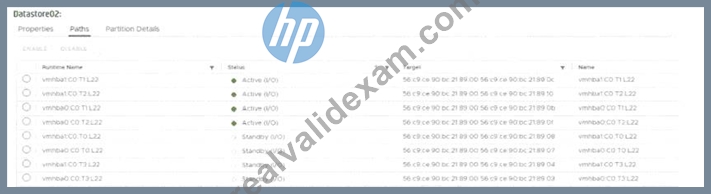
You are analyzing a customer environment with two Alletra 6000 arrays in a VMware stretched cluster.
Application latency differs slightly depending on whether the VM is on Datastore01 or Datastore02.
Question: Based on this scenario, what would you recommend to equalize latency for the workload?
- A. Issue pinning option for Datastore02 for lower latency.
- B. Relocate the workload on Datastore02 to a volume collection shared with Datastore01.
- C. Issue handover to the volume collection hosting Datastore01.
- D. Relocate the workload on Datastore01 to a volume collection shared with Datastore02.
Answer: B
NEW QUESTION # 21
Your customer has expressed an interest in an HPE CloudPhysics assessment of their environment. They would like to know what to expect from this process.
Which of the following statements is true of a CloudPhysics assessment?
- A. Some assessment results are visible in only 2 hours.
- B. The assessment period lasts for 5 business days.
- C. Your customer can only access a partial view of the results.
- D. An auto-generated token from HPE is required to view the results.
Answer: A
Explanation:
Detailed Explanation:
Rationale for Correct Answer:
HPE CloudPhysics begins collecting performance and capacity data immediately after deployment of the Observer VM/collector. Some initial assessment results (e.g., environment inventory, early utilization stats) can be visible within 2 hours, while deeper trending insights require longer data collection (days/weeks).
Distractors:
B: Tokens are not required for customers to view results; reports are available via the portal.
C: Customers get a full dashboard view of results, not partial.
D: Assessments can run for longer periods (days-weeks), not fixed at 5 days.
Key Concept: CloudPhysics delivers initial insights within hours.
Reference: HPE CloudPhysics Technical Overview.
NEW QUESTION # 22
A junior engineer doing their first assessment makes the comment that all assessments are basically done
"entirely by the assessment tool" and all they must do is start the process in the HPE website.
You caution them that some assessment tools require a manual email by the engineer to HPE to really start the process.
Which type of assessments require an email?
- A. Non-HPE
- B. Backup
- C. CloudPhysics
- D. SAF
Answer: D
Explanation:
Detailed Explanation:
Rationale for Correct Answer:
The SAF (Storage Assessment Framework) requires engineers to manually email the collected assessment data to HPE for processing. This is different from fully automated tools like CloudPhysics or Backup assessments that integrate directly with portals. This distinction is important for new engineers performing customer assessments.
Distractors:
A: Backup assessments are usually tool-driven (StoreOnce, RMC, etc.) and automated.
C: Non-HPE assessments are outside scope and not part of HPE standard process.
D: CloudPhysics is fully automated and cloud-based - no manual email required.
Key Concept: SAF = requires manual email submission to HPE.
Reference: HPE Internal Assessment and Sizing Tools Guide.
NEW QUESTION # 23
A pool of Microsoft SQL servers started to use the Alletra 6000 family array six months ago. The data growth has been higher than expected, and the performance of the databases is facing some latency issues.
Which method would allow both capacity and performance to grow when expanding the array, while keeping the management simple?
- A. By adding more arrays and capacity to a single scale-out group.
- B. By selecting more flash to cache ratio on the expansion shelves.
- C. By initially selecting the timeless storage option for the array.
- D. By including more NIC cards to load balance host traffic.
Answer: A
Explanation:
Detailed Explanation:
Rationale for Correct Answer:
HPE Alletra 6000 is a scale-out architecture array. Adding more arrays to a single scale-out group increases both performance (IOPS, throughput) and capacity, while maintaining single-pane management via HPE Data Services Cloud Console. This is the most efficient way to address both capacity growth and latency reduction for SQL workloads.
Distractors:
B: Adding NICs may help with throughput but not backend latency or capacity scaling.
C: Flash-to-cache ratios can optimize read caching but don't fundamentally increase system-wide performance.
D: Timeless storage is a procurement/licensing option, not a performance/capacity scaling method.
Key Concept: Alletra 6000 scale-out clustering for balanced growth of capacity and performance.
Reference: HPE Alletra 6000 Technical Architecture Guide.
NEW QUESTION # 24
Refer to the exhibit.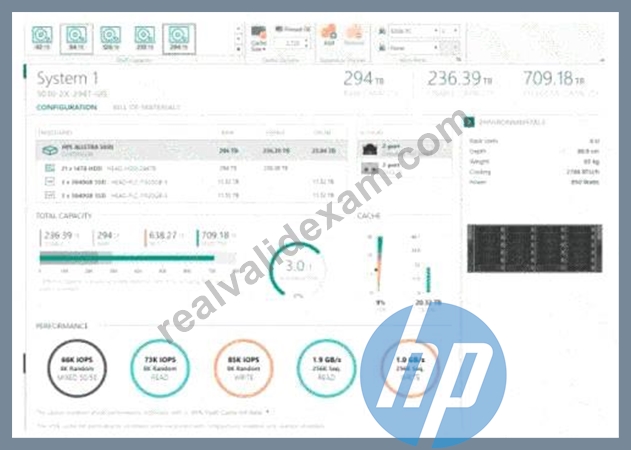
The array is experiencing frequent cache misses for read operations.
Which action plan would you suggest to correct the issue?
- A. Increase the pinned cache size.
- B. Upgrade the controllers to Alletra 5050 models.
- C. Upgrade the setup with additional expansion shelf.
- D. Increase the flash to disk ratio.
Answer: D
Explanation:
Detailed Explanation:
Rationale for Correct answer:
Frequent cache misses occur when the working dataset does not fit effectively in cache. Increasing the flash- to-disk ratio ensures a higher portion of hot data is served from flash media rather than backend disk, reducing cache miss penalties. This is the standard HPE recommendation for read-intensive workloads where cache is insufficient.
Distractors:
A: Adding shelves adds capacity, not cache-to-data efficiency.
B: Upgrading controllers increases CPU, but not necessarily cache efficiency.
C: Pinned cache is intended for metadata or specific workloads, not large-scale read caching.
Key Concept: Flash-to-disk ratio optimization reduces cache misses.
Reference: HPE Alletra Performance Sizing Guide.
NEW QUESTION # 25
Which statement is true regarding HPE's SAP HANA solutions?
- A. 77% of customers prefer SAP HANA solutions on HPE.
- B. Customers can reduce licensing costs with Alletra MP Block.
- C. HPE supplies custom HANA licenses exclusive for HPE appliances.
- D. About 40% of HANA infrastructure runs on HPE.
Answer: D
Explanation:
Detailed Explanation:
Rationale for Correct Answer:
HPE is one of the leading infrastructure providers for SAP HANA, with ~40% of global SAP HANA deployments running on HPE platforms (ProLiant, Alletra, Nimble/Primera for storage). This is an official HPE statistic repeatedly cited in white papers and customer references.
Distractors:
A: SAP HANA licensing is provided directly by SAP, not custom-issued by HPE.
B: Licensing costs are tied to SAP metrics (memory size), not Alletra storage type.
C: "77% prefer" is a marketing exaggeration and not the accurate documented figure.
Key Concept: HPE's strong positioning in SAP HANA infrastructure market share.
Reference: HPE SAP HANA Solutions Overview, HPE Global SAP HANA Customer Reference Sheet.
NEW QUESTION # 26
You are working with a customer to upgrade their backup target environment and they are interested in HPE StoreOnce.
Which HPE tool should you use to size and configure a solution for this customer?
- A. HPE NinjaSTARS
- B. One Config Advanced
- C. HPE CloudPhysics
- D. HPE Ninja Online
Answer: A
Explanation:
Detailed Explanation:
Rationale for Correct Answer:
HPE NinjaSTARS (Storage Assessment and Right Sizing) is the dedicated HPE tool for sizing and configuring StoreOnce backup appliances. It evaluates backup datasets, retention policies, deduplication ratios, and replication to recommend the right StoreOnce model and configuration.
Distractors:
A (CloudPhysics): Used for virtual infrastructure and block storage assessments, not backup target sizing.
C (Ninja Online): General sizing tool, not specific for StoreOnce.
D (OCA): Used for quoting/configuration, but sizing requires NinjaSTARS first.
Key Concept: HPE NinjaSTARS is the StoreOnce sizing tool.
Reference: HPE NinjaSTARS Backup Sizing Tool Guide.
NEW QUESTION # 27
The storage solution based on the exhibit is deployed at a customer site.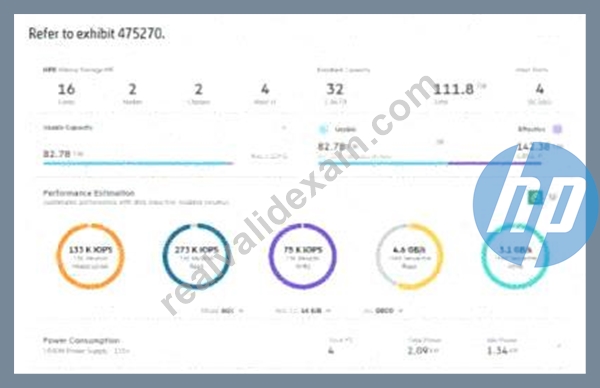
How can the sequential read performance be enhanced with this setup?
- A. By adding a third node to the solution
- B. By upgrading the nodes to 32-core IOMs
- C. By adding more NVMe media to the solution
- D. By increasing the amount of 10Gb NICs
Answer: D
Explanation:
Detailed Explanation:
Rationale for Correct Answer:
The exhibit shows an Alletra MP configuration delivering ~4.6 GB/s (256 KB sequential read) with four 10 Gb host ports. That throughput is close to the aggregate front-end bandwidth ceiling of 4×10 GbE (#5 GB/s raw, less with protocol overhead). For large-block sequential workloads, the front-end link budget is often the bottleneck; adding additional 10 GbE ports (or moving to higher-speed links) increases available host bandwidth and raises sustained sequential read throughput. This aligns with HPE sizing guidance: scale host connectivity to meet sequential throughput targets before adding media.
Analysis of Incorrect Options (Distractors):
B: Adding a third node isn't applicable to a 2-node HA block pair and would not address a front-end bandwidth limit.
C: More controller cores don't raise link-level throughput if host I/O is already constrained by port bandwidth.
D: Adding NVMe media primarily boosts IOPS/parallelism; sequential read is bounded here by front-end ports.
Key Concept: Sequential throughput is front-end bandwidth bound; scale host ports to increase GB/s.
Reference: HPE Alletra MP Performance and Sizing best practices (host connectivity scaling for throughput).
NEW QUESTION # 28
Your customer has just gone through a merger and is consolidating datacenters. They are currently using a mix of manufacturers. They are evaluating whether to consolidate on HPE as their new standard. You are helping them size their new virtualized environment.
What additional information do you need to decide on an assessment tool?
- A. If they are virtualized on VMware or Hyper-V
- B. If they are only purchasing in a CapEx model
- C. If they are using AWS or Azure public cloud storage
- D. If any equipment has expired support contracts
Answer: A
Explanation:
Detailed Explanation:
Rationale for Correct Answer:
The choice of assessment tool (e.g., HPE CloudPhysics for VMware vs. CloudPhysics.vhdx collector for Hyper-V) depends primarily on the virtualization platform in use. VMware and Hyper-V require different collectors, and this is the deciding factor for tool selection.
Distractors:
A: Public cloud use matters for hybrid sizing but not for tool selection.
C: Expired contracts are unrelated to tool choice.
D: Procurement model (CapEx vs. GreenLake) is separate from sizing assessment.
Key Concept: Assessment tool choice = based on hypervisor platform (VMware vs Hyper-V).
Reference: HPE CloudPhysics Assessment Guide.
NEW QUESTION # 29
Refer to the exhibit of Zerto Vault architecture.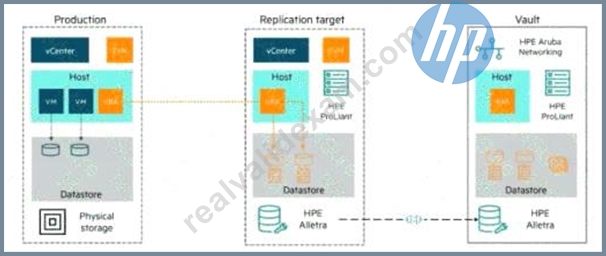
Which statement about the Zerto Vault architecture is correct?
- A. The Resilience Automation Server manages port access between Production and the Replication Target.
- B. Data is replicated via encrypted periodic replication between Production and the Replication Target.
- C. Data is replicated via encrypted periodic replication between the Replication Target and the Vault.
- D. Immutable snapshots of all Zerto components are taken at the Replication Target and replicated to the Vault.
Answer: C
Explanation:
Detailed Explanation:
Rationale for Correct Answer:
In the Zerto Vault architecture, production workloads replicate continuously to a Replication Target (secondary site). From there, data is further replicated periodically and encrypted into the Vault (air-gapped, isolated site). This two-step process ensures ransomware resilience and immutability, as the Vault acts as a hardened third copy.
Distractors:
A: Production-to-replication target traffic is continuous synchronous/asynchronous replication, not periodic.
Periodic replication applies to Replication Target # Vault.
C: The Resilience Automation Server (RAS) is responsible for orchestrating failover and immutability enforcement, but it does not control port access between production and replication target.
D: Snapshots of Zerto components are not what is replicated - it's application data VMs/volumes. The Vault ensures immutability of replicated data, not ZVM components.
Key Concept: Zerto Vault = encrypted, periodic replication from replication target to immutable vault.
Reference: HPE Zerto Vault Architecture White Paper, HPE Ransomware Recovery Solutions.
NEW QUESTION # 30
You need to evaluate a customer virtual server environment to size an HPE Block storage solution according to the metrics seen on the system over a period of time. The environment consists of Lenovo servers and Pure Storage as the storage vendor for a Microsoft Hyper-V cluster managed by Microsoft SCVMM.
Which HPE tools can you utilize to gather the usage metrics of this setup?
- A. Export the Microsoft System Center Virtual Machine Manager database for NinjaProtected analysis.
- B. Use the HPE InfoSight Primary Storage sizing tool to calculate the competitive performance metrics.
- C. Import the HPE CloudPhysics.vhdx collector to the Hyper-V cluster to gather the analytics.
- D. Install the SAFcollector agents into the environment and use SAFanalyze to import the agent output.
Answer: C
Explanation:
Detailed Explanation:
Rationale for Correct Answer:
HPE CloudPhysics provides comprehensive environment assessment and competitive sizing for virtualized environments (VMware, Hyper-V, etc.). The CloudPhysics collector (available as a .vhdx for Hyper-V) is deployed into the cluster to gather metrics on CPU, memory, storage IOPS/latency, and utilization trends.
These analytics feed into the sizing of HPE storage solutions.
Distractors:
B: InfoSight sizing tools work with HPE systems, not competitive 3rd-party storage like Pure.
C: SAF is a manual assessment requiring email submission and is not the correct modern method for this case.
D: NinjaProtected applies to backup analysis, not production Hyper-V cluster sizing.
Key Concept: CloudPhysics.vhdx collector for Hyper-V sizing with 3rd-party infrastructure.
Reference: HPE CloudPhysics Assessment Guide.
NEW QUESTION # 31
Your customer is using 2 HPE StoreOnce appliances across 2 sites with replication enabled for disaster recovery. They are concerned about the fact that the StoreOnce administrators have full access to the systems, which allows them to delete backup copies on these systems.
What needs to be used to address the concern of your customer?
- A. Dual Authorization
- B. Resource restriction policies
- C. Challenge Handshake Authentication Protocol (CHAP)
- D. Data at rest encryption
Answer: A
Explanation:
Detailed Explanation:
Rationale for Correct Answer:
HPE StoreOnce Dual Authorization prevents a single administrator from deleting, expiring, or modifying backup data. Instead, any destructive action requires approval from a second administrator, mitigating insider threats and accidental deletions. This is the correct feature for immutability protection in a replicated StoreOnce environment.
Distractors:
B (CHAP): Used for iSCSI authentication, not backup immutability.
C: Encryption protects data confidentiality, not accidental deletion.
D: Resource restrictions are policy-driven but don't enforce dual control over destructive actions.
Key Concept: Dual Authorization for ransomware and insider-threat protection on StoreOnce.
Reference: HPE StoreOnce Security Features White Paper.
NEW QUESTION # 32
Refer to the exhibit.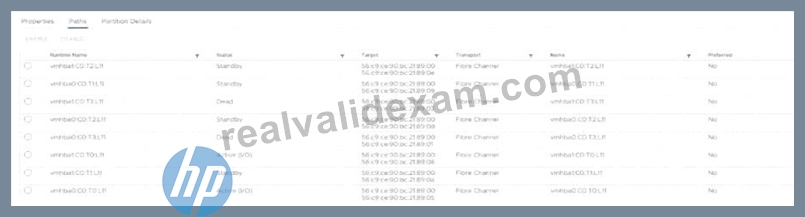
The above image represents an existing Alletra 6000 Peer Persistence configuration.
Which statement could be true in this scenario?
- A. The amount of active (0) paths could reduce the performance of the array.
- B. The performance of the array could be reduced due to the amount of paths active.
- C. The performance of the array could be reduced due to a missing controller.
Answer: C
Explanation:
Detailed Explanation:
Rationale for Correct Answer:
In the exhibit, several paths show "Standby" and some appear "Dead", while only a subset is Active (0).
This typically indicates that one storage controller may be missing or offline, which reduces redundancy and can cause performance degradation. In a healthy Peer Persistence environment, both controllers should present active and non-optimized paths.
Distractors:
A & B: Having multiple active paths does not inherently reduce performance; in fact, MPIO load balances traffic. The issue here is path failures, not excessive active paths.
Key Concept: MPIO pathing in HPE Peer Persistence and controller health.
Reference: HPE Alletra 6000 Peer Persistence Implementation Guide.
NEW QUESTION # 33
A local startup company has grown rapidly and now needs block storage for enterprise workloads. They are virtualized with VMware and have a small IT staff. They are evaluating an HPE Alletra MP and a Pure FlashArray //X90R4.
Environment:
VMware 8.0
Cisco switches
Dell servers
HPE servers
What statement about HPE should you point out as a differentiator?
- A. HPE can natively tier data on a software-only deployment.
- B. HPE has the ability to disable garbage collection and overhead to meet workload requirements.
- C. HPE provides full-stack visibility up to the app layer with prescriptive, actionable recommendations.
- D. HPE has live workload migration via the ActiveWorkload feature, based on a stretch cluster.
Answer: C
Explanation:
Detailed Explanation:
Rationale for Correct Answer:
HPE Alletra with InfoSight provides end-to-end visibility from infrastructure through to virtual machines and applications. It offers prescriptive, AI-driven recommendations to simplify management - a key differentiator for startups with small IT staff. Pure arrays do not offer the same level of integrated, cross-stack predictive analytics.
Distractors:
B: "ActiveWorkload" is not an HPE feature - HPE uses Peer Persistence for stretch clusters.
C: Garbage collection is managed automatically in HPE arrays; disabling it is not supported.
D: Data tiering is not natively provided as "software-only" - HPE uses GreenLake and Alletra services.
Key Concept: InfoSight = predictive analytics and app-to-infra visibility differentiator.
Reference: HPE InfoSight for Alletra Datasheet.
NEW QUESTION # 34
You are working with a customer to upgrade their current VMware infrastructure. The hardware is outdated, and the customer has no information about performance requirements for the new servers and storage array.
You are using HPE CloudPhysics to run an assessment.
Which Card Deck will give you insights on the under- and overprovisioning of the current environment?
- A. Reclaimable VMware vDisk Space
- B. Storage Space Management
- C. Infrastructure Planning
- D. Simulator for VM Rightsizing
Answer: D
Explanation:
Detailed Explanation:
Rationale for Correct Answer:
The Simulator for VM Rightsizing Card Deck in HPE CloudPhysics evaluates actual VM utilization against provisioned resources. It identifies under- and overprovisioned VMs, providing insights into reclaimable resources and accurate sizing recommendations. This directly helps plan server and storage upgrades.
Distractors:
A: Storage Space Management focuses on datastore usage trends, not provisioning mismatches.
B: Reclaimable VMware vDisk Space identifies unused storage, not CPU/RAM sizing.
D: Infrastructure Planning helps plan new builds but doesn't directly analyze current over/under provisioning.
Key Concept: VM Rightsizing = CloudPhysics tool for over/under provisioning analysis.
Reference: HPE CloudPhysics Card Decks Guide.
NEW QUESTION # 35
Your customer wants to use their HPE Alletra Storage MP B10000 array to store persistent data for Kubernetes-based applications. After deploying the CSI driver using Helm and creating the secret with the command kubectl create -f hpe-backed.yaml, what is the next required step to enable the containerized applications to consume persistent volumes on the Alletra MP array?
- A. Create a PersistentVolume by using kubectl create -f pv.yaml
- B. Create a PersistentVolumeClaim by using kubectl create -f my-pvc.yaml
- C. Define a StorageClass by running kubectl create -f storageclass.yaml
- D. Update the Helm repository by using helm repo update to recognize the CSI driver
Answer: C
Explanation:
Detailed Explanation:
Rationale for Correct Answer:
After installing the HPE CSI driver and creating backend secrets, the next critical step is to define a StorageClass that references the backend driver and parameters. Without the StorageClass, Kubernetes cannot dynamically provision PersistentVolumes (PVs). Once the StorageClass is created, workloads can request storage using PersistentVolumeClaims (PVCs).
Distractors:
A: Helm repo update only refreshes Helm charts; it does not enable CSI provisioning.
B: A PVC requires a StorageClass to bind dynamically - it cannot be created successfully beforehand.
C: Manually creating PVs is possible, but not the HPE best practice with CSI, which relies on StorageClass for dynamic provisioning.
Key Concept: Kubernetes CSI workflow: Secret # StorageClass # PVC # Pod.
NEW QUESTION # 36
You are migrating your customer's virtualization platform from an old third-party storage array to a newly installed HPE Alletra MP B10000 array. You are using HPE Zerto Move for the migration.
Which statement is correct when using HPE Zerto Move compared to the typical Failover feature?
- A. The Zerto Checkpoint (and RPO) is user-selectable during the move
- B. The migration results in an RPO and RTO of seconds
- C. You can keep the source VMs after the migration
- D. The source VMs are deleted automatically after the migration
Answer: C
Explanation:
Detailed Explanation:
Rationale for Correct Answer:
When using Zerto Move, unlike a typical disaster recovery failover, the migration process allows the source VMs to be retained after cutover. This is useful when testing or validating the migration. In contrast, failover scenarios typically assume the source environment has failed or is decommissioned. Therefore, keeping source VMs is a differentiator for Move.
Distractors:
A: Checkpoints and RPO are controlled by Zerto replication but are not selectable per migration cutover in this way.
B: Source VMs are not deleted automatically; this is intentionally avoided to allow rollback.
D: While Zerto does provide low RPO/RTO (seconds to minutes), this applies mainly to DR failover, not migration cutovers.
Key Concept: Zerto Move vs Zerto Failover semantics.
Reference: HPE Zerto Move Technical Overview, HPE Zerto Replication & Migration Best Practices.
NEW QUESTION # 37
Your customer is beginning to convert their applications to cloud-native apps on Kubernetes. They are considering HPE GreenLake for Containers.
Which statement about this platform is true?
- A. Provides tools for orchestration of containers without microservices support.
- B. Provides open-source Kubernetes with simplified management.
- C. Supports legacy virtualization technologies with manual configuration for containers.
- D. Supports only cloud-native applications.
Answer: B
Explanation:
Detailed Explanation:
Rationale for Correct Answer:
HPE GreenLake for Containers delivers an enterprise-grade Kubernetes platform, leveraging open- source Kubernetes but with simplified lifecycle management, monitoring, and integration with HPE infrastructure. It provides full support for containerized workloads, whether cloud-native or modernized traditional applications.
Distractors:
A: Incorrect - not about legacy virtualization.
B: Incorrect - microservices are supported; orchestration is Kubernetes-native.
D: Incorrect - it supports both cloud-native and modernized workloads.
Key Concept: GreenLake for Containers = Kubernetes with simplified enterprise management.
Reference: HPE GreenLake for Containers Overview.
NEW QUESTION # 38
Review the diagram showing an Active Peer Persistence deployment across two arrays.
Question: Which Host Proximity Parameter should be configured for ESX31 to ensure localized access?
- A. Secondary
- B. Exclusive
- C. All
- D. Primary
Answer: A
NEW QUESTION # 39
......
HPE7-J02 Questions - Truly Beneficial For Your HP Exam: https://www.realvalidexam.com/HPE7-J02-real-exam-dumps.html
Download HP HPE7-J02 Sample Questions: https://drive.google.com/open?id=1KEqkrkUpZcsfwpckHdXirzzg3MbA7kXM
