
[Nov 23, 2025] Get Free Updates Up to 365 days On Developing C_THR81_2405 Braindumps
Best Quality SAP C_THR81_2405 Exam Questions
SAP C_THR81_2405 Exam Syllabus Topics:
| Topic | Details |
|---|---|
| Topic 1 |
|
| Topic 2 |
|
| Topic 3 |
|
| Topic 4 |
|
| Topic 5 |
|
NEW QUESTION # 42
Which of the following are examples of standard one-to-one associations? Note: There are 2 correct answers to this question.
- A. Pay Range to Legal Entity
- B. Location to Geozone
- C. Department to Division
- D. Location to Legal Entity
Answer: A,B
Explanation:
Standard one-to-one associations link objects in a parent-child relationship, where each instance of the parent object is associated with one instance of the child object. Examples include:
* Location to Geozone: A location belongs to one specific geozone.
* Pay Range to Legal Entity: A pay range is tied to a single legal entity.
Location to Legal EntityandDepartment to Divisionare examples of one-to-many associations.
NEW QUESTION # 43
Which employment objects support a country-specific field configuration? Note: There are 2 correct answers to this question.
- A. Job Relationship Info
- B. Pay Component Recurring
- C. Job Information
- D. Employment Details
Answer: C,D
NEW QUESTION # 44
Based on the screenshot below, can you identify any errors on the definition of the business rule to Default Position Attributes?Note: There are 2 correct answers to this question.If Then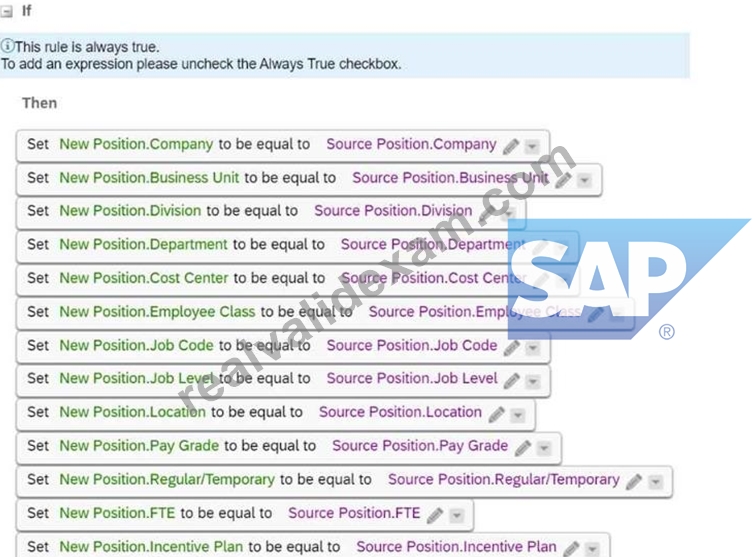
- A. The Company field should NOT be included in the business rule.
- B. The workflow configuration should NOT be included in the business rule.
- C. The FTE field should be derived from the business rule to Calculate FTE based on Standard Hours.
- D. The Parent Position field should NOT be included in the business rule.
Answer: C,D
NEW QUESTION # 45
How do you create country-specific fields for the Legal Entity object?
- A. As an HRIS element in the Country Specific Field for Corporate Data Model with a Valid When association to the Legal Entity object
- B. As a generic object with a composite association to the Legal Entity object
- C. As a generic object with a Valid When association to the Legal Entity object
- D. As an HRIS element in the Corporate Data Model with a composite association to the Legal Entity object
Answer: A
NEW QUESTION # 46
How should you build the IF condition to identity the user when the employee is updating their own Personal Information?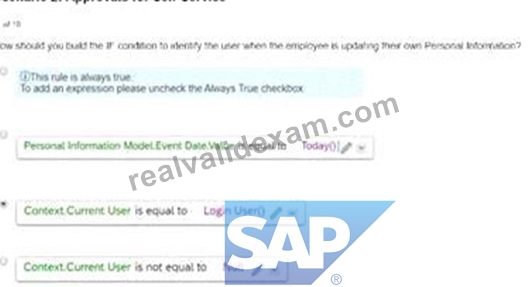
- A. Option C
- B. Option D
- C. Option A
- D. Option B
Answer: A
Explanation:
To identify the user when the employee is updating their own personal information, theIF conditioninOption Cis correct. This configuration:
* Checks if theContext.Current Useris equal to theLogin User.
* Ensures that the rule applies only when the employee is making changes to their own personal data.
This approach is aligned with SAP SuccessFactors logic for self-service scenarios, enabling accurate identification of the user in such workflows.
Scenario 2: Approvals for Self-Service
NEW QUESTION # 47
An HR admin/Global Mobility person must create a transfer for an employee. The employee will be moving from Position A in Team A to Position B in Team B.
Both managers will have to approve the transfer. How do you configure a two-step workflow so that the approval goes first to the current manager and second to the future manager?
- A. By selecting in Step 1: Position Relationship - Parent Parent Position - Source By selecting in Step 2: Position Relationship - Parent Position - Target
- B. By selecting in Step 1: Role - Self - Source By selecting in Step 2: Role - Manager - Target
- C. By selecting in Step 1: Role - Manager - Source By selecting in Step 2: Role - Manager Manager - Target
- D. By selecting in Step 1: Role - Manager - Source By selecting in Step 2: Role - Manager - Target
Answer: D
NEW QUESTION # 48
In which order must you assign the rules?
- A. ERD1, ERD2, ERD3, WFD, ERD-Catch
- B. ERD-Calch, ERD1, ERD2, ERD3, WFD
- C. WFD, ERD1, ERD2, ERD3, ERD-Catch
- D. ERD1, ERD2, ERD3, ERD-Catch, WFD
Answer: D
NEW QUESTION # 49
What does SAP SuccessFactors recommend when you create custom associations between foundation objects (FO)?
- A. All custom associations should be built between an MDF FO and another MDF FO.
- B. All custom associations should be built as one-to-many.
- C. All custom associations should be built between an XML FO and another XML FO.
- D. All custom associations should be built as one-to-one.
Answer: B
NEW QUESTION # 50
In which entities is Alert Notification supported? Note: There are 2 correct answers to this question.
- A. Job Information
- B. Pay Component Recurring
- C. Address Information
- D. Personal Information
Answer: A,B
NEW QUESTION # 51
The manager has the ability to change the salary during the workflow. Which of the following options do you need to select for a new workflow to be triggered when the manager edits the salary?
- A. Edit Attachment Only
- B. Edit without Route Change
- C. No edit
- D. Edit with Route Change
Answer: D
NEW QUESTION # 52
Where do you enable the Incumbent of Parent Position option to filter positions in Hire, MSS Job Information and History?
- A. In Position Management Settings > UI Customizing
- B. In Position Management Settings > Hierarchy Adaptation
- C. In Manage Business Configuration > jobInfo
- D. In Configure Object Definitions > Position
Answer: A
NEW QUESTION # 53
Which of the following are features of the clean core dashboard? Note: There are 2 correct answers to this question.
- A. Customers can grant access to the dashboard to partners.
- B. It can be used in all SAP S/4HANA Cloud editions.
- C. Customers can use the dashboard in the dev, test, and production tenants.
- D. It can be accessed by using SAP For Me.
Answer: A,D
NEW QUESTION # 54
An employee is changing their Last Name, so a CC workflow notification should be sent to their manager. When is the CC workflow notification sent out?
- A. When the approvers decline the workflow
- B. When the workflow is approved by all approvers
- C. When the employee initiates the workflow
- D. When the workflow is sent back by any approver
Answer: C
NEW QUESTION # 55
A customer has scheduled an HRIS sync job, which includes mapping of job titles, to run every Friday. On Tuesday, an employee's job title is changed via Manager Self-Service (MSS) to become effective on Thursday.
When will the synchronization happen?
- A. Thursday, when the change becomes effective
- B. Friday, when the sync job completes
- C. Saturday, the day after the sync job completes
- D. Tuesday, the day the transaction is entered
Answer: B
Explanation:
In SAP SuccessFactors Employee Central, the HRIS synchronization (sync) job is responsible for aligning data between different modules and ensuring consistency across the system. When an employee's job title is changed via Manager Self-Service (MSS) with an effective date set to Thursday, and the HRIS sync job is scheduled to run every Friday, the synchronization will occur onFriday, when the sync job completes.
This means that any changes made effective on Thursday will be synchronized during the next scheduled HRIS sync job on Friday. Therefore, the correct answer isC. Friday, when the sync job completes.
NEW QUESTION # 56
Which of the following standard behaviors in Position Management can be set differently using Position Types? Note: There are 3 correct answers to this question.
- A. Respect workflow at Copy Position in Position Organizational Chart
- B. Set or reset TBH status if an incumbent's FTE is changed
- C. Transfer incumbents of the lower-level positions to a new manager if the current manager leaves their position
- D. Define a specific transition period for a group of positions
- E. Trigger workflows on Job Information if the position changes are synchronized to the incumbents
Answer: C,D,E
NEW QUESTION # 57
Which objects are supported in cross-entity business rules? Note: There are 2 correct answers to this question.
- A. Job Information
- B. Pay Component Recurring
- C. Personal Information
- D. Work Permit Information
Answer: A,B
Explanation:
Cross-entity business rules in SAP SuccessFactors Employee Central allow for data propagation and validation across different HRIS elements. The following objects are supported in cross-entity business rules:
* A. Pay Component Recurring
* This object pertains to regular, recurring payments such as salaries. Cross-entity rules can be configured to update or validate data between Pay Component Recurring and other entities like Job Information.
* D. Job Information
* This object contains details about an employee's job role, department, and other related information. Cross-entity rules can be used to ensure consistency between Job Information and other entities, such as Compensation Information.
Objects likeWork Permit InformationandPersonal Informationare not currently supported in cross-entity business rules. The focus of cross-entity rules is primarily on employment-related entities to maintain data integrity across core HR processes.
NEW QUESTION # 58
Which object requires entity-type to be configured in HRIS sync mapping?
- A. complnfo
- B. phoneInfo
- C. Opersoninfo
- D. jobinfo
Answer: B
NEW QUESTION # 59
The manager has the ability to change the salary during the workflow
Which of the following options do you need to select for a new workflow to be triggered when the manager edits the salary?
- A. Edit Attachment Only
- B. Edit without Route Change
- C. No edit
- D. Edit with Route Change
Answer: D
Explanation:
To trigger a new workflow when the manager edits the salary during the approval process, you must selectEdit with Route Change. This option ensures that when an edit is made, the workflow is restarted or rerouted based on the updated information, allowing for revalidation and approvals to reflect the changes.
This option is essential for ensuring data integrity and compliance during workflows involving edits.
NEW QUESTION # 60
What base object must you use for the Job info_FTE_Comp rule?
- A. Compensation Model
- B. Compensation Information Model
- C. Job Information Model
- D. Non Recurring Pay Component Model
Answer: C
NEW QUESTION # 61
Which of the following API types does SAP recommend to use to achieve clean core integrations? Note: There are 2 correct answers to this question.
- A. Data
- B. RFC
- C. IDoc
- D. SOAP
Answer: A,D
NEW QUESTION # 62
......
SAP Exam Practice Test To Gain Brilliante Result: https://www.realvalidexam.com/C_THR81_2405-real-exam-dumps.html
Tested Material Used To C_THR81_2405: https://drive.google.com/open?id=1kCW1D6t9GMbDXM02Y-3OMQER1xoRnG-9
