
Achive your Success with Latest Cisco 100-150 Exam [Jul 28, 2026]
The 100-150 Exam Test For Brief Preparation
Cisco 100-150 Exam Syllabus Topics:
| Topic | Details |
|---|---|
| Topic 1 |
|
| Topic 2 |
|
| Topic 3 |
|
| Topic 4 |
|
NEW QUESTION # 26
HOTSPOT
You want to list the IPv4 addresses associated with the host name www.companypro.net.
Complete the command by selecting the correct option from each drop-down list.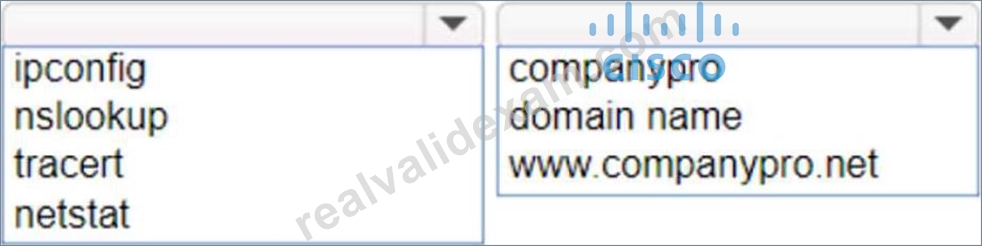
Answer:
Explanation: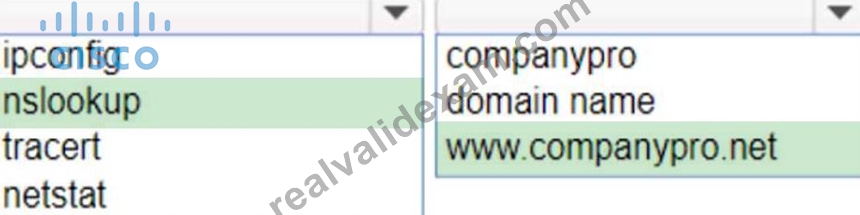
Explanation:
To list the IPv4 addresses associated with the host name www.companypro.net, you should use the following command:
nslookup www.companypro.net
This command will query the DNS servers to find the IP address associated with the hostname provided. If you want to ensure that it returns the IPv4 address, you can specify the -type=A option, which stands for Address records that hold IPv4 addresses1. However, the nslookup command by default should return the IPv4 address if available.
To list the IPv4 addresses associated with the host name www.companypro.net, you should use the nslookup command.
Command: nslookup
Target: www.companypro.net
So, the completed command is:
nslookup www.companypro.net
nslookup: This command is used to query the Domain Name System (DNS) to obtain domain name or IP address mapping or for any other specific DNS record.
www.companypro.net: This is the domain name you want to query to obtain its associated IP addresses.
Reference: Using nslookup: nslookup Command Guide
NEW QUESTION # 27
Which device is an Internet of Things (IoT) device?
- A. An internet-accessible thermostat
- B. A cloud-based file storage array
- C. A video streaming server
- D. A virtual private network concentrator
Answer: A
Explanation:
An Internet of Things device is a physical endpoint with embedded connectivity that can collect, send, or receive data over a network. An internet-accessible thermostat matches that definition because it is a connected smart device used in the physical environment.
NEW QUESTION # 28
Hotspot Question
You want to list the IPv4 addresses associated with the host name www.companypro.net.
Complete the command by selecting the correct option from each drop-down list.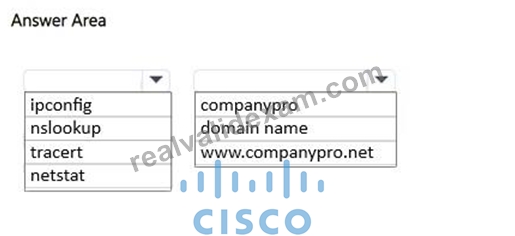
Answer:
Explanation: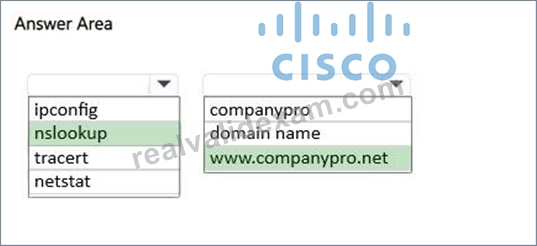
Explanation:
The nslookup command queries DNS to return the IPv4 addresses for the specified hostname.
NEW QUESTION # 29
A help desk technician receives the four trouble tickets listed below.
Which ticket should receive the highest priority and be addressed first?
- A. Ticket 3: A user reports that response time for a cloud-based application is slower than usual.
- B. Ticket 4: Two users report that wireless access in the cafeteria has been down for the last hour.
- C. Ticket 2: An online webinar is taking place in the conference room. The video conferencing equipment lost internet access.
- D. Ticket 1: A user requests relocation of a printer to a different network jack in the same office. The jack must be patched and made active.
Answer: C
Explanation:
When prioritizing trouble tickets, the most critical issues affecting business operations or high-impact activities should be addressed first.
Here's a breakdown of the tickets:
Ticket 1: Relocation of a printer, while necessary, is not urgent and does not impact critical operations.
Ticket 2: An ongoing webinar losing internet access is critical, especially if the webinar is time-sensitive and involves multiple participants.
Ticket 3: Slower response time for a cloud-based application is important but typically not as urgent as a complete loss of internet access for a live event.
Ticket 4: Wireless access down in the cafeteria affects users but does not have the same immediate impact as a live webinar losing connectivity.
Thus, the correct answer is B. Ticket 2: An online webinar is taking place in the conference room. The video conferencing equipment lost internet access.
Reference: =
IT Help Desk Best Practices
Prioritizing IT Support Tickets
NEW QUESTION # 30
A local company requires two networks in two new buildings. The addresses used in these networks must be in the private network range.
Which two address ranges should the company use? Note: You will receive partial credit for each correct selection. (Choose 2.)
- A. 172.16.0.0 to 172.31.255.255
- B. 11.0.0.0 to 11.255.255.255
- C. 192.16.0.0 to 192.16.255.255
- D. 192.168.0.0 to 192.168.255.255
Answer: A,D
Explanation:
The private IP address ranges that are set aside specifically for use within private networks and not routable on the internet are as follows:
Class A: 10.0.0.0 to 10.255.255.255
Class B: 172.16.0.0 to 172.31.255.255
Class C: 192.168.0.0 to 192.168.255.255
These ranges are defined by the Internet Assigned Numbers Authority (IANA) and are used for local communications within a private network123.
Given the options:
A). 172.16.0.0 to 172.31.255.255 falls within the Class B private range.
B). 192.16.0.0 to 192.16.255.255 is not a recognized private IP range.
C). 11.0.0.0 to 11.255.255.255 is not a recognized private IP range.
D). 192.168.0.0 to 192.168.255.255 falls within the Class C private range.
Therefore, the correct selections that the company should use for their private networks are A and D.
Reference: =
Reserved IP addresses on Wikipedia
Private IP Addresses in Networking - GeeksforGeeks
Understanding Private IP Ranges, Uses, Benefits, and Warnings
NEW QUESTION # 31
Move each network type from the list on the left to the correct example on the right.
Answer:
Explanation:
* Two home office computers are connected to a switch by Ethernet cables.
* Network Type: LAN (Local Area Network)
* Explanation: A LAN connects devices within a limited area such as a home, office, or building, using Ethernet cables or Wi-Fi.
* Three government buildings in the same city connect to a cable company over coaxial cables.
* Network Type: MAN (Metropolitan Area Network)
* Explanation: A MAN connects networks across a city or campus, often using fiber optic or coaxial cables.
* A cell phone connects to a Bluetooth headset.
* Network Type: PAN (Personal Area Network)
* Explanation: A PAN connects devices within a personal workspace, typically using wireless technologies like Bluetooth.
* A financial institution connects its branches through a telecommunications service provider.
* Network Type: WAN (Wide Area Network)
* Explanation: A WAN connects multiple LANs over long distances, often using leased lines or satellite links provided by telecommunications companies.
* LAN (Local Area Network): Used for connecting devices within a small geographical area such as a single building or home.
* MAN (Metropolitan Area Network): Covers a larger geographical area than a LAN, typically a city or campus.
* PAN (Personal Area Network): Connects devices within the range of an individual person, such as connecting a phone to a Bluetooth headset.
* WAN (Wide Area Network): Spans large geographical areas, connecting multiple LANs across cities, countries, or continents.
References:
* Network Types Overview: Cisco Networking Basics
* Understanding Different Network Types: Network Types Guide
NEW QUESTION # 32
Which device protects the network by permitting or denying traffic based on IP address, port number, or application?
- A. Firewall
- B. VPN gateway
- C. Access point
- D. Intrusion detection system
Answer: A
Explanation:
* Firewall: A firewall is a network security device that monitors and controls incoming and outgoing network traffic based on predetermined security rules. It permits or denies traffic based on IP addresses, port numbers, or applications.
* Access Point: This is a device that allows wireless devices to connect to a wired network using Wi-Fi.
It does not perform traffic filtering based on IP, port, or application.
* VPN Gateway: This device allows for secure connections between networks over the internet, but it is not primarily used for traffic filtering based on IP, port, or application.
* Intrusion Detection System (IDS): This device monitors network traffic for suspicious activity and policy violations, but it does not actively permit or deny traffic.
References:
* Understanding Firewalls: Firewall Basics
NEW QUESTION # 33
Examine the output of the show mac-address-tablecommand on a Cisco 24 port Ethernet switch.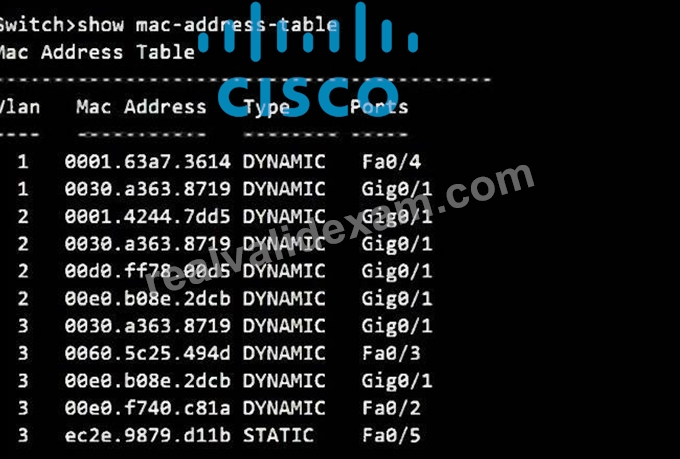
What can you determine about this switch from the command output?
- A. All entries were learned by examining incoming frames.
- B. There are eleven active ports on this switch.
- C. Port Gig0/1 connects to another switch.
- D. Port Fa0/5 is set to administratively down.
Answer: C
Explanation:
Multiple different MAC addresses in several VLANs are being learned on port Gig0/1, which indicates that this port is forwarding traffic for multiple devices beyond the local switch. That behavior is typical of a connection to another switch.
NEW QUESTION # 34
Which address is included in the 192.168.200.0/24 network?
- A. 192.168.199.13
- B. 192.168.200.13
- C. 192.168.201.13
- D. 192.168.1.13
Answer: B
Explanation:
192.168.200.13 falls within the 192.168.200.0-192.168.200.255 range defined by the /24 network.
NEW QUESTION # 35
Which standard contains the specifications for Wi-Fi networks?
- A. IEEE 802.11
- B. EIA/TIA 568A
- C. GSM
- D. IEEE 802.3
- E. LTE
Answer: A
Explanation:
The IEEE 802.11 standard contains the specifications for Wi-Fi networks. It is a set of media access control (MAC) and physical layer (PHY) specifications for implementing wireless local area network (WLAN) computer communication in various frequencies, including but not limited to 2.4 GHz, 5 GHz, and 6 GHz1. This standard is maintained by the Institute of Electrical and Electronics Engineers (IEEE) and is commonly referred to as Wi-Fi. The standard has evolved over time to include several amendments that improve speed, range, and reliability of wireless networks.
Reference: =
* The Most Common Wi-Fi Standards and Types, Explained
* 802.11 Standards Explained: 802.11ax, 802.11ac, 802.11b/g/n, 802.11a
* Wi-Fi Standards Explained - GeeksforGeeks
NEW QUESTION # 36
Which command will display all the current operational settings configured on a Cisco router?
- A. show startup-config
- B. show protocols
- C. show version
- D. show running-config
Answer: D
Explanation:
The show running-config command displays the router's current operational configuration in RAM.
NEW QUESTION # 37
A Cisco switch is not accessible from the network. You need to view its running configuration.
Which out-of-band method can you use to access it?
- A. Console
- B. Telnet
- C. SNMP
- D. SSH
Answer: A
Explanation:
When a Cisco switch is not accessible from the network, the recommended out-of-band method to access its running configuration is through the console port. Out-of-band management involves accessing the network device through a dedicated management channel that is not part of the data network. The console port provides direct access to the switch's Command Line Interface (CLI) without using the network, which is essential when the switch cannot be accessed remotely via the network12.
Reference: =
Out-of-band (OOB) network interface configuration guidelines Out of band management configuration
If you have any more questions or need further assistance, feel free to ask!
NEW QUESTION # 38
Which network technology is not impacted by electromagnetic and radio wave interference?
- A. Copper
- B. Twisted pair
- C. Fiber
- D. Wireless
Answer: C
Explanation:
Fiber transmits data as light rather than electrical signals, so it is not affected by electromagnetic or radio frequency interference.
NEW QUESTION # 39
Which type of cable is commonly used for Ethernet connections and contains twisted pairs to reduce electromagnetic interference?
- A. Fiber optic
- B. Serial
- C. Coaxial
- D. Twisted pair
Answer: D
Explanation:
Twisted pair cables reduce interference by twisting wires together, improving signal integrity and making them the most widely used medium for Ethernet LAN connections.
NEW QUESTION # 40
What is the purpose of assigning an IP address to the management VLAN interface on a Layer 2 switch?
- A. To enable the switch to resolve URLs for the attached the devices
- B. To enable access to the CLI on the switch through Telnet or SSH
- C. To enable the switch to provide DHCP services to other switches in the network
- D. To enable the switch to act as a default gateway for the attached devices
Answer: B
Explanation:
The primary purpose of assigning an IP address to the management VLAN interface on a Layer 2 switch is to facilitate remote management of the switch. By configuring an IP address on the management VLAN, network administrators can access the switch's Command Line Interface (CLI) remotely using protocols such as Telnet or Secure Shell (SSH). This allows for convenient configuration changes, monitoring, and troubleshooting without needing physical access to the switch1.
References :=
*Understanding the Management VLAN
*Cisco - VLAN Configuration Guide
*Remote Management of Switches
Assigning an IP address to the management VLAN interface (often the VLAN 1 interface by default) on a Layer 2 switch allows network administrators to remotely manage the switch using protocols such as Telnet or SSH. This IP address does not affect the switch's ability to route traffic between VLANs but provides a means to access and configure the switch through its Command Line Interface (CLI).
*A: The switch does not act as a default gateway; this is typically a function of a Layer 3 device like a router.
*B: The switch does not resolve URLs; this is typically a function of DNS servers.
*C: The switch can relay DHCP requests but does not typically provide DHCP services itself; this is usually done by a dedicated DHCP server or router.
Thus, the correct answer is D. To enable access to the CLI on the switch through Telnet or SSH.
References :=
*Cisco VLAN Management Overview
*Cisco Catalyst Switch Management
NEW QUESTION # 41
Which two statements are true about the IPv4 address of the default gateway configured on a host? (Choose 2.) Note: You will receive partial credit for each correct selection.
- A. Hosts learn the default gateway IPv4 address through router advertisement messages.
- B. The default gateway is the IPv4 address of the router interface connected to the same local network as the host.
- C. The same default gateway IPv4 address is configured on each host on the local network.
- D. The default gateway is the Loopback0 interface IPv4 address of the router connected to the same local network as the host.
- E. The IPv4 address of the default gateway must be the first host address in the subnet.
Answer: B,C
Explanation:
*Statement B: "The same default gateway IPv4 address is configured on each host on the local network." This is true because all hosts on the same local network (subnet) use the same default gateway IP address to send packets destined for other networks.
*Statement D: "The default gateway is the IPv4 address of the router interface connected to the same local network as the host." This is true because the default gateway is the IP address of the router's interface that is directly connected to the local network.
*Statement A: "The IPv4 address of the default gateway must be the first host address in the subnet." This is not necessarily true. The default gateway can be any address within the subnet range.
*Statement C: "The default gateway is the Loopback0 interface IPv4 address of the router connected to the same local network as the host." This is not true; the default gateway is the IP address of the router's physical or logical interface connected to the local network.
*Statement E: "Hosts learn the default gateway IPv4 address through router advertisement messages." This is generally true for IPv6 with Router Advertisement (RA) messages, but not typically how IPv4 hosts learn the default gateway address.
References:
*Cisco Default Gateway Configuration: Cisco Default Gateway
NEW QUESTION # 42
Which address is included in the 192.168.200.0/24 network?
- A. 192.168.199.13
- B. 192.168.200.13
- C. 192.168.201.13
- D. 192.168.1.13
Answer: B
Explanation:
*192.168.200.0/24 Network: This subnet includes all addresses from 192.168.200.0 to 192.168.200.255. The
/24 indicates a subnet mask of 255.255.255.0, which allows for 256 addresses.
*192.168.199.13: This address is in the 192.168.199.0/24 subnet, not the 192.168.200.0/24 subnet.
*192.168.200.13: This address is within the 192.168.200.0/24 subnet.
*192.168.201.13: This address is in the 192.168.201.0/24 subnet, not the 192.168.200.0/24 subnet.
*192.168.1.13: This address is in the 192.168.1.0/24 subnet, not the 192.168.200.0/24 subnet.
References:
*Subnetting Guide: Subnetting Basics
NEW QUESTION # 43
Which standard contains the specifications for Wi-Fi networks?
- A. IEEE 802.11
- B. EIA/TIA 568A
- C. GSM
- D. IEEE 802.3
- E. LTE
Answer: A
Explanation:
IEEE 802.11 is the standard that defines the protocols and specifications for wireless local area (Wi-Fi) networking.
NEW QUESTION # 44
What is the main purpose of a default gateway configured on a host within a local area network?
- A. Forward traffic to external networks
- B. Resolve domain names
- C. Assign IP addresses
- D. Filter malicious packets
Answer: A
Explanation:
A default gateway allows devices to send traffic destined for outside networks, acting as the exit point from the local network to other networks or the internet.
NEW QUESTION # 45
......
Revolutionary Guide To Exam Cisco Dumps: https://www.realvalidexam.com/100-150-real-exam-dumps.html
Pass 100-150 Exam Latest Practice Questions: https://drive.google.com/open?id=14Bqi-BGh19HdAWQHlIoHK17mu1_HPoC7
