
Get 100% Authentic Microsoft DP-750 Dumps with Correct Answers
New Training Course DP-750 Tutorial Preparation Guide
NEW QUESTION # 50
You have an Azure Databricks workspace that contains a Git folder and uses Azure Repos as the Git provider.
From the main branch, you create a branch named Branch1. You commit changes to Branch1.
You need to incorporate the changes from Branch1 into main. The solution must preserve the commit history in the repository.
Which command should you run?
- A. rebase
- B. push
- C. pull
- D. merge
Answer: D
Explanation:
To incorporate changes from your feature branch into the main branch while keeping every individual commit intact, you must use a fast-forward merge or a standard merge commit.
In the Azure Databricks Git folders UI or via standard Git operations, use the following command:
The Correct Command: git merge <branch-name>
Preserves History: Unlike a squash merge, a standard merge keeps all individual commit messages, authors, and timestamps.
Maintains Timeline: It seamlessly integrates the exact commit graph from your feature branch into the main branch.
Reference:
https://docs.databricks.com/aws/en/repos/git-operations-with-repos
NEW QUESTION # 51
Which operation guarantees ACID compliance in Delta Lake?
- A. INSERT OVERWRITE
- B. Spark RDD transformation
- C. Delta transaction log
- D. Direct file append
Answer: C
Explanation:
Delta Lake ensures ACID compliance through its transaction log (Delta log). It tracks all changes, enabling consistency, isolation, and rollback capabilities. File append operations alone are not transactional. RDD transformations are low-level and not ACID-aware.
NEW QUESTION # 52
You need to develop the task logic for a new job in Lakeflow Jobs that processes telemetry data.
Each task must contain only the appropriate logic for its step in the pipeline. The solution must support the planned changes and meet the data ingestion and processing requirements.
What should you do?
- A. Use a single SQL task that performs ingestion, cleansing, and curation by running merge commands.
- B. Use a single Databricks notebook task that performs ingestion, cleansing, and curation in one script.
- C. Create separate tasks for ingestion, cleansing, and curation.
- D. Create three tasks that each contains the identical logic and use task retries.
Answer: C
Explanation:
The correct answer is D. Breaking the pipeline into separate tasks for ingestion, cleansing, and curation is the foundation of well-designed Lakeflow Jobs pipelines. Each task should own one responsibility - when a task does too much, debugging a failure becomes a hunt through unrelated code, and retry logic becomes expensive because you re-execute work that already succeeded.
Contoso's planned changes explicitly call for 'a clear execution order and dependencies' and 'orchestrate multi- step ingestion and transformation workflows.' Separate tasks map directly to those goals: Lakeflow Jobs tracks each task's status independently, so if cleansing fails, ingestion doesn't re-run.
Option A bundles everything into one notebook, which means a curation bug forces a full re-ingestion. Option B copies logic three times - any future change must be applied in triplicate, which is a maintenance hazard.
Option C forces everything through SQL MERGE, which is the wrong tool for raw-event ingestion and doesn't address cleansing or schema drift.
Reference: https://learn.microsoft.com/en-us/azure/databricks/jobs/
Topic 1, Contoso Case Study
Overview
Contoso has a single Azure Databricks workspace named Workspace1 in the West US Azure region.
Workspace1 is enabled for Unity Catalog.
Workspace1 contains all-purpose clusters for both development and production workloads.
The company's Azure environment contains:
* In the West US, Central US, and East US Azure regions, Azure event hubs that stream telemetry data and an Azure Data Lake Storage Gen2 account in each region for each hub
* A single Azure SQL database in the West US region that hosts enterprise resource planning (ERP) data
* An Azure Database for PostgreSQL server in the West US region that stores operational maintenance data Company information Contoso, Inc. is a renewable energy provider that operates solar and wind farms across North America.
Data Environment
Contoso ingests the following operational and business data:
* Telemetry data: More than 40,000 loT sensors across 28 sites emit JSON telemetry events every few seconds. Each site sends the events to the nearest event hub, which writes the data into the corresponding Data Lake Storage Gen2 account. These files frequently experience schema drift.
* Maintenance logs: Maintenance systems generate historical repair logs, daily incremental updates, technician notes, and unstructured attachments that are stored in the Data Lake Storage Gen2 accounts.
* Operational maintenance data: Structured operational maintenance data is stored on the Azure Database for PostgreSQL server.
* External weather data: Hourly weather forecasts are retrieved from a REST API and written to the Data Lake Storage Gen2 accounts.
* ERP data: Daily CSV extracts of 50 to 100 GB contain equipment metadata, work orders, and purchase order information.
Problem Statements
The company's existing analytics environment has several issues:
Ingestion
* Telemetry pipelines fall behind during peak loads.
* Telemetry ingestion fails when schema drift occurs.
* Streaming pipelines reprocess events after a pipeline restarts.
Compute
* Production and development workloads run on the same all-purpose clusters.
* Production and development workloads do NOT support autoscaling or workload isolation.
Governance
* The ERP data is duplicated across systems and development teams.
* Naming conventions are inconsistent across development teams, regions, and products.
* Ownership of the loT sensors changes over time, and analysts must track the full history of the ownership.
* Occasionally, equipment manufacturers must correct data-entry mistakes in equipment names. Historical values are NOT required.
Pipeline operations
* Pipelines lack resiliency, alerting, and centralized scheduling.
Planned Changes
Contoso plans to implement the following changes:
* Implement scalable data pipeline orchestration.
* Create a managed analytics catalog in Unity Catalog.
* Implement a consistent approach to creating curated datasets.
* Establish a centralized governance model across ingestion, cleansed, and curated layers.
* Grant data engineers access to the ERP tables by using minimal development effort.
* Adopt a compute strategy that isolates production workloads and supports autoscaling.
* Adopt a slowly changing dimension (SCD) approach to address current data modeling issues.
Technical Requirements
Contoso identifies the following environment and compute requirements:
* Ensure that production ingestion workloads run on compute clusters that can scale automatically during telemetry spikes.
* Provide fast and consistent performance for business intelligence (Bl) workloads.
* Prevent development activity from affecting production pipelines.
* Production ingestion workloads must run as scheduled, non-interactive pipelines rather than on shared interactive development clusters.
Contoso identifies the following data ingestion and processing requirements:
* Auto-scale ingestion pipelines to handle bursty workloads.
* Handle schema drift for the maintenance and telemetry data.
* Ingest file-based telemetry data by using minimal operational effort.
* Store all the ingested data in a format that supports incremental processing.
* Support the continuous ingestion of telemetry data from the event hubs by using exactly-once semantics.
* Support the ingestion of the structured maintenance data from the Azure Database for PostgreSQL server.
* Build a new telemetry pipeline that ingests raw events from the event hubs, cleanses the data, and publishes curated tables to Unity Catalog.
* Ensure that the Apache Spark Structured Streaming pipelines reading from the event hubs write the data into a managed Delta table named telemetry.raw_events. The pipelines must support schema drift and resume processing after failures without reprocessing the data.
Contoso identifies the following data modeling and optimization requirements:
* Build curated tables that standardize business logic.
* Overwrite equipment metadata attributes, such as name, manufacturer, model, and commissioning date, when the attributes change. Historical values are NOT required.
Contoso identifies the following pipeline deployment and operation requirements: |^ * Orchestrate multi-step ingestion and transformation workflows.
* Define a clear execution order and dependencies.
* Automatically retry failed steps and notify operators.
* Schedule ingestion and transformation workloads consistently.
Governance Requirements
Contoso identifies the following governance requirements:
* Centralize the metadata catalog.
* Provide isolated development areas that follow standard naming conventions.
* Establish a consistent structure for organizing raw, cleansed, and curated data.
* Provide a read-only mechanism to reference the ERP data through a foreign catalog.
Business Requirements
Contoso identifies the following business requirements:
* Improve ingestion reliability and reduce operational effort.
* Standardize data definitions across development teams.
NEW QUESTION # 53
You have an Azure Databricks workspace that is enabled for Unity Catalog and contains a managed Delta table named Tabid.
Table! is written by batch jobs every hour and is queried frequently by filtering two columns named Customerld and EventDate.
You expect Table1 to grow significantly over time.
The rows in Table1 are frequently updated and deleted to support compliance requests.
You need to keep query performance consistent as Table1 grows. The solution must minimize update and deletion effort.
What should you include in the solution? To answer, select the appropriate options in the answer area NOTE: Each correct selection is worth one point.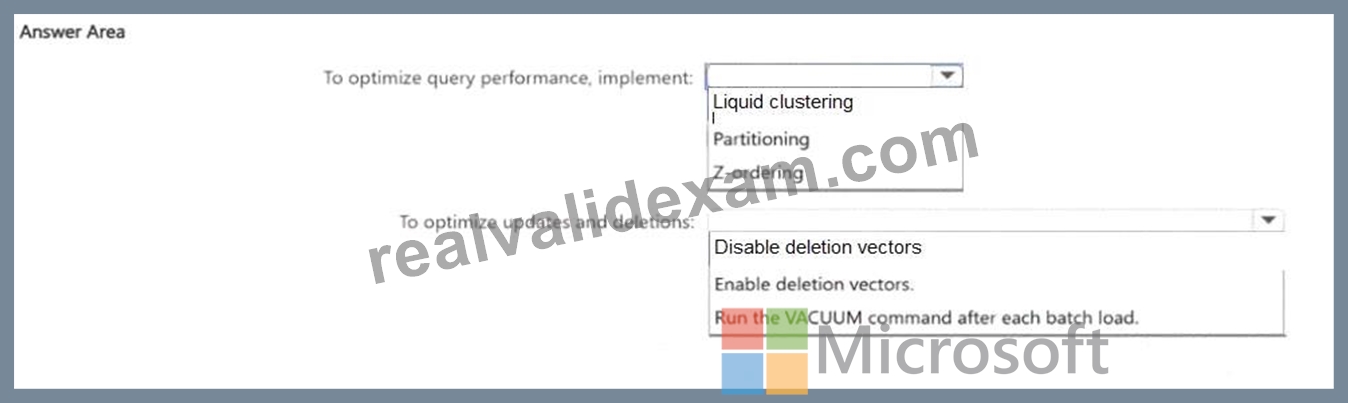
Answer:
Explanation: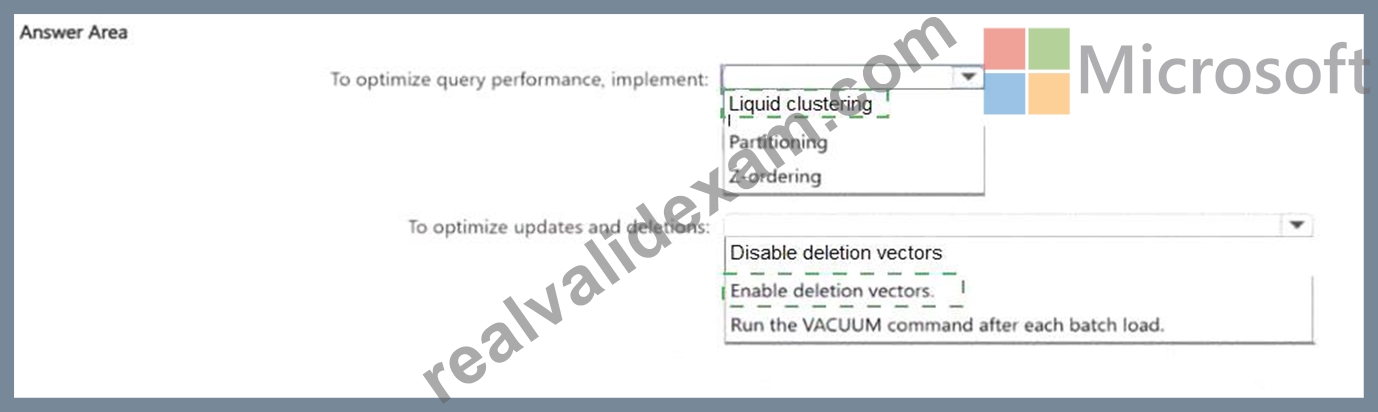
Explanation:
Two features work together to keep performance consistent and update costs low:
OPTIMIZE with ZORDER BY (CustomerId, EventDate). Z-Ordering co-locates rows with the same CustomerId and EventDate values in the same Parquet files. When a query filters on those columns, the Delta engine uses file statistics to skip files that can't possibly contain matching rows (data skipping). As the table grows, skipping scales proportionally - query time stays consistent.
Deletion Vectors (delta.enableDeletionVectors = true). When a row is updated or deleted, instead of rewriting the entire Parquet file, Delta marks the affected row in a small companion deletion vector file. This dramatically reduces write amplification for the frequent compliance-driven updates and deletions the question describes. Actual file rewrites are deferred to the next OPTIMIZE run.
Reference: https://learn.microsoft.com/en-us/azure/databricks/delta/data-skipping
NEW QUESTION # 54
You have an Azure Databricks workspace
You are creating a Lakeflow Spark Declarative Pipelines (SDP) pipeline that scales automatically. You need to configure compute for the pipeline. The solution must minimize operational costs and effort. What should you use?
- A. a single-node, all-purpose cluster
- B. a job cluster that uses autoscaling
- C. the existing SQL warehouse
- D. an all-purpose cluster that uses autoscaling
Answer: B
Explanation:
The correct answer is C - a job cluster that uses autoscaling.
Job clusters (also called pipeline clusters in the SDP context) are created exclusively for a pipeline run and terminated when the pipeline stops. You pay only for what the pipeline uses, and there's no idle cost between runs. Autoscaling on a job cluster lets the pipeline expand during heavy processing and contract during lighter stages - the combination of on-demand lifecycle and elastic scaling gives the lowest operational cost.
Option A (all-purpose cluster) runs at a higher DBU rate and persists beyond the pipeline's lifecycle, meaning you're paying for it even when the pipeline isn't running. Option B (SQL warehouse) is optimised for interactive BI and ad-hoc queries, not for the batch/streaming workloads SDP pipelines run. Option D (single- node all-purpose) has no scaling, runs at the all-purpose DBU rate, and is capped at one node - unsuitable for any production pipeline.
Reference: https://learn.microsoft.com/en-us/azure/databricks/delta-live-tables/configure-pipeline
NEW QUESTION # 55
You have an Azure Databricks workspace.
You have an Apache Spark Structured Streaming job named Job1 that processes data continuously and fails periodically due to transient errors.
You need to ensure that Job1 meets the following requirements:
- Resumes processing from the point that Job1 failed
- Minimizes how long it takes to restart Job1
- Minimizes the costs to restart Job1
What should you do?
- A. Decrease the retry interval.
- B. Increase the minimum number of nodes in the cluster.
- C. Add an alert and manually restart Job1.
- D. Implement checkpointing.
Answer: D
Explanation:
You must use checkpointing.
Checkpointing is the native Apache Spark mechanism designed specifically to handle failures in Structured Streaming jobs. It saves the exact execution state and progress to cloud storage (like Azure Data Lake Storage), allowing the job to resume precisely where it left off without data loss.
Resumes from Failure Point: The checkpoint directory stores the stream offsets. When restarted, Spark reads these offsets to pick up exactly where it failed.
Minimizes Restart Time: By saving the state, Spark does not need to recompute historical streaming data or re-evaluate the entire stream architecture from scratch.
Minimizes Restart Costs: It prevents the reprocessing of duplicate data, saving valuable cluster compute time and reducing cloud infrastructure costs.
Reference:
https://www.linkedin.com/posts/shilpa-das-ln_what-is-checkpointing-in-spark-checkpointing- activity-7297113790393815041-AhPg
NEW QUESTION # 56
You have an Azure Databricks workspace that is enabled for Unity Catalog.
You need to create an external volume named Volume1 in an existing schema. Volume1 must expose files from an Azure Storage container. The solution must meet the following requirements:
* Ensure that authentication does NOT require storing credentials in Databricks
* Ensure that users can access the files, but NOT modify the files.
* Follow the principle of least privilege
Which type of authentication should you configure, and which permission should you grant to the users? To answer, select the appropriate options in the answer area.
NOTE: Each correct selection is worth one point.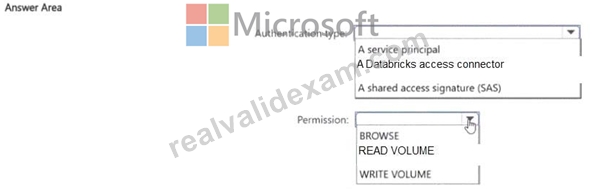
Answer:
Explanation: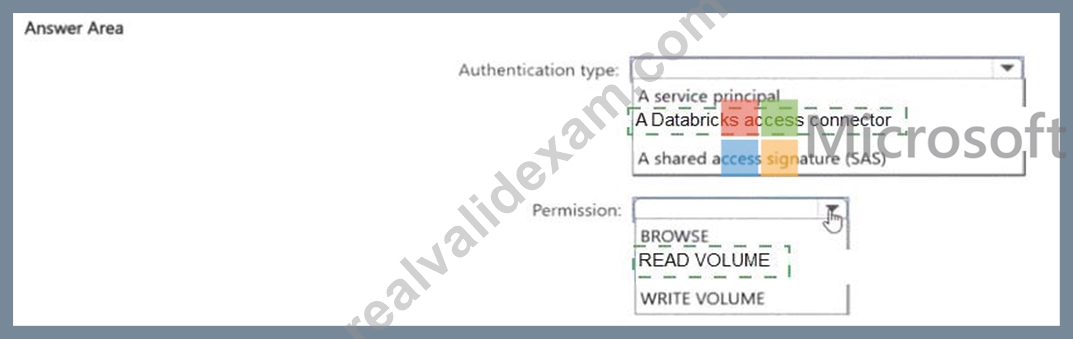
Explanation:
For authentication, a Managed Identity (via a Databricks Access Connector) is the right choice. The Access Connector wraps an Azure-managed identity so Databricks can authenticate to Azure Storage without any credentials being stored in the workspace. The cloud security team controls the identity through Azure RBAC
- there are no secrets to rotate or leak inside Databricks.
For the permission, READ FILES on the volume is exactly right. It allows users to read and list files through the volume path while blocking writes, deletes, and modifications. This is the minimum necessary access, honouring the principle of least privilege.
WRITE FILES would allow modifications, contradicting 'users can access but NOT modify.' ALL PRIVILEGES grants far more than needed. Service principals with stored client secrets would mean credentials inside Databricks, violating the 'does not require storing credentials' requirement.
Reference: https://learn.microsoft.com/en-us/azure/databricks/connect/unity-catalog/volumes
NEW QUESTION # 57
You need to deploy Declarative Automation Bundles to a development environment. The solution must support automated and repeatable deployments across environments.
What should you use?
- A. the Jobs UI
- B. the Databricks CLI
- C. Git folders
- D. the Databricks SDK for Python
Answer: B
Explanation:
The Databricks CLI contains the bundle command group for validating, deploying, and running Declarative Automation Bundles. CLI commands can be executed consistently from developer terminals or CI/CD pipelines, making deployments automated, repeatable, and suitable for multiple target environments. The Databricks SDK for Python can manage workspace APIs programmatically, but it is not the standard bundle deployment interface required here. Git folders provide source-control integration inside the workspace but do not deploy bundle-defined resources. The Jobs UI supports interactive creation and management of jobs, which introduces manual steps and does not provide the same infrastructure-as-code workflow. Using commands such as databricks bundle validate and databricks bundle deploy -t dev directly satisfies the automated development deployment requirement. Microsoft Learn
NEW QUESTION # 58
Note: This section contains one or more sets of questions with the same scenario and problem. Each question presents a unique solution to the problem. You must determine whether the solution meets the stated goals. More than one solution in the set might solve the problem. It is also possible that none of the solutions in the set solve the problem.
After you answer a question in this section, you will NOT be able to return. As a result, these questions do not appear on the Review Screen.
You have an Azure Databricks workspace named Workspace1 that contains a lakehouse and is enabled for Unity Catalog.
You have a connection to a Microsoft SQL Server database named DB1.
You need to expose the schemas and tables of DB1 to meet the following requirements:
- The schemas and tables can be queried in Databricks.
- The schemas and tables appear alongside other Unity Catalog objects.
- The data is NOT copied into Databricks-managed storage.
Solution: You create a Lakeflow Connect pipeline and connect it to DB1.
Does this meet the goal?
- A. No
- B. Yes
Answer: A
Explanation:
Correct:
* You create a foreign catalog in Catalog Explorer.
You should create a Foreign Catalog using Lakehouse Federation.
Data Copying: Lakehouse Federation queries data directly in the source SQL Server without moving or copying it.
Seamless Integration: The database schemas and tables appear right inside Unity Catalog alongside your other data objects.Real-time Access: It provides immediate access to live SQL Server data.
Incorrect:
* You create a Databricks access connector.
* You create a Lakeflow Connect pipeline and connect it to DB1.
Data Copying: Lakeflow Connect is an ingestion tool that physically replicates and copies data into Databricks-managed storage (Delta tables).
Storage Costs: It violates your requirement to keep data out of Databricks storage.
* You create a new native catalog in Unity Catalog.
Note:
To expose the external SQL Server database in Unity Catalog without copying the data, you must use Lakehouse Federation.
Here are the step-by-step actions you need to take:
1. Create a Connection
Create a securable object in Unity Catalog that specifies the path and credentials to access the SQL Server database.
Go to Catalog Explorer or use SQL.
Select External Data > Connections.
Create a connection using the SQL Server connection details (URL, host, port, and database credentials).
*-> 2. Create a Foreign Catalog
Create a specific type of catalog in Unity Catalog that mirrors the external database.
Use the CREATE FOREIGN CATALOG SQL command or the Catalog Explorer UI.
Link this foreign catalog directly to the connection you created in step 1.
3. Query the DataOnce the foreign catalog is created, Unity Catalog automatically syncs the schemas and tables from SQL Server.
Reference:
https://docs.databricks.com/gcp/en/database-objects/
NEW QUESTION # 59
What happens if incoming data violates Delta table schema?
- A. Table is overwritten
- B. Data is automatically cast
- C. Data is rejected
- D. Data is appended with nulls
Answer: C
Explanation:
Delta Lake enforces schema by default. If incoming data does not match schema, the write operation fails unless schema evolution is explicitly enabled. It does not auto-cast or append invalid data. Overwriting would require explicit command.
NEW QUESTION # 60
You have an Azure Databricks workspace that is enabled for Unity Catalog.
You need to implement a data lifecycle and expiration solution that meets the following requirements
* Transaction logs and deleted data files that are older than 90 days must be removed from Delta tables to reclaim storage.
* All the tables must remain available for querying during the cleanup process.
* Administrative effort must be minimized
What should you do for each requirement? To answer, select the appropriate options in the answer area.
NOTE: Each correct selection is worth one point.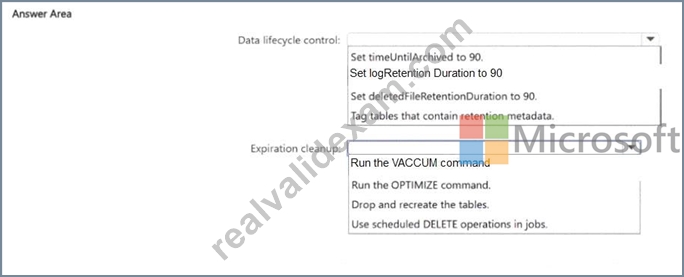
Answer:
Explanation: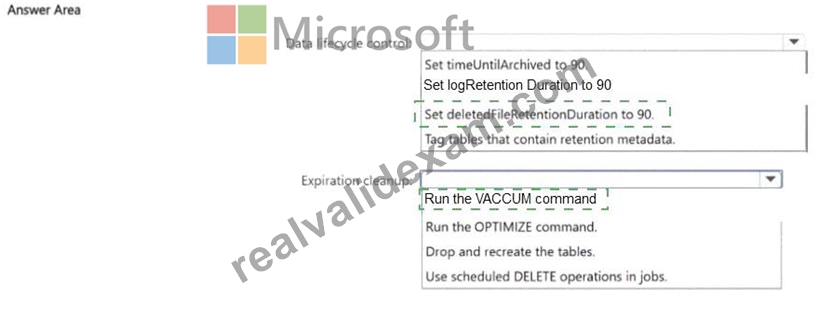
Explanation:
Two actions are needed to reclaim storage while keeping tables queryable:
Set delta.deletedFileRetentionDuration and delta.logRetentionDuration to 90 days on each table. These properties define the retention floor - VACUUM will not touch anything newer than this threshold, so no data needed for time travel within 90 days can be accidentally removed.
Run VACUUM on each table. VACUUM is the Delta Lake command that physically removes data files and transaction log entries older than the retention duration. Importantly, VACUUM runs as a background operation - it uses Delta Lake's MVCC (multi-version concurrency control) to ensure that concurrent reads against the table continue uninterrupted while cleanup happens. Tables are fully available throughout.
OPTIMIZE compacts small files for query performance but doesn't delete anything. Manually deleting files outside the Delta protocol would corrupt the table.
Reference: https://learn.microsoft.com/en-us/azure/databricks/sql/language-manual/delta-vacuum
NEW QUESTION # 61
Note: This section contains one or more sets of questions with the same scenario and problem. Each question presents a unique solution to the problem. You must determine whether the solution meets the stated goals. More than one solution in the set might solve the problem. It is also possible that none of the solutions in the set solve the problem.
After you answer a question in this section, you will NOT be able to return. As a result, these questions do not appear on the Review Screen.
You have an Azure Databricks workspace that is enabled for Unity Catalog and contains a Delta table named Orders.
You load the Orders table into an Apache Spark DataFrame named df.
You need to create a DataFrame that excludes rows where the order amount is null.
Solution: You run the following expression.
df.filter(df.order_amount.isNotNull())
Does this meet the goal?
- A. No
- B. Yes
Answer: B
Explanation:
Correct:
* You run the following expression.
df.dropna(subset=["order_amount"])
The expression df.dropna(subset=["order_amount"]) is an appropriate and effective way to exclude rows where order_amount is null.
* You run the following expression.
df.filter(df.order_amount.isNotNull())
To exclude rows where the order amount is null, you can use the isNotNull() method or a SQL expression within the filter() or where() functions.Here are the standard, appropriate expressions:
Option 1: Python/PySpark API (Recommended)
pythondf_clean = df.filter(df["order_amount"].isNotNull())
Incorrect:
* You run the following expression.
df.fillna(0, subset=['order_amount'])
* You run the following expression.
df.filter(df.order_amount != None)
Reference:
https://www.geeksforgeeks.org/python/filter-pyspark-dataframe-columns-with-none-or-null-values/
https://learn.microsoft.com/en-us/azure/databricks/pyspark/reference/classes/dataframe/dropna
NEW QUESTION # 62
Which feature provides end-to-end tracking of data movement in Databricks?
- A. Unity Catalog lineage
- B. Query history only
- C. Cluster metrics
- D. Spark logs
Answer: A
Explanation:
Unity Catalog provides data lineage tracking across ingestion, transformation, and consumption layers. It helps visualize dependencies and compliance auditing. Spark logs are low-level and not structured for lineage. Query history is partial only.
NEW QUESTION # 63
Hotspot Question
You have an Azure Databricks workspace that is enabled for Unity Catalog and contains a managed Delta table named Table1.
Table1 is written by batch jobs every hour and is queried frequently by filtering two columns named Customerid and EventDate.
You expect Table1 to grow significantly over time.
The rows in Table1 are frequently updated and deleted to support compliance requests.
You need to keep query performance consistent as Table1 grows. The solution must minimize update and deletion effort.
What should you include in the solution? To answer, select the appropriate options in the answer area.
NOTE: Each correct selection is worth one point.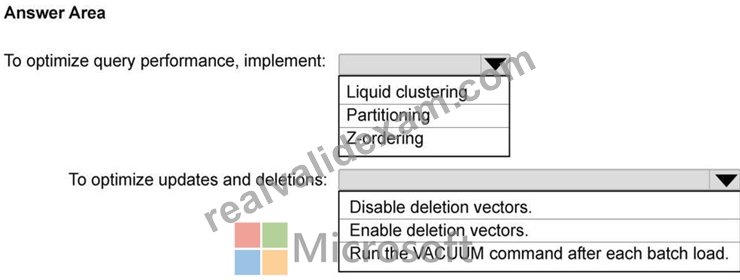
Answer:
Explanation: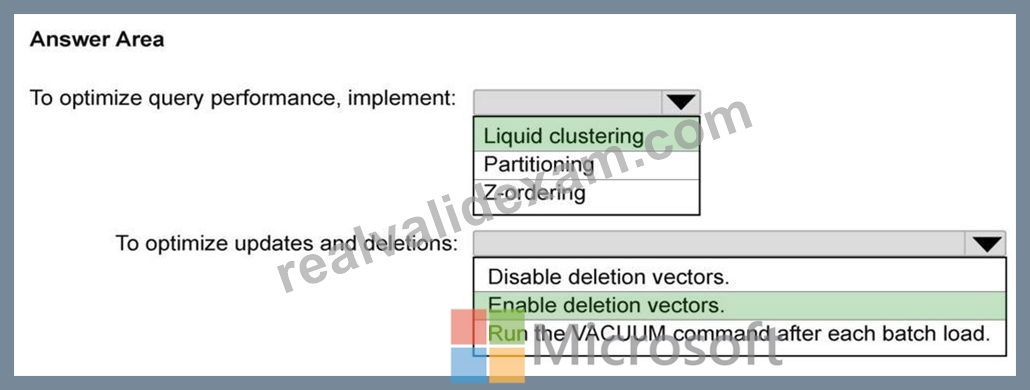
NEW QUESTION # 64
Which layer contains cleaned and conformed data in Databricks Lakehouse architecture?
- A. Bronze
- B. Silver
- C. Raw
- D. Gold
Answer: B
Explanation:
Silver layer contains cleaned, validated, and enriched data ready for analytics. Bronze stores raw ingested data. Gold contains aggregated business-level data. Raw is not part of formal medallion architecture naming.
NEW QUESTION # 65
You have an Azure Databricks workspace.
You are creating a Lakeflow Spark Declarative Pipelines (SDP) pipeline that scales automatically.
You need to configure compute for the pipeline. The solution must minimize operational costs and effort.
What should you use?
- A. a single-node, all-purpose cluster
- B. a job cluster that uses autoscaling
- C. the existing SQL warehouse
- D. an all-purpose cluster that uses autoscaling
Answer: B
Explanation:
The best option for a Lakeflow Spark Declarative Pipelines (SDP) pipeline that scales automatically while keeping costs and administrative effort low is a job cluster that uses autoscaling.
Lowest Costs: Job clusters (also called automated compute) are billed at a significantly lower Data Processing Unit (DBU) rate compared to all-purpose clusters. By enabling autoscaling, Databricks dynamically allocates or removes worker nodes based on real-time pipeline demand, ensuring you never pay for unutilized resources.
Low Administrative Effort: While Databricks generally recommends Serverless compute as the absolute ideal for zero-admin pipelines, when selecting from classic compute options, a job cluster automatically handles its own lifecycle. It deploys when the pipeline starts executing and terminates automatically when processing is finished.
Incorrect:
[Not A]
Databricks SQL warehouses are designed to run standalone materialized views and streaming tables via standard SQL. They are not the native compute vehicle for running a fully automated, dedicated Lakeflow Spark Declarative Pipelines (SDP) deployment framework.
[Not B]
All-purpose compute is meant for interactive development, debugging, and ad-hoc analysis. It is billed at a much higher DBU rate, which violates the requirement to keep costs low.
[Not D]
Aside from the higher billing rate of all-purpose compute, a single-node configuration does not scale horizontally. This directly conflicts with your requirement to build a pipeline that scales automatically.
Reference:
https://docs.databricks.com/gcp/en/ldp/auto-scaling
NEW QUESTION # 66
You have an Azure Databricks job named Job1 that contains an ingestion task named Task1 and transformation task named Task2. You need to ensure that if Task1 fails, the task retries automatically, and Task2 is prevented from running How should you configure Job1? To answer, select the appropriate options in the answer area.
NOTE: Each correct selection is worth one point.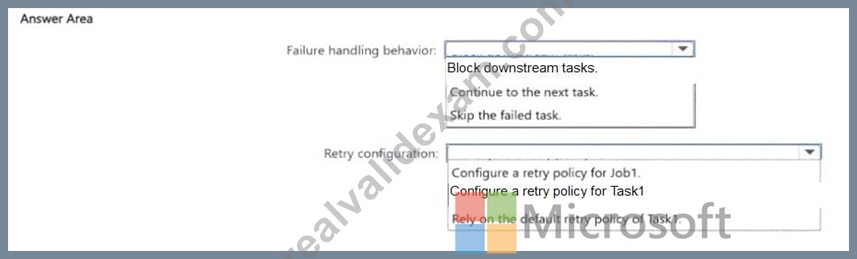
Answer:
Explanation: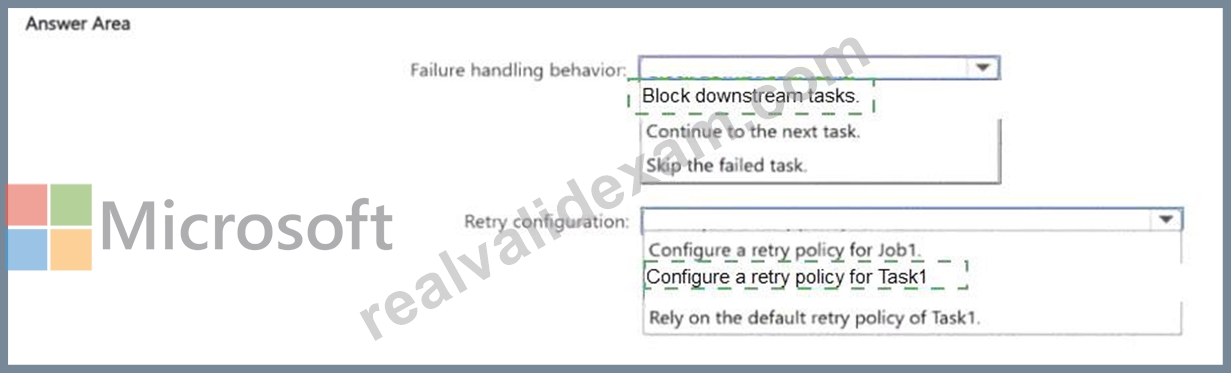
Explanation:
Two task-level settings solve this:
Task1 retry policy: configure Task1 with a maximum number of retries and a retry interval. When Task1 fails, Lakeflow Jobs automatically re-runs it up to the retry limit without any manual intervention. This handles transient infrastructure failures transparently.
Task2 run condition set to ' All succeeded ' with Task1 as its dependency: this means Task2 only starts when Task1 has succeeded. If Task1 fails and exhausts all retries, Task2 remains blocked - it never runs on data from a failed upstream ingestion. The dependency is declared in Task2 ' s ' Depends on ' setting in the job configuration.
These two settings are independent and composable. Task1 ' s retry policy gives it multiple chances to recover. Task2 ' s dependency and run condition ensure the downstream transformation only runs on clean, successfully ingested data.
Reference: https://learn.microsoft.com/en-us/azure/databricks/jobs/configure-jobs#task-retries
NEW QUESTION # 67
Which Azure service is best integrated with Databricks Unity Catalog for centralized data governance?
- A. Azure DevTest Labs
- B. Microsoft Purview
- C. Azure Key Vault
- D. Azure Automation
Answer: B
Explanation:
Microsoft Purview integrates with Unity Catalog to provide centralized data governance, classification, and lineage tracking. It helps organizations manage data compliance and discovery. Key Vault handles secrets, not governance. DevTest Labs is for testing environments.
Azure Automation is for workflow automation.
NEW QUESTION # 68
You have an Azure Databricks workspace that is enabled for Unity Catalog and contains two Delta tables named Table1 and Table2 of the same data type.
Table1 contains a column named Columnl. Table2 contains a column named Column2. You run the following query.
SELECT Column1
FROM Table1
GROUP BY Column1
HAVING COUNT(") > 1
INTERSECT
SELECT C0lumn2
FROM Table2
GROUP BY Column2
HAVING COUNT(') > 1;
What occurs when you run the query?
- A. Values appear in Table more than once.
- B. Values appear in both tables more than once.
- C. Values appear in Table2 but NOT Table1.
- D. Values appear in either table more than once.
Answer: B
Explanation:
The correct answer is B - values appear in both tables more than once.
Reading the query from the inside out: each subquery identifies values that appear more than once within their own table. The first subquery returns Column1 values that are duplicated in Table1. The second returns Column2 values that are duplicated in Table2. INTERSECT then returns only the values that appear in both result sets - meaning values that are duplicated in Table1 AND also duplicated in Table2.
Option A describes a UNION result (values in either table), not INTERSECT. Option C only considers duplicates in Table1, ignoring the Table2 condition - that would be the first subquery in isolation. Option D describes values exclusive to Table2 (EXCEPT or MINUS), the opposite of INTERSECT's requirement that values appear in both sets.
INTERSECT always requires membership in both operands - that's its fundamental definition in standard SQL.
Reference: https://learn.microsoft.com/en-us/azure/databricks/sql/language-manual/sql-ref-syntax-qry-select- setops
NEW QUESTION # 69
You have an Azure Databricks workspace that is enabled for Unity Catalog and contains a catalog named Catalog 1. Catalog 1 contains a table named Transactions. Transactions contains the following columns:
* transaction_id
* customet_name
* email address
* credit_card_number
* transaction_amount
You need to ensure that business analysts can query all the tows in the Transactions table. The solution must meet the following requirements:
* Prevent the analysts from seeing the full values in the email_address and credit_catd_number columns.
* Ensure that the analysts can see only the values after the @ character in each email address.
* Ensure that the analysts can see only the last four digits of each credit card number.
* Enable the analysts to query the table without errors.
* Follow the principle of least privilege.
What should you do?
- A. Grant the analysts the select permission for the Transactions table and apply column masks to email_address and credit_card_number
- B. Grant the analysts the select permission for columns that do NOT contain sensitive data.
- C. Grant the analysts the SELECT permission for the Transactions table and implement row-level filters.
- D. Grant the analysts the select permission for the Transactions table and apply column-level encryption
Answer: A
Explanation:
The correct answer is C. Column masks are the right tool when you need to partially expose sensitive data rather than hide it entirely. A column mask is a SQL function attached to a column that rewrites the returned value based on who is querying. For email_address, the mask returns only the substring after '@'. For credit_card_number, it returns only the last four digits. Business analysts get useful data without seeing anything sensitive, and they can still query the table without errors.
Option A (row-level filters) controls which rows a user sees, not the values within a row - it can't partially redact a column. Option B (grant SELECT only on non-sensitive columns) removes the columns entirely, so analysts can't see even partial email or card values - that doesn't meet the 'can see only partial values' requirement. Option D (column-level encryption) requires key management infrastructure and decryption at query time, which is significantly more complex than column masking for this use case.
Reference: https://learn.microsoft.com/en-us/azure/databricks/data-governance/unity-catalog/row-and-column- filters
NEW QUESTION # 70
You have an Azure Databricks workspace that is enabled for Unity Catalog.
You have a complex job named Job1 that contains eight tasks. Job1 takes multiple hours to complete.
During the last job run, the final task fails due to a transient issue.
You need to retry the last task without rerunning tasks that have already completed.
What should you do?
- A. Disable and reenable the job schedule.
- B. Update the job parameters.
- C. Repair the current job run.
- D. Restart Job1.
Answer: C
Explanation:
You can retry only the failed final task by using the Repair Run feature in Azure Databricks. This allows you to rerun failed or skipped tasks without restarting the successful ones, preserving your Unity Catalog data lineage and saving hours of compute time.
Reference:
https://www.databricks.com/blog/2022/05/06/save-time-and-money-on-data-and-ml-workflows- with-repair-and-rerun.html
NEW QUESTION # 71
You have an Azure Databricks workspace named Workspace1 that uses a Git repository. The repository contains a Databricks notebook named Notebook1.
From the main branch, you create a feature branch named Branch1 and commit changes to Notebook1. Another user commits changes to Notebook1 in main.
When you attempt to merge Branch1 into main, the merge fails due to conflicts.
You need to merge Branch1 into the main branch. The solution must ensure that Notebook1 includes all the changes from both the branches.
What should you do?
- A. Apply the changes directly to the main branch.
- B. Apply the main branch changes to Branch1 and resolve the conflicts.
- C. From Workspace1, clone the main branch as a new repository.
- D. From Workspace1, clone Branch1 as a new repository.
Answer: B
Explanation:
To resolve the merge conflict and keep all changes from both branches, you must pull the updated main branch into your feature branch, resolve the conflicts manually within Databricks or a local Git tool, and then merge.
Reference:
https://devactivity.com/insights/streamlining-your-git-workflow-resolving-branch-behind-main- issues-in-your-git-repo/
NEW QUESTION # 72
You have an Azure Databricks workspace that contains a Delta table named Table1.
Table1 has accumulated obsolete files.
You need to reduce storage costs. The solution must preserve 30 days of time travel history.
Which two actions should you perform? Each correct answer presents part of the solution.
NOTE: Each correct selection is worth one point.
- A. Set the delta.logRetentionDuration table property to 30 days.
- B. Run the vacuum command on Table1.
- C. Run the OPTIMIZE command on Table1.
- D. Reduce the deleted file retention period to one day.
- E. Set the delta.deletedFileRetentionDuration table property to 30 days.
Answer: B,E
Explanation:
To diminish storage costs while preserving 60 days of time travel history, you must perform the following two actions: Set the delta.deletedFileRetentionDuration table property to 60 days and Run the vacuum command on the table.
Set the delta.deletedFileRetentionDuration table property to 30 days
This property controls how long data files must be deleted before they become eligible for removal by a cleanup process. By default, it is set to 7 days. Increasing it to 60 days ensures that Delta Lake preserves the underlying parquet files required to query any historical snapshot within your 30-day time travel window.
Run the vacuum command on the tableChanging the retention property alone does not delete files or reduce costs. You must explicitly execute the VACUUM command. The command scans the table and permanently deletes uncommitted or deleted data files that are older than the 60- day threshold defined by your retention duration, thereby freeing up storage space.
Incorrect:
[Not C]
Set the delta.logRetentionDuration table property to 30 days
This property controls how long the transaction log (_delta_log) history is kept, which defaults to
30 days. While the transaction log is required for time travel, modifying this property alone does not delete the heavy data files causing high storage costs. Furthermore, it governs the logs rather than the actual deleted data files.
Reference:
https://www.cloudmatter.io/post/data-audit-with-databricks-delta-time-travel
NEW QUESTION # 73
Case Study 1 - Contoso, Inc.
Overview
Company Information
Contoso, Inc. is a renewable energy provider that operates solar and wind farms across North America.
Existing Environment
Azure Environment
Contoso has a single Azure Databricks workspace named Workspace1 in the West US Azure region. Workspace1 is enabled for Unity Catalog.
Workspace1 contains all-purpose clusters for both development and production workloads.
The company's Azure environment contains:
- In the West US, Central US, and East US Azure regions, Azure event hubs that stream telemetry data and an Azure Data Lake Storage Gen2 account in each region for each hub
- A single Azure SQL database in the West US region that hosts enterprise resource planning (ERP) data
- An Azure Database for PostgreSQL server in the West US region that stores operational maintenance data Data Environment Contoso ingests the following operational and business data:
- Telemetry data: More than 40,000 IoT sensors across 28 sites emit JSON telemetry events every few seconds. Each site sends the events to the nearest event hub, which writes the data into the corresponding Data Lake Storage Gen2 account. These files frequently experience schema drift.
- Maintenance logs: Maintenance systems generate historical repair logs, daily incremental updates, technician notes, and unstructured attachments that are stored in the Data Lake Storage Gen2 accounts.
- Operational maintenance data: Structured operational maintenance data is stored on the Azure Database for PostgreSQL server.
- External weather data: Hourly weather forecasts are retrieved from a REST API and written to the Data Lake Storage Gen2 accounts.
- ERP data: Daily CSV extracts of 50 to 100 GB contain equipment metadata, work orders, and purchase order information.
Problem Statements
The company's existing analytics environment has several issues:
Ingestion
- Telemetry pipelines fall behind during peak loads.
- Telemetry ingestion fails when schema drift occurs.
- Streaming pipelines reprocess events after a pipeline restarts.
Compute
Production and development workloads run on the same all-purpose clusters.
Production and development workloads do NOT support autoscaling or workload isolation.
Governance
- The ERP data is duplicated across systems and development teams.
- Naming conventions are inconsistent across development teams, regions, and products.
- Ownership of the IoT sensors changes over time, and analysts must track the full history of the ownership.
- Occasionally, equipment manufacturers must correct data-entry mistakes in equipment names.
Historical values are NOT required.
Pipeline operations
- Pipelines lack resiliency, alerting, and centralized scheduling.
Requirements
Planned Changes
Contoso plans to implement the following changes:
- Implement scalable data pipeline orchestration.
- Create a managed analytics catalog in Unity Catalog.
- Implement a consistent approach to creating curated datasets.
- Establish a centralized governance model across ingestion, cleansed, and curated layers.
- Grant data engineers access to the ERP tables by using minimal development effort.
- Adopt a compute strategy that isolates production workloads and supports autoscaling.
- Adopt a slowly changing dimension (SCD) approach to address current data modeling issues.
Technical Requirements
Contoso identifies the following environment and compute requirements:
- Ensure that production ingestion workloads run on compute clusters that can scale automatically during telemetry spikes.
- Provide fast and consistent performance for business intelligence (BI) workloads.
- Prevent development activity from affecting production pipelines.
- Production ingestion workloads must run as scheduled, non-interactive pipelines rather than on shared interactive development clusters.
Contoso identifies the following data ingestion and processing requirements:
- Auto-scale ingestion pipelines to handle bursty workloads.
- Handle schema drift for the maintenance and telemetry data.
- Ingest file-based telemetry data by using minimal operational effort.
- Store all the ingested data in a format that supports incremental processing.
- Support the continuous ingestion of telemetry data from the event hubs by using exactly-once semantics.
- Support the ingestion of the structured maintenance data from the Azure Database for PostgreSQL server.
- Build a new telemetry pipeline that ingests raw events from the event hubs, cleanses the data, and publishes curated tables to Unity Catalog.
- Ensure that the Apache Spark Structured Streaming pipelines reading from the event hubs write the data into a managed Delta table named telemetry.raw_events. The pipelines must support schema drift and resume processing after failures without reprocessing the data.
Contoso identifies the following data modeling and optimization requirements:
- Build curated tables that standardize business logic.
- Overwrite equipment metadata attributes, such as name, manufacturer, model, and commissioning date, when the attributes change. Historical values are NOT required.
Contoso identifies the following pipeline deployment and operation requirements:
- Orchestrate multi-step ingestion and transformation workflows.
- Define a clear execution order and dependencies.
- Automatically retry failed steps and notify operators.
- Schedule ingestion and transformation workloads consistently.
Governance Requirements
Contoso identifies the following governance requirements:
- Centralize the metadata catalog.
- Provide isolated development areas that follow standard naming conventions.
- Establish a consistent structure for organizing raw, cleansed, and curated data.
- Provide a read-only mechanism to reference the ERP data through a foreign catalog.
Business Requirements
Contoso identifies the following business requirements:
- Improve ingestion reliability and reduce operational effort.
- Standardize data definitions across development teams.
Hotspot Question
You need to complete the PySpark code for the Spark Structured Streaming pipelines. The solution must meet the data ingestion and processing requirements.
How should you complete the code segment? To answer, select the appropriate options in the answer area.
NOTE: Each correct selection is worth one point.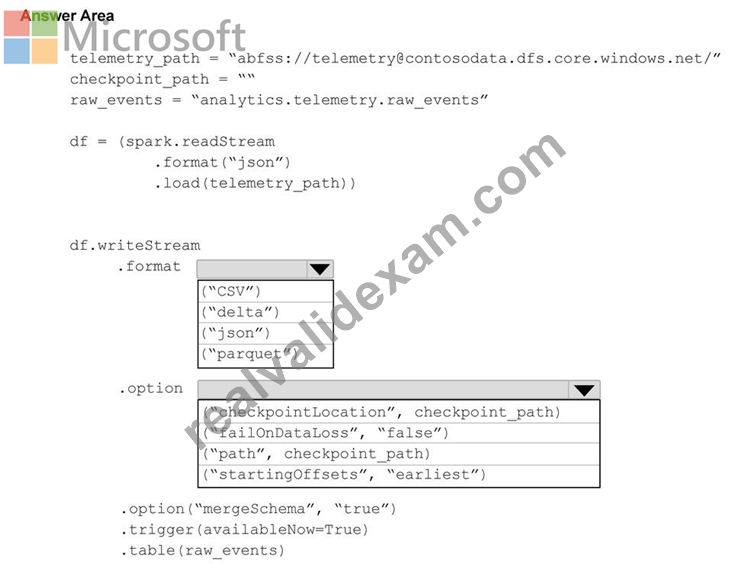
Answer:
Explanation: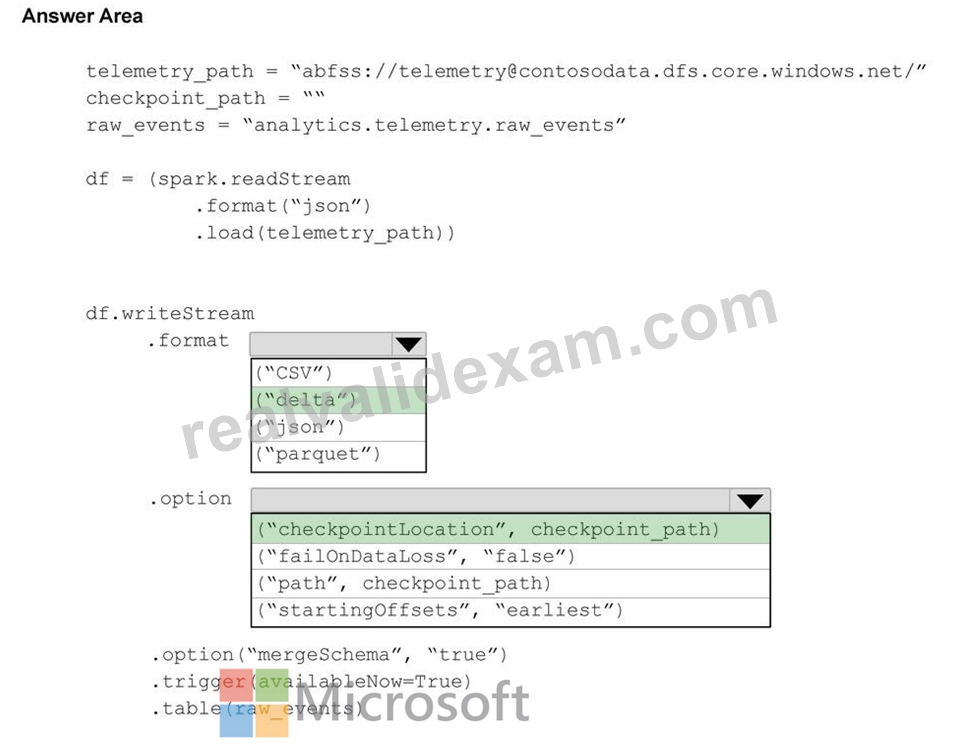
NEW QUESTION # 74
......
Dumps of DP-750 Cover all the requirements of the Real Exam: https://www.realvalidexam.com/DP-750-real-exam-dumps.html
