
[Aug-2026] Download Real PCNSE Exam Dumps for candidates. 100% Free Dump Files
Prepare Important Exam with PCNSE Exam Dumps(2026)
NEW QUESTION # 91
A firewall administrator has been tasked with ensuring that all Panorama configuration is committed and pushed to the devices at the end of the day at a certain time. How can they achieve this?
- A. Use the Scheduled Config Export to schedule Commit to Panorama and also Push to Devices.
- B. Use the Scheduled Config Push to schedule Commit to Panorama and also Push to Devices.
- C. Use the Scheduled Config Push to schedule Push lo Devices and separately schedule an API call to commit all Panorama changes.
- D. Use the Scheduled Config Export to schedule Push to Devices and separately schedule an API call to commit all Panorama changes.
Answer: B
Explanation:
Explanation
https://docs.paloaltonetworks.com/panorama/10-2/panorama-admin/manage-firewalls/schedule-a-configuration-p Log in to the Panorama Web Interface. Create a scheduled configuration push. Select PanoramaScheduled Config Push and Add a new scheduled configuration push. You can also schedule a configuration push to managed firewalls when you push to devices (CommitPush to Devices).
NEW QUESTION # 92
Which virtual router feature determines if a specific destination IP address is reachable?
- A. Heartbeat Monitoring
- B. Ping-Path
- C. Failover
- D. Path Monitoring
Answer: D
Explanation:
Explanation/Reference:
Reference: https://www.paloaltonetworks.com/documentation/71/pan-os/pan-os/policy/pbf
NEW QUESTION # 93
An administrator has configured OSPF with Advanced Routing enabled on a Palo Alto Networks firewall running PAN-OS 10.2. After OSPF was configured, the administrator noticed that OSPF routes were not being learned.
Which two actions could an administrator take to troubleshoot this issue? (Choose two.)
- A. In the WebUI, view Runtime Stats in the logical router
- B. Look for configuration problems in Network > virtual router > OSPF
- C. In the WebUI, view the Runtime Stats in the virtual router
- D. Run the CLI command show advanced-routing ospf neighbor
Answer: A,D
Explanation:
A:
https://docs.paloaltonetworks.com/pan-os/10-1/pan-os-web-interface-help/network/network-virtual-routers/more D:
https://docs.paloaltonetworks.com/pan-os/10-2/pan-os-cli-quick-start/cli-cheat-sheets/cli-cheat-sheet-networking
NEW QUESTION # 94
How does an administrator schedule an Applications and Threats dynamic update while delaying installation of the update for a certain amount of time?
- A. Configure the option for "Threshold".
- B. Automatically "download only" and then install Applications and Threats later, after the administrator approves the update.
- C. Disable automatic updates during weekdays.
- D. Automatically "download and install" but with the "disable new applications" option used.
Answer: B
Explanation:
Explanation
NEW QUESTION # 95
Which profile generates a packet threat type found in threat logs?
- A. WildFire
- B. Antivirus
- C. Zone Protection
- D. Anti-Spyware
Answer: C
Explanation:
Explanation
"Threat/Content Type (subtype) Subtype of threat log." "packet-Packet-based attack protection triggered by a Zone Protection profile."
https://docs.paloaltonetworks.com/pan-os/10-2/pan-os-admin/monitoring/use-syslog-for-monitoring/syslog-field
https://docs.paloaltonetworks.com/pan-os/10-1/pan-os-admin/monitoring/use-syslog-for-monitoring/syslog-field packet-Packet-based attack protection triggered by a Zone Protection profile.
NEW QUESTION # 96
SD-WAN is designed to support which two network topology types? (Choose two.)
- A. hub-and-spoke
- B. point-to-point
- C. full-mesh
- D. ring
Answer: A,C
Explanation:
https://docs.paloaltonetworks.com/plugins/vm-series-and-panorama-plugins-release-notes/panorama-plugin-for-sd-wan/sd-wan-plugin-200/features-introduced-in-sd-wan-2-0.html
https://www.paloaltonetworks.nl/apps/pan/public/downloadResource?pagePath=/content/pan/en_US/resources/guides/pan-os-secure-sd-wan-deployment-guide
NEW QUESTION # 97
Place the steps in the WildFire process workflow in their correct order.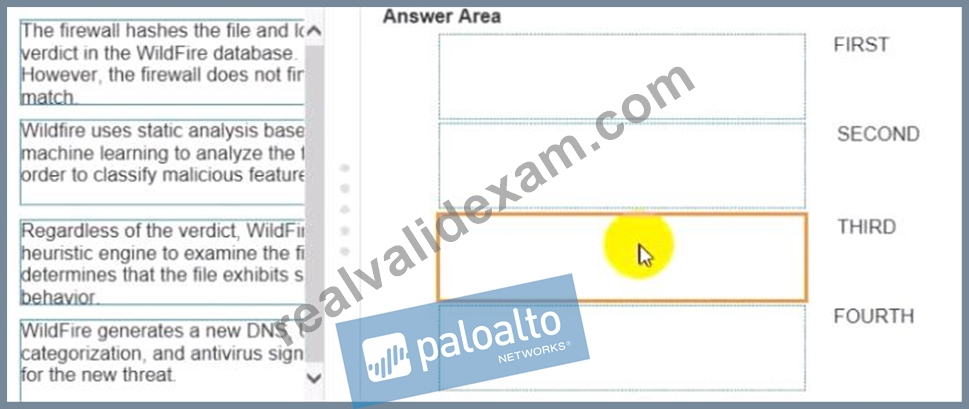
Answer:
Explanation: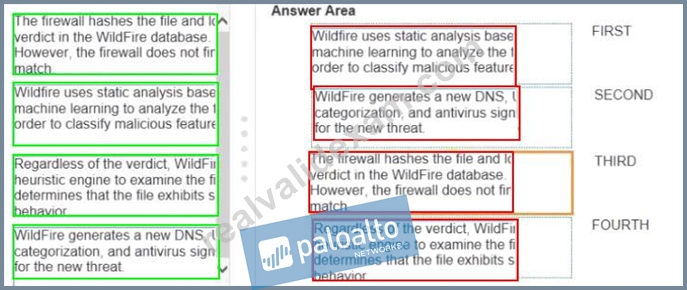
NEW QUESTION # 98
What type of address object would be useful for internal devices where the addressing structure assigns meaning to certain bits in the address, as illustrated in the diagram?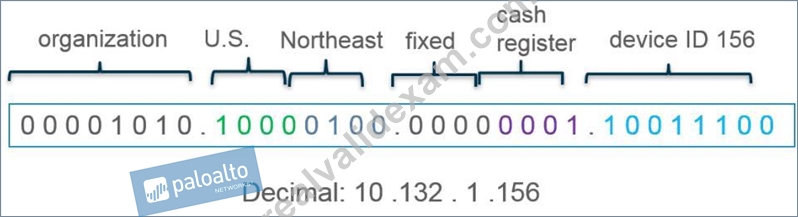
- A. IP Netmask
- B. IP Range
- C. IP Wildcard Mask
- D. IP Address
Answer: C
Explanation:
https://docs.paloaltonetworks.com/pan-os/10-2/pan-os-admin/policy/use-address-object-to-represent-ip- addresses/address-objects
NEW QUESTION # 99
A network administrator notices a false-positive state after enabling Security profiles. When the administrator checks the threat prevention logs, the related signature displays the following:
threat type: spyware category: dns-c2 threat ID: 1000011111
Which set of steps should the administrator take to configure an exception for this signature?
- A. Navigate to Objects > Security Profiles > Anti-SpywareSelect related profileSelect the Exceptions lab and then click show all signaturesSearch related threat ID and click enable Commit
- B. Navigate to Objects > Security Profiles > Vulnerability ProtectionSelect related profileSelect the Exceptions lab and then click show all signaturesSearch related threat ID and click enableCommit
- C. Navigate to Objects > Security Profiles > Anti-Spyware Select related profile Select DNS exceptions tabs Search related threat ID and click enable Commit
- D. Navigate to Objects > Security Profiles > Vulnerability Protection Select related profileSelect the signature exceptions tab and then click show all signatures Search related threat ID and click enable Change the default action Commit
Answer: C
Explanation:
When dealing with a false positive, particularly for a spyware threat detected through DNS queries (as indicated by the category "dns-c2"), the correct course of action involves creating an exception in the Anti- Spyware profile, not the Vulnerability Protection profile. This is because the Anti-Spyware profile in Palo Alto Networks firewalls is designed to detect and block spyware threats, which can include command and control (C2) activities often signaled by DNS queries.
The steps to configure an exception for this specific spyware signature (threat ID: 1000011111) are as follows:
* Navigate to Objects > Security Profiles > Anti-Spyware. This is where all the Anti-Spyware profiles are listed.
* Select the related Anti-Spyware profile that is currently applied to the security policy which is generating the false positive.
* Within the profile, go to the DNS Exceptions tab. This tab allows you to specify exceptions based on DNS signatures.
* Search for the related threat ID (in this case, 1000011111) and click enable to create an exception for it.
By doing this, you instruct the firewall to bypass the detection for this specific signature, effectively treating it as a false positive.
* Commit the changes to make the exception active.
By following these steps, the administrator can effectively address the false positive without disabling the overall spyware protection capabilities of the firewall.
NEW QUESTION # 100
Match each GlobalProtect component to the purpose of that component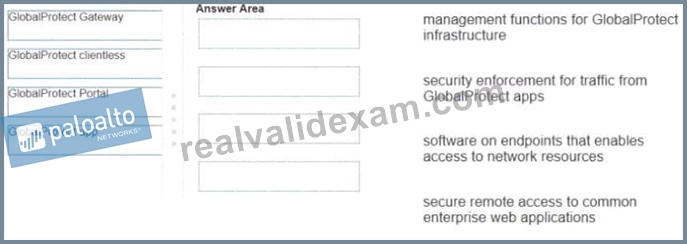
Answer:
Explanation: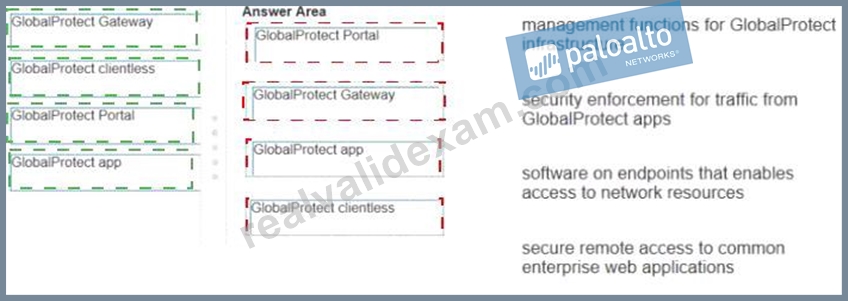
Explanation
The GlobalProtect portal provides the management functions for your GlobalProtect infrastructure The GlobalProtect gateways provide security enforcement for traffic from GlobalProtect apps The GlobalProtect app software runs on endpoints and enables access to your network resources
NEW QUESTION # 101
A web server is hosted in the DMZ, and the server is configured to listen for incoming connections only on TCP port 8080. A Security policy rule allowing access from the Trust zone to the DMZ zone need to be configured to enable we browsing access to the server.
Which application and service need to be configured to allow only cleartext web-browsing traffic to thins server on tcp/8080.
- A. application: web-browsing; service: (custom with destination TCP port 8080)
- B. application: web-browsing; service: service-https
- C. application: web-browsing; service: application-default
- D. application: ssl; service: any
Answer: A
NEW QUESTION # 102
Refer to the exhibit.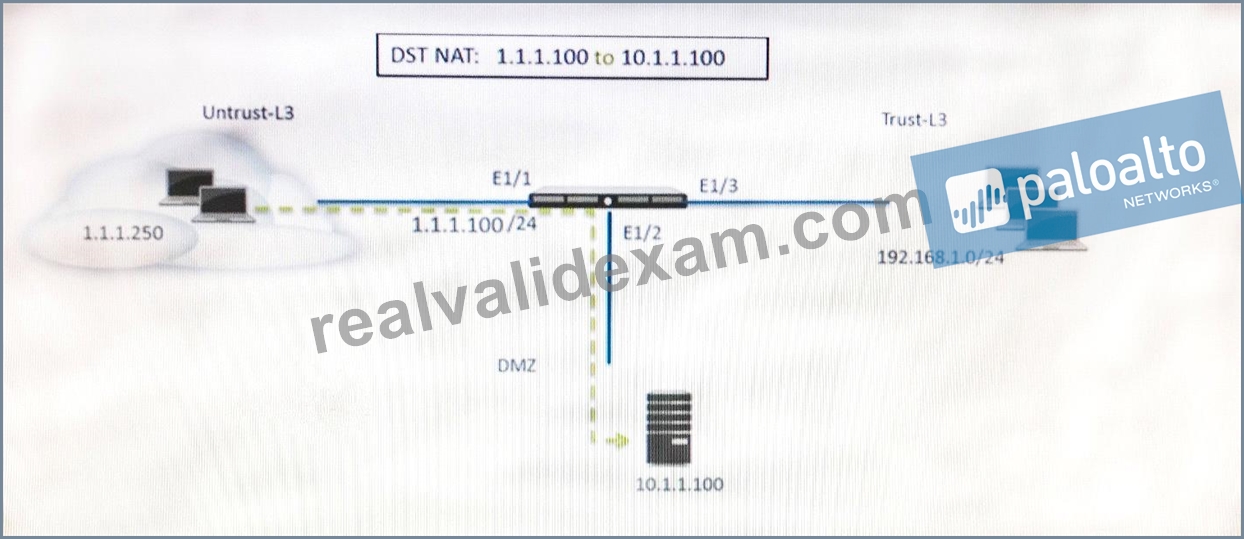
A web server in the DMZ is being mapped to a public address through DNAT.
Which Security policy rule will allow traffic to flow to the web server?
- A. Untrust (any) to Untrust (10. 1.1. 100), web browsing - Allow
- B. Untrust (any) to DMZ (1. 1. 1. 100), web browsing - Allow
- C. Untrust (any) to Untrust (1. 1. 1. 100), web browsing - Allow
- D. Untrust (any) to DMZ (10. 1. 1. 100), web browsing - Allow
Answer: B
Explanation:
https://docs.paloaltonetworks.com/pan-os/10-0/pan-os-admin/networking/nat/nat-policy-rules/nat-policy-overview.html
https://docs.paloaltonetworks.com/pan-os/8-0/pan-os-admin/networking/nat/nat-configuration-examples/destination-nat-exampleone-to-many-mapping
NEW QUESTION # 103
A Palo Alto Networks firewall is being targeted by an NTP Amplification attack and is being flooded with tens thousands of bogus UDP connections per second to a single destination IP address and post.
Which option when enabled with the correction threshold would mitigate this attack without dropping legitirnate traffic to other hosts insides the network?
- A. Zone Protection Policy with UDP Flood Protection
- B. Security Policy rule to deny trafic to the IP address and port that is under attack
- C. QoS Policy to throttle traffic below maximum limit
- D. Classified DoS Protection Policy using destination IP only with a Protect action
Answer: D
Explanation:
Step 1: Configure a DoS Protection profile for flood protection.
1. Select Objects > Security Profiles > DoS Protection and Add a profile Name.
2. Select Classified as the Type.
3. For Flood Protection, select the check boxes for all of the following types of flood protection:
* SYN Flood
* UDP Flood
* ICMP Flood
* ICMPv6 Flood
* Other IP Flood
Step 2: Configure a DoS Protection policy rule that specifies the criteria for matching the incoming traffic.
This step include: (Optional) For Destination Address, select Any or enter the IP address of the device you want to protect.
https://www.paloaltonetworks.com/documentation/61/pan-os/pan-os/policy/configure-dos- protection-against-flooding-of-new-sessions
NEW QUESTION # 104
Refer to the exhibit.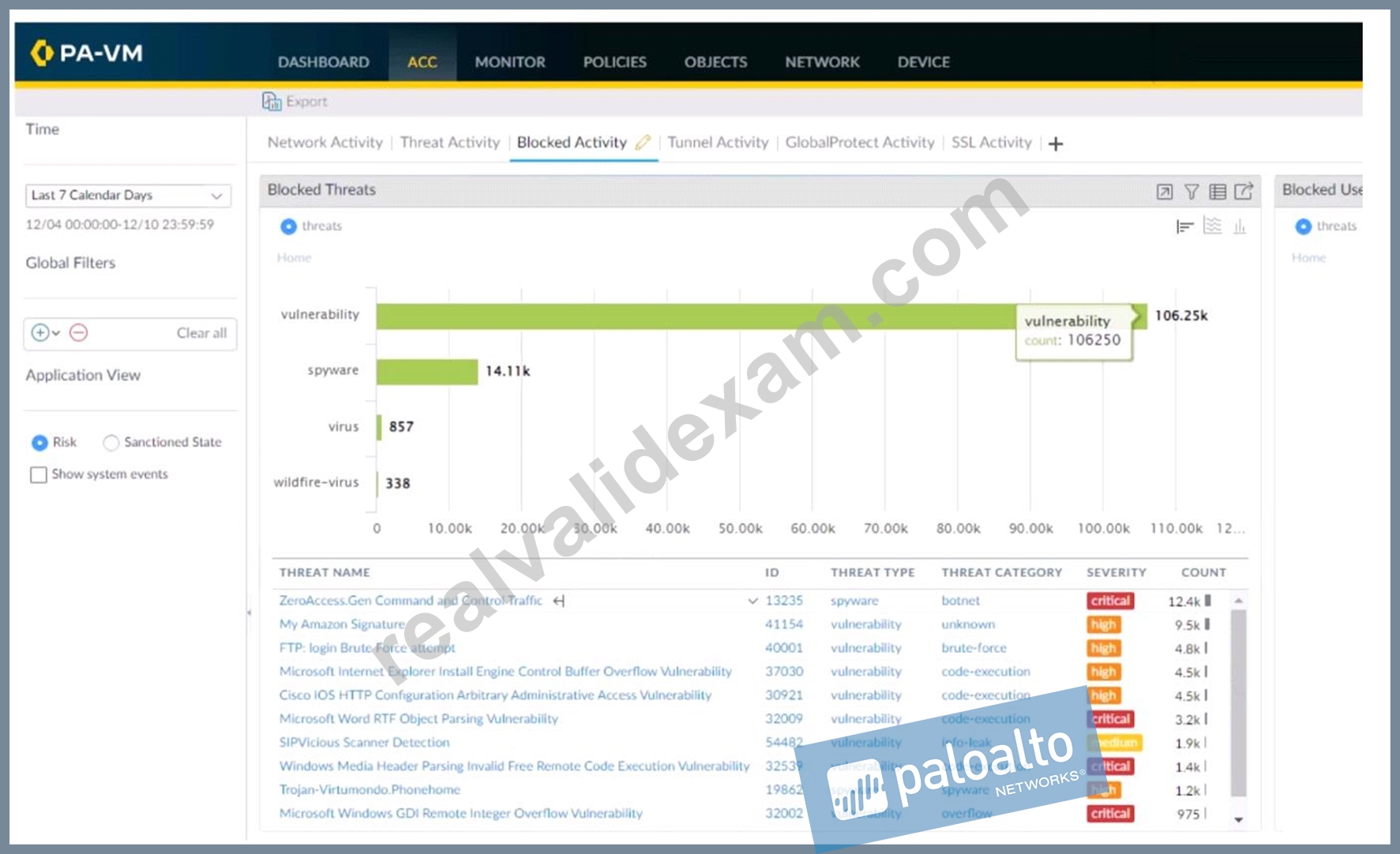
Using the above screenshot of the ACC, what is the best method to set a global filter, narrow down Blocked User Activity, and locate the user(s) that could be compromised by a botnet?
- A. Click the left arrow beside the Zero Access.Gen threat.
- B. lick the source user with the highest threat count.
- C. Click the hyperlink for the Zero Access.Gen threat.
- D. Click the hyperlink for the hotport threat Category.
Answer: A
NEW QUESTION # 105
An administrator needs firewall access on a trusted interface. Which two components are required to configure certificate-based, secure authentication to the web UI? (Choose two.)
- A. certificate profile
- B. server certificate
- C. SSH Service Profile
- D. SSL/TLS Service Profile
Answer: A,B
Explanation:
https://docs.paloaltonetworks.com/pan-os/10-2/pan-os-admin/firewall-administration/manage- firewall-administrators/configure-administrative-accounts-and-authentication/configure-certificate- based-administrator-authentication-to-the-web-interface
NEW QUESTION # 106
Given the following snippet of a WildFire submission log, did the end user successfully download a file?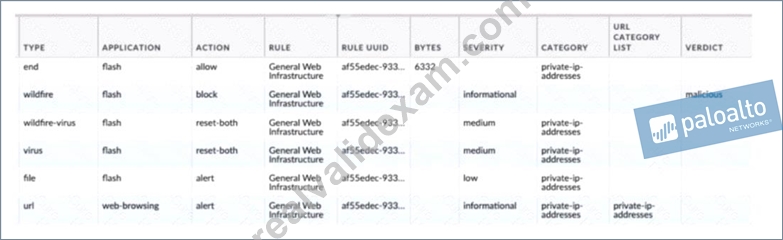
- A. Yes, because both the web-browsing application and the flash file have the 'alert" action.
- B. No, because the URL generated an alert.
- C. Yes, because the final action is set to "allow.''
- D. No, because the action for the wildfire-virus is "reset-both."
Answer: D
Explanation:
Based on the snippet of the WildFire submission log provided, it appears that the end user was able to successfully download a file. The key indicator here is that the final action for the web-browsing application and the flash file is set to "allow." This means that despite any alerts or other actions taken earlier in the process, the ultimate decision was to allow the file to be downloaded.
NEW QUESTION # 107
Refer to the exhibit.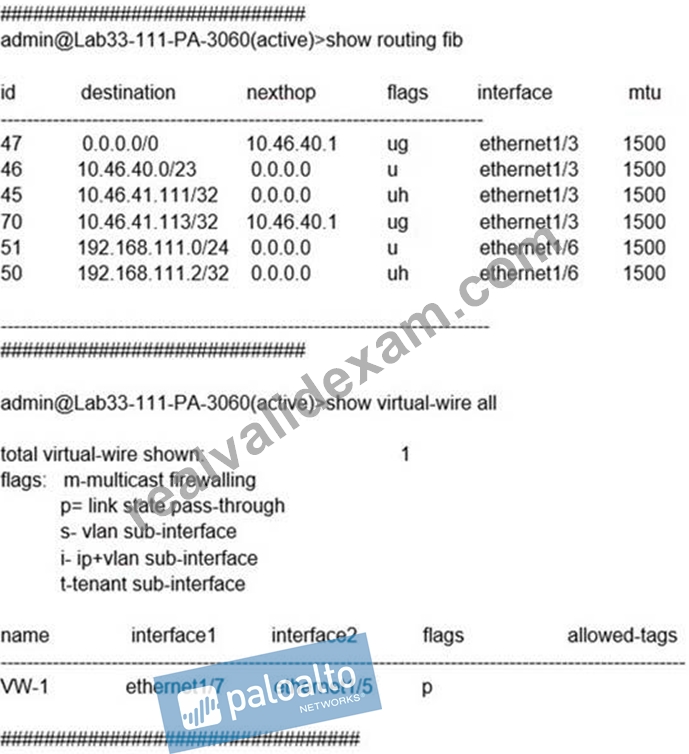
Which will be the egress interface if the traffic's ingress interface is ethernet 1/7 sourcing from
192.168.111.3 and to the destination 10.46.41.113?
- A. ethernet1/6
- B. ethernet1/5
- C. ethernet1/7
- D. ethernet1/3
Answer: B
NEW QUESTION # 108
To ensure that a Security policy has the highest priority, how should an administrator configure a Security policy in the device group hierarchy?
- A. Clone the security policy and add it to the other device groups.
- B. Reference the targeted device's templates in the target device group.
- C. Add the policy to the target device group and apply a master device to the device group.
- D. Add the policy in the shared device group as a pre-rule
Answer: D
Explanation:
https://docs.paloaltonetworks.com/panorama/9-1/panorama-admin/manage-firewalls/manage-device-groups/manage-the-rule-hierarchy#idfb9e2593-a7f1-4e0d-aab5-a2903d654c99 https://docs.paloaltonetworks.com/panorama/9-1/panorama-admin/panorama-overview/centralized-firewall-configuration-and-update-management/device-groups/device-group-policies#id671977ca-1041-4605-8a80-fbc10f3f5d7b
NEW QUESTION # 109
An administrator needs to upgrade a Palo Alto Networks NGFW to the most current version of PAN- OS software. The firewall has internet connectivity through an Ethernet interface, but no internet connectivity from the management interface. The Security policy has the default security rules and a rule that allows all web-browsing traffic from any to any zone. What must the administrator configure so that the PAN-OS software can be upgraded?
- A. Service route
- B. Security policy rule
- C. CRL
- D. Scheduler
Answer: B
NEW QUESTION # 110
A firewall engineer creates a destination static NAT rule to allow traffic from the internet to a webserver hosted behind the edge firewall. The pre-NAT IP address of the server is 153.6 12.10, and the post-NAT IP address is 192.168.10.10. Refer to the routing and interfaces information below.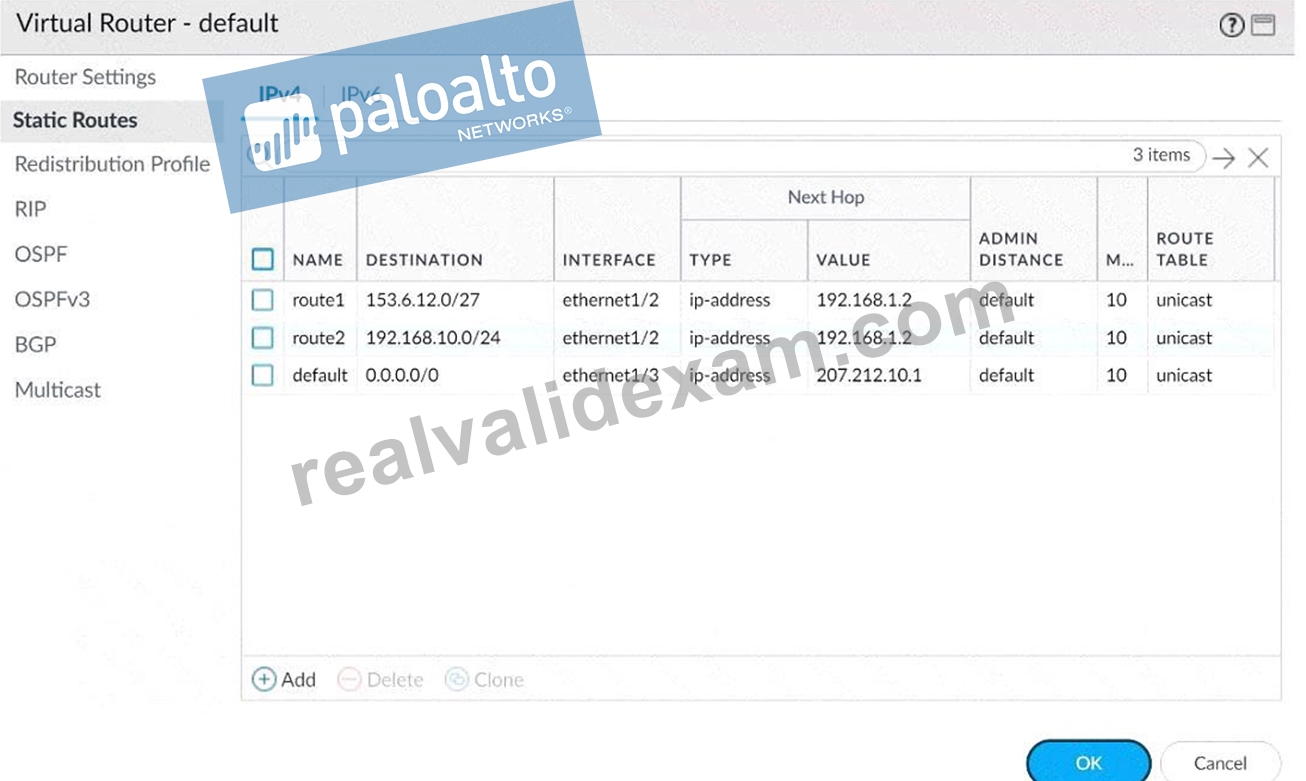
What should the NAT rule destination zone be set to?
- A. None
- B. Outside
- C. DMZ
- D. Inside
Answer: D
Explanation:
https://docs.paloaltonetworks.com/pan-os/10-1/pan-os-networking-admin/nat/nat-configuration-examples
/destination-nat-exampleone-to-one-mapping
NEW QUESTION # 111
Refer to the exhibit.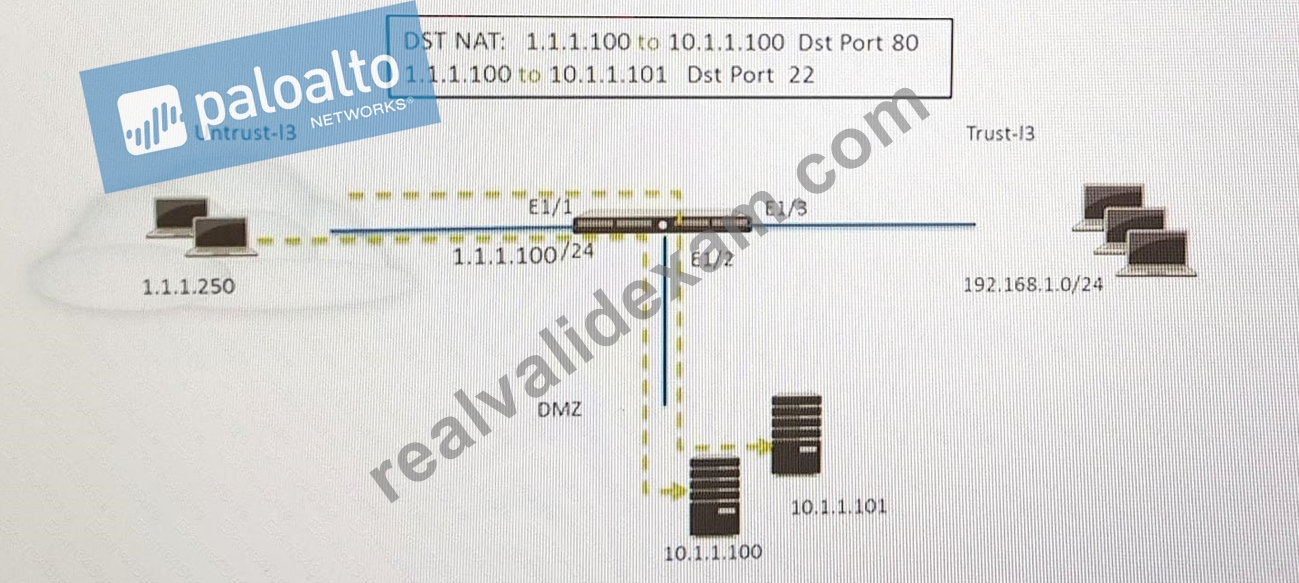
An administrator is using DNAT to map two servers to a single public IP address. Traffic will be steered to the specific server based on the application, where Host A (10.1.1.100) received HTTP traffic and host B(10.1.1.101) receives SSH traffic.
Which two security policy rules will accomplish this configuration? (Choose two)
- A. Untrust (Any) to Untrust (10.1.1.1) Ssh-Allow
- B. Untrust (Any) to Untrust (10.1.1.1) Web-browsing -Allow
- C. Untrust (Any) to DMZ (1.1.1.100) Web-browsing -Allow
- D. Untrust (Any) to DMZ (1.1.1.100) Ssh-Allow
Answer: C,D
NEW QUESTION # 112
ln a security-first network, what is the recommended threshold value for apps and threats to be dynamically updated?
- A. 1 to 4 hours
- B. 6 to 12 hours
- C. 36 hours
- D. 24 hours
Answer: B
Explanation:
Schedule content updates so that they download-and-install automatically. Then, set a Threshold that determines the amount of time the firewall waits before installing the latest content. In a security-first network, schedule a six to twelve hour threshold. https://docs.paloaltonetworks.com/pan-os/8-1/pan-os-admin/threat-prevention/best-practices-for-content-and-threat-content-updates/best-practices-security-first.html#id184AH00F06E
https://docs.paloaltonetworks.com/pan-os/10-1/pan-os-upgrade/software-and-content-updates/best-practices-for-app-and-threat-content-updates/best-practices-security-first
NEW QUESTION # 113
......
PCNSE Questions - Truly Beneficial For Your Palo Alto Networks Exam: https://www.realvalidexam.com/PCNSE-real-exam-dumps.html
Pass Exam Questions Efficiently With PCNSE Questions: https://drive.google.com/open?id=1597H4Hkgt3Mu9zi1OPDx4XO2wfOA5sHm
